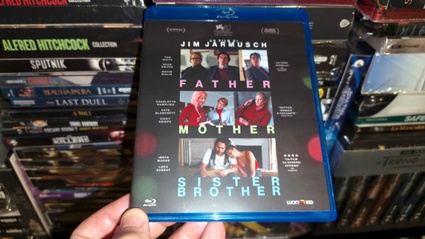
Did Jim Jarmusch deserve the Golden Lion for Father Mother Sister Brother? Review of the Venice 2025 winning film
Many are raising eyebrows at the Golden Lion for Father Mother Sister Brother: what's Jim Jarmusch's much-debated film like?
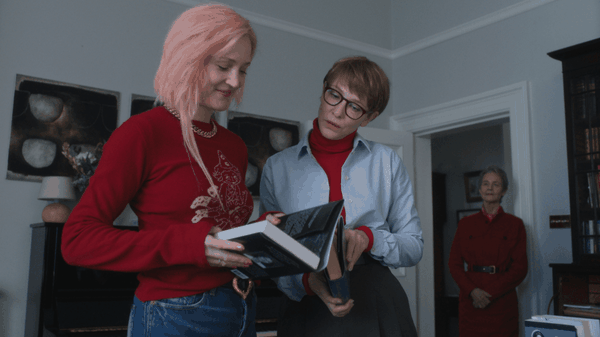


On the eve of the Venice 82 Golden Lion award, in the traditional Lion Prediction, I had emphasized: any film that came between The Voice of Hind Rajab by Kaouther Ben Hania and the victory of the edition would not have an easy time, such was the critical consensus and human emotion for the symbolic film of the edition, reconstructed from recordings of phone calls in which the child trapped in Gaza asked rescuers from the Ramallah Red Crescent to save her. However, I had also stressed that many juries are reluctant to make overly definitive judgments or take too strong positions with their choices, seeking a more unifying, utopian, balanced harmony.
Therefore, I was not surprised to discover that the jurors led by Alexander Payne preferred to award The Voice of Hind Rajab the second most important prize of the edition, the Grand Prix of the Jury, assigning the Golden Lion to an "old master" of American cinema like Jim Jarmusch. Inevitably, the decision sparked endless controversy, and this time I partly agree with those who criticize (with good reason) this Lion. Not because Father Mother Sister Brother is an unsuccessful film, but simply because as a work, it does not have the quality or the right characteristics to be a critic-proof Lion, especially in a year where the top prize will inevitably be perceived by many as an injustice to a film considered more deserving for extra-cinematic reasons.

Why Jarmusch's film is not a Golden Lion immune to criticism
Father Mother Sister Brother certainly doesn't meow, but it doesn't roar either: it would have been a perfect Lion for a year where the uninspiring level of the competition would have left the door open for the option of the "Lion that almost becomes a career achievement award," an opportunity to reward a master of cinema perhaps not with his best film, but taking into account what he has done over the years. Somewhat like what happened last year with the Golden Lion for Pedro Almodóvar's The Room Next Door, which, however, was strong in a very thorny theme treated with great delicacy, a personal and intimate perspective, and two excellent performances by protagonists Moore and Swinton. A year later, we can already say that that Lion did not leave its mark and had much more to offer the viewer than this latest Jarmusch, which is a small, accessory anthology project in his long career, far from the desire to change register and tackle new scenarios like The Dead Don't Die or the clear ambition of a very heartfelt and in some ways radical project like Only Lovers Left Alive, to name just two of his most recent works.
There's another comparison that perfectly conveys the type of film Father Mother Sister Brother is: just imagine an alternative reality where Yorgos Lanthimos won his first major festival not with the Golden Lion for Poor Things! but with Kinds of Kindness, which Father Mother Sister Brother closely resembles, in its own way. Both films are anthology films divided into three single stories, not linked to each other except by slight thematic references and recurring images.
Father Mother Sister Brother is a cinematic Zazie in the Metro
It's as if with Father Mother Sister Brother, Jim Jarmusch had written his Zazie in the Metro, taking a series of recurring elements, small and large, and building three family stories around them. Among the recurring elements in all three stories are always a light blue old car, a dialogue between driver and passenger, three kids skateboarding, an aerial shot of a table with cups and glasses, a conversation about the purity of water, an involuntary chromatic coordination between protagonists who always wear some dark red clothing (here the support of Saint Laurent production might be involved), the mention of "Desolandia" in the sense of a remote and not very attractive place, a recurring joke about telling something to Uncle Bob.
Jarmusch the screenwriter takes this set of bizarre elements and uses them as building blocks to construct three family stories centered, as the title suggests, on a father, a mother, and two twin siblings. The filial double act is actually present in all three episodes: in the first, sister and brother visit their father in financial difficulty, with a visit revealing that the man is probably siphoning money from both and faking a lower standard of living than his actual one. In the second story, a bestselling author mother annually summons her two daughters to Dublin for tea where they pretend to update each other on their lives: it becomes clear that one of the daughters fakes a standard of living she doesn't have and that the mother has a soft spot for her, causing great pain to the more unkempt-looking but precise and punctual daughter in relationships, whose affection is experienced as cumbersome and annoying. In the third episode, two twin siblings, a brother and a sister, confront their deceased parents, visiting their Parisian apartment, which they have just sold, for the last time: parents who had a very unconventional approach to life, inherited by their offspring.
You will have noticed how the word "pretend" recurs in these three plots. At the heart of Father Mother Sister Brother are always family relationships that are very, very grammatically incorrect on a relational level, maintained more out of convention than true affection, where children don't understand their parents or deny themselves the unpleasant realities they've intuited about those who brought them into the world. Parents, on the other hand, have entire emotional and private lives that they are careful not to share with their offspring, so much so that the father in the first story "stages" a more disordered and solitary life in his own home than the one he actually leads.

Jarmusch's dysfunctional families don't warm the heart
These are very dysfunctional families, but not with the kind of embarrassments and impasses that underlie great affectionate relationships and evoke emotion. There is embarrassment, sometimes pity, in the face of these family encounters, often dominated by the silent rigidity of those who understand that they are being lied to or who prefer to be reticent but keep their own victories and defeats to themselves. The locations (Dublin, Paris, the New Jersey suburbs) also play an important role in defining these relationships, which emerge from the three revealing and failed conversations exactly identical to the premise. There is no revelation, catharsis, or evolution in these families, only a lack of communication, a lack of honesty that is never judged by Jarmusch, who merely observes many of his fetish actors (Adam Driver, Tilda Swinton, Tom Waits) and new entries to his imaginary (Vicky Krieps, Charlotte Rampling) grappling with characters about whom the little we know puts us in difficulty. The form, moreover, is very sparse and sometimes aesthetically disappointing: the shots of the car dialogues with exteriors added to the windshield and windows in post-production are really ugly, and in general, on the directorial side, there is nothing exciting.
The stylistic (narrative) exercise of Father Mother Sister Brother is an overall pleasant film to watch but doesn't add much to Jim Jarmusch's filmography, presenting itself as an absolutely secondary, minor title. The dysfunctional families in Father Mother Sister Brother, which don't warm the heart and are presented without moral judgment, barely scrape a passing grade and are not the most representative Lion of a Venice year where other films would have " roared" more convincingly.
Score
Editorial team
Did Jim Jarmusch deserve the Golden Lion for Father Mother Sister Brother? Review of the Venice 2025 winning film
The stylistic (narrative) exercise of Father Mother Sister Brother is an overall pleasant film to watch but doesn't add much to Jim Jarmusch's filmography, presenting itself as an absolutely secondary, minor title. The dysfunctional families in Father Mother Sister Brother, which don't warm the heart and are presented without moral judgment, barely scrape a passing grade and are not the most representative Lion of a Venice year where other films would have "roared" more convincingly.
Similar articles