Did Yellow Letters Deserve to Win the Golden Bear at Berlin? The Review of the Unexpected Winner
The director of The Teachers' Lounge won over Wim Wenders' jury – but not critics – with the marital and political drama Yellow Letters. A review of the Berlin 76 winning film.



The final victory of Yellow Letters at the Berlin Film Festival 2026 was so unpredictable that even bookmakers didn't have odds for the German film by Turkish-born director İlker Çatak, which goes to show how much the jury's decision to award it the Golden Bear caught everyone by surprise. Critics, in fact, on the first day of the Festival, when this drama reconstructing Turkish cities and situations on German soil was shown, had given the film a lukewarm reception.
From The Teachers' Lounge to Yellow Letters: a step forward or backward?
This writer largely agrees with his colleagues: before it won the Golden Bear, İlker Çatak's film could have been dismissed as a substantial step backward. Yellow Letters, in fact, failed to live up to the expectations suddenly raised by the international success of his previous film, The Teachers' Lounge, which had led Germany to secure a nomination in the Best International Feature Film category at the Oscars two years ago. A small film that, incidentally, proved to be a quiet hit at the Italian box office, grossing more than one of the five million collected globally right in our country.
Little of the brilliant writing of that school and social drama, of the incisive cynicism that revolved entirely around a teacher who was as well-intentioned as she was probably a terrible life coach and indeed, is found in Yellow Letters, and only in glimpses; a more ambitious work than the previous one but also much more conventional in the political and social discourses it weaves and the narrative solutions it attempts to provide.
The film declares itself openly political, often disproving the jury president, who had said he was reluctant to delve into the merits, prioritizing the cinematic aspect of the competition. It's hard to believe Wenders because, despite this Berlin competition being a truly mediocre-to-low level, much, much better was seen than a film shown on the first day and very quickly dismissed (although, to be fair, it should be noted that Variety reported that the sale of its rights was going very well at the market coinciding with the festival).
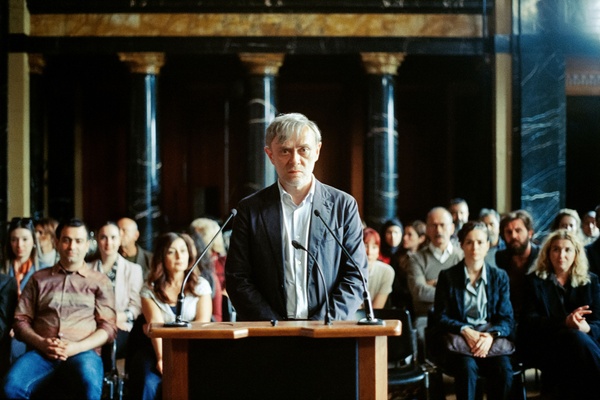
Yellow Letters: how hard it is to be "against" when you lose your job
The Yellow Letters of the title are those on straw-colored paper on which the Turkish government notifies state employees of their dismissal. One arrives for Aziz (Tansu Biçer) who teaches philosophy at the university as well as being a writer and director at the national theater. The reason for the sudden "change of wind" could be that his wife, the lead actress in his play, the previous evening made the minister who had attended the play wait, refusing a photo that the politician would have used as propaganda. Annoyed by the politician's late arrival at the theater and his constantly ringing phone, Derya (Özgü Namal) refused the shot, thus losing for her and her husband a protective political umbrella that shielded them, despite being artists who had publicly declared their opposition to the government's latest military actions.
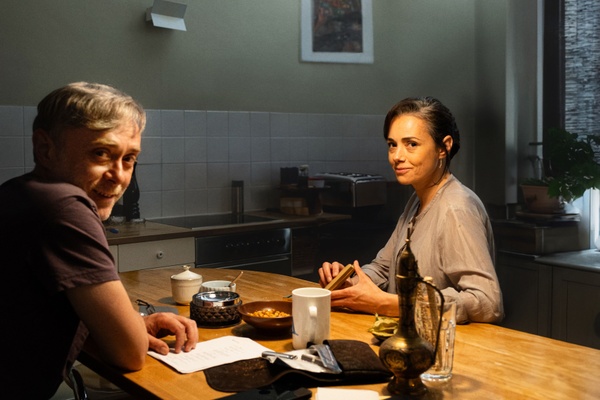
The couple thus finds themselves without a theater, without work, and very soon, without money: Yellow Letters follows them as they try to re-establish their lives, gradually discovering that they had always been "contrarian" intellectuals, certainly, but who benefited from the visibility and income of a secure position in one of the nation's most important government-subsidized theaters. The two end up with their teenage daughter at his mother's house and find themselves having to decide what to do with their marriage and their political positions.
After this kind of long introduction, İlker Çatak addresses the core of the matter: the two protagonists, in fact, established professionals and esteemed intellectuals, rediscover themselves in very different positions on how to face this economic and family crisis. It is in the central part that the film – an original subject inspired by the director by various recent news reports, including Trump's attack on US universities, the Israeli-Palestinian conflict, and the diaspora of Turkish artists and intellectuals in Germany – that the film gives its best. In the second act, the film builds a careful imbalance in which unresolved resentments and tensions emerge between wife and husband, actress and director, which a comfortable and fulfilled life had buried, but not erased.
Aziz reacts to the dismissal by choosing to maintain his positions and opting for a more spartan lifestyle, driving a taxi and writing in his free time. He tries to stage a new, more radical play in a small independent theater. Derya initially follows him, but begins to consider the possibility of softening her position and opening up to more popular, commercial acting. Her seemingly hypocritical position is perfectly balanced with her husband's: she is the one living as a guest at his mother's house, she is the one who suffers from a "left-wing" man who loves her certain not-so-pleasant remarks about her having been born artistically under his wing, while demonstrating in many instances that she is his equal (if not even more astute).
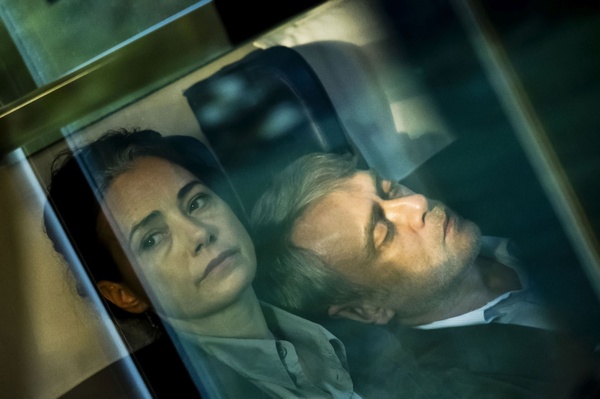
The "German" Turkey of Yellow Letters
With large red superimposed letters (Berlin like Ankara, reads the title of the first chapter) İlker Çatak decides to reveal his artifice. He discovered the story of the yellow letters during a trip to Istanbul, where, however, for political and economic reasons, it was impossible for him to set the story. So he filmed in large German cities, between Hamburg and Berlin, in just twenty-one days. Considering the speed of production, it is a film that has its high moments, skillfully led by its main actors, who wisely are rich in ambiguous nuances even before falling into disgrace. Just as in The Teachers' Lounge, albeit less incisively, it investigates the moral nuances of "progressive" ideological positions and theoretically dictated by the best intentions.
İlker Çatak has the undeniable merit of doing something that his colleagues often lack the courage or ability to do: confronting contemporaneity, directly addressing the ideological and political crisis of our time. However, the film, especially towards the end, plays it a bit too safe, never dispelling the impression of being an operation that is too premeditated and clever, less incisive and sharp than the feature film that precedes it.
Furthermore, the film has poor management of its running time, wasting a good portion of the second part on the portrayal of the most classic of obnoxious "good but somewhat rebellious" teenage daughters when the story is populated by much more interesting characters to explore: Aziz's mother, even more feminist and radical than her daughter-in-law, Derya's orthodox brother whom she gradually approaches.
The most demoralizing aspect, however, is that the film always seems on the verge of an insight that would be necessary to focus on even in real political life, let alone in cinema, on what exactly doesn't work in progressive, "left-wing" and liberal positions. It uncovers their hypocrisy, but without ever going all the way, even if at times it seems very close to having a revelation. Instead, it settles for a film that is not so iconoclastic, subtly reassuring, that starts from contemporaneity to make a rather unincisive argument, similar to that of films that addressed the same issues twenty or thirty years ago, in a radically different world.
Score
Editorial team

Did Yellow Letters Deserve to Win the Golden Bear at Berlin? The Review of the Unexpected Winner
A bit like Baumbach's Marriage Story, a bit like a perfectly clever film that becomes a safe choice for a jury wanting to make a moderately political but uninspired (and indeed) choice for the Palmares, Yellow Letters demonstrates commendable creative verve from director İlker Çatak, a writer at heart, who isn't afraid to look at the present with a critical and investigative eye. Compared to The Teachers' Lounge, however, the ambition increases but the incisiveness and bite are lost along the way. It's a half-hearted blow to a certain status quo and, despite some valuable passages, it never gives the impression of being such an incisive and resolved film.
Similar articles

Defender of the Crown: The Legend Returns: Review of an unexpected return from the Amiga era

Heart of the Beast: Trailer Brings Unexpected Spoiler

People of Note Review: An RPG to the Rhythm of Music