Nightborn, the review of the Finnish film where motherhood truly becomes horror again
A deeply in love couple in a house deep in the Finnish forest confronts a classic horror genre trope: motherhood as a source of paranoia, violence, and monstrosity.



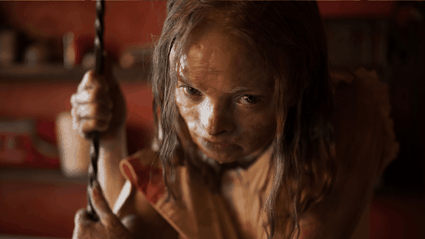
In the opening scene of Nightborn, we see the protagonist Seidi Haarla at the wheel, driving alongside her husband, played by Rupert Grint. Their minivan travels a remote road deep in the Finnish forest, arriving at the ruined house where the woman spent her childhood and where she hopes to raise the child she is carrying. The scene is striking for a rather disconcerting detail: the talented actress from Compartment No. 6 seems incapable of acting. Her way of smiling, her way of talking to her husband, even her manicure: everything conveys a rather marked impression of artificiality. It will only be much, much later in the film that one can appreciate the reason for this (intentional) tone and with it the mastery of its protagonist, who lends herself to a canonical role in the horror genre: that of the mother convinced that her child is not "normal" and harbors a monstrous and evil nature.
Nightborn, in fact, looks at that whole strand of horror films where the horrific element is motherhood itself. Its protagonist faces a difficult birth, is deprived of sleep by an eternally crying newborn, while the transformations of the "deformed" body take on a sinister tone. Still physically scarred by the trauma of childbirth, Saga finds herself exhausted and socially and geographically isolated in the large house undergoing renovation. She fully experiences the psychological isolation of a mother who does not feel fulfilled because she struggles to feel empathy for her creature, at least as society expects of her.
Nightborn fuels the climate of maternal paranoia with its stylistic choices
The problem for Saga is that her son appears monstrous to her, and she instinctively fears him. Nightborn decides not to give us answers about this: the film doesn't show us his face, perpetually shrouded in headphones or shadow, but it does show us his body, hairier than normal, and makes us hear his continuous menacing grunts. The child's behavior gradually convinces the mother that there is something profoundly wrong with him, born with a particularly bloody birth (watch out for the full frontal vaginal shot with a gush of blood) and who bites her breast so hard when she breastfeeds that the areola bleeds.
Alongside Saga is her English husband Jon, who allows himself to be convinced to renovate the old house in the woods and to move to a reality he feels is "very Finnish." The couple in the film must therefore also face a cultural gap that only begins to make its weight felt when the situation becomes more critical. Thoughtful and understanding in the face of the great difficulties his wife experiences in adapting to the role of mother, Jon then becomes a link in a chain in which we gradually re-read the experience that Saga herself lived as a child. His need for normality becomes radically different from his wife's: for Saga, it is important to let the child be himself and for her to learn to "mask" her own nature less, while Jon gradually stiffens, making us imagine what the protagonist's childhood was really like, as she seems to have idealized a context that her sister remembers very differently.
Saga fails to bond with her son until she focuses on the repression of her own identity, pigeonholed into rigid social dictates that the woman does not understand, blinded by resentment towards her career-driven and un-maternal mother. Saga was, in fact, raised by her grandmother deep in the forest, while her mother was a chief physician in a hospital. The character of the new grandmother who continues to attend conferences because she doesn't want to change diapers is among the most amusing in the film, which, despite being horror in its imagery and atmosphere, does not shy away from a good dose of irony. Saga's mother, cold and detached to the point of bordering on anhedonia, will provide her daughter with a series of key pieces of information to understand what is really wrong with her son, or rather, why Saga cannot accept him.
Nightborn is a good Northern European horror, but not competition material
Director Hanna Bergholm crafts a good horror about motherhood, driven by its occasional gore, combined with darker Finnish folklore and a strong propensity to replace the usual, banal jump scares with a dark irony that punctuates the film. However, its inclusion in the Berlinale competition is at least generous.
Partly because Nightborn reworks an already extensively explored theme in the horror genre without having the grit or inspiration necessary to create an addition to it that pushes the genre into unexplored or truly memorable territory.
Partly because the act of showing and not showing the newborn to fuel the viewer's doubt about its appearance (is it really monstrous as the mother claims, or is it a ugliness that only exists in her mind?) forces the film into somewhat unfortunate scenes of the baby crouching next to lifeless bodies from which it sucks blood.
Or because, once the central mystery of the story is revealed, the director and co-screenwriter finds a rather "easy" resolution, albeit an apt one considering the theme of motherhood. In resolving the film and finding an ending for it, Hanna Bergholm falls a little too much into easy allegory (see the conclusion for Jon's character) and does not fully resolve the position of the handful of relatives and friends of the couple. For much of the film, Hanna Bergholm gradually moves the family dynamics of Saga and her relatives in the direction of paranoia, with her sister, mother, and friends seemingly not seeing the child's peculiarity (to be generous) and instilling doubt that it's all really just in the mother's head. Only, the film takes too much advantage of the viewer's suspension of disbelief (see the scene with the little cousin) and never quite reaches a precise point in the relationship between Saga, her mother, and the other women in her family, suddenly abandoning the problem to take refuge, like its protagonist, in the film's forest ending.
Score
Editorial team

Nightborn, the review of the Finnish film where motherhood truly becomes horror again
Nightborn is one of many European horrors that reaffirm the vitality of a genre where tight budgets and co-productions between multiple nations never seem to be an issue, even in the European landscape, and moreover, it provides significant opportunities for female authors and directors. It remains several steps below the comparable film that screened at Berlin last year (The Ugly Stepsister) and its placement in competition is at least generous, but it is still an interesting watch, ennobled by the great work on the body effects of the mother and child and by the acting of Seidi Haarla, who is capable of evolving into a radically different person in mannerisms, expressiveness, and energy from the beginning to the end of the film.
Similar articles