Barrier takes us to the limits of communication
A story of borders, misunderstanding, and... aliens?
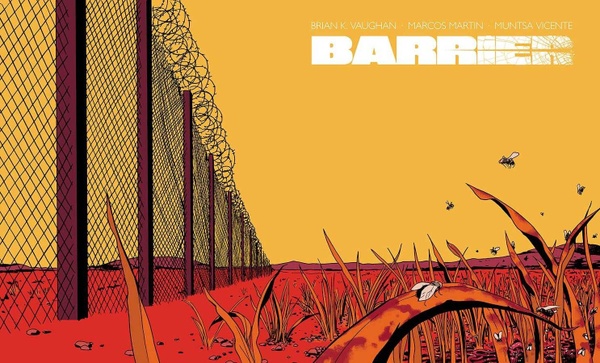


When he founded Panel Syndicate in 2013, Brian K. Vaughan was already a successful screenwriter: his resume included, among other things, a critically acclaimed graphic novel for Vertigo (Pride of Baghdad), a couple of seasons as a producer for the series Lost, and the global success of Saga, published by Image Comics. Panel Syndicate is an online platform through which Vaughan allows other authors to publish digital works, retaining 100% of the rights and letting readers set a price they deem fair: even $0 is fine if you're not doing well. From time to time, however, Vaughan himself serializes one of his stories on Panel Syndicate, and Barrier (brought by Bao to Lucca) comes from there.
The Plot of Barrier
The formula is the same as the previous success that launched Panel Syndicate, namely The Private Eye, an elegant futuristic spy story also brought to Italy by Bao a few years ago. Vaughan's partner in crime on pencils is Marcos Martin, a Spanish illustrator, co-founder of Panel Syndicate, and fresh off successes on The Amazing Spider-Man and Daredevil. On colors is again Muntsa Vicente, also Spanish, whose touch characterized The Private Eye, but perhaps reaches its peak in Barrier. And again, the distribution in episodes, serialized in five different installments. And the horizontal format, conceived for panoramic page reading on screens, which Bao translates into a beautiful hardcover volume.
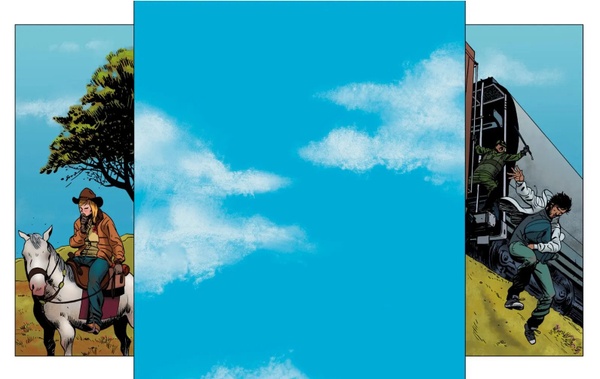
The Barrier of the title is the famous wall, or rather, the most famous wall in recent times, the one running between Mexico and the southern United States, erected to stop illegal immigration, a more symbolic than effective demarcation line between the wealthy West and the developing rest of the world, between the capitalist ownership wing and the remittances of servitude. North of the fence, more precisely in Pharr, Texas, are the lands remaining to Liddy. As much as she appears to be the most reasonable person within several miles of her estate, Liddy is convinced that her land is being trampled at night by aliens (a term used in the USA for both deep space visitors and immigrants, which Vaughan cleverly plays with). And then, of course, if those from outside come to ruin our idyllic society with drugs and violence, these aliens must necessarily be members of the Latino gangs who daily – according to her – arrive to bring violence and disorder to that realm of enlightenment and reason known as Texas.
Finding a severed horse head in a pool of blood mixed with desert sand must have only strengthened her convictions. The one who pays the price is Oscar, a migrant fleeing the same gangs Liddy thinks are running rampant on her doorstep, who miraculously escaped a hell on earth in a corner of Honduras only to end up huddled in a puddle in the middle of the night, in the middle of nowhere in Texas, like a flashlight pointed at a rifle between his eyes. Liddy was right, in fact, she still doesn't imagine how right she was.
Mute Dialogues
Barriers are walls that don't let people through, nor ideas. The latter, if left within an enclosure, can only harden, becoming convictions, axioms disconnected from factual evidence, a priori truths that we are no longer able to question. And Vaughan has a lot of fun playing with this typically human and particularly typical drift of our era: it's clear, Liddy expects to find aliens, illegal immigrants on her property, but what awaits her is a welcome committee of real aliens, appearing above her head, quick to drag her and Oscar aboard a ship for unknown, but very likely painful, purposes.

But it is at that point that Vaughan raises the stakes and gets to what he really wants to talk about. Liddy and Oscar's situation on the alien ship is a triangle: there are the others from deep space with a language that makes human ears bleed (literally), there's Liddy with her English and her convictions, and then there's Oscar, with his Spanish and no certainties in his pocket. At least he has pockets: Liddy is naked, scared, sure it's all Oscar's fault, and terribly cold. It's a gesture that builds the first bridge between her and her involuntary and bewildered companion in misfortune, a gesture that needs no words, universal in every society: a jacket offered to someone who is cold.
If Kojima's Sam Bridge wanders across the American and Australian continents building roads to reunite a fragmented and scattered humanity, Barrier is a metaphor built within a narrative mechanism on a reduced scale, but identical in purpose. To increase its scope and effectiveness, we readers are placed in the same conditions as Liddy, unable to understand the alien language and equally disoriented by the untranslated Spanish used for all of Oscar's dialogues and for the scenes set south of the US border.
There's an underlying and very comic-book-like level to the whole affair: we, like the characters, have a probably partial or even minority understanding of the written component of the story. Like them, we can only make sense of the actions our eyes see. And it's hard to imagine an artist more suited to this task than Marcos Martin. The Spanish artist's style is precise, clean, always clear in its staging. His faces, with elegant Kirby-esque echoes, convey emotions with a few lines, with a precision and variety that make you forget the absence of text. The horizontal format allows him to lay out wide, expansive panels, with enormous breathing room when necessary, used to set the pace. The openings slow down, the gaze can wander, while Muntsa Vicente's mostly flat colors delineate an almost liquid, rarefied atmosphere, where a question mark seems to perpetually hover as if over a scene directed by the Coen brothers. And just as the American directing duo likes it, the imponderable arrives, and the Martin/Vicente duo is still ready, giving shape and color to existences that challenge the deciphering capabilities of our limited terrestrial brain.

In that mass of fat and synapses, in addition to an instinct for survival that has already surprised numerous extraterrestrial species in the vast sci-fi tradition, there is a receptor for the humanity of others often obscured by brick-like convictions. It is a slow process of crumbling that Vaughan stages, bouncing us between the here and now and the past, sometimes without distinctions between where one ends and the other begins, applying to us the same treatment that extraterrestrial entities reserve for Liddy and Oscar. Yet, without being able to rely too much on words, the progressive unveiling of one to the other, which we as spectators experience as sudden flashbacks, initiates their respective recognition.
Free from the constraints of a publishing house (not that he has problems, we will talk about Spectator in another article soon), Vaughan dives into an openly political story (to the chagrin of those who think comics shouldn't get involved), which explicitly uses the rhetorical figures of science fiction to give voice to fears about the imminent future, a function that the genre has admirably fulfilled since its inception. And do you want to know the funniest thing: Barrier is a comic that started in 2015 and concluded in 2017. Which says something about the timelessness of certain stories, but also about the power of genre narrative (to which comics fully belong) as a tool for deciphering the present.
Similar articles
Digital Dragons - Gravity Rifters Takes Us to the Future of Work with Cosminers
NUTMEG! A Nostalgic Deckbuilding Football Manager: takes us back to the era of teletext and sticker albums
Nvidia, DLSS 5 and the Myth of Perfect Communication