The Green Hand: Eris Brings Nicole Claveloux Back to Italy
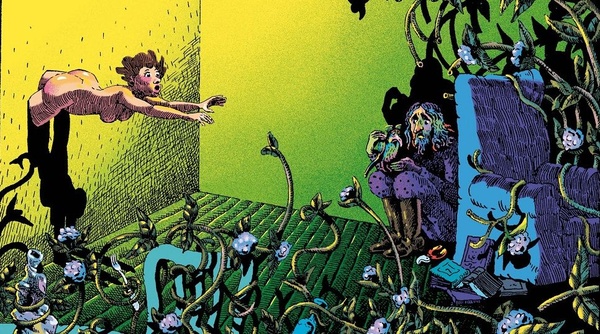


In all likelihood, you've never heard of Nicole Claveloux. And that's a shame, because she is an extraordinary and visionary author who has ranged from illustration to erotica to children's comics, marking a very important stage in French and European comics with her collaboration with Metal Hurlant and the brief feminist season of Ah!Nana magazine. She has been practically ignored by Italian publishers, save for a fleeting two-page appearance almost half a century ago. At least until today, because Eris Edizioni has published for Lucca a volume titled The Green Hand and Other Stories, which collects the eponymous story published in episodes in Metal Hurlant in 1978 and other stories from that period, most of which are unpublished in Italy.
Nicole Claveloux was born in 1940. After graduating, she pursued a career as an illustrator for advertising first, and then for children's books. In 1976, her path crossed with Jeanne-Pierre Dionnet (founder of the Humanoides publishing house with Moebius, Druillet, and Farkas) and his wife Janic Guillerez, who were about to launch the feminist magazine Ah!Nana, a "spin-off" of Metal Hurlant born in the wake of similar initiatives already appearing in the USA and Europe.
When Metal Hurlant asked her for a long story, to be broken into chapters for the magazine, Claveloux turned to Edith Zha, whom she had met in the Parisian publishing scene. Neither of them had ever worked on a comic book story of this type before. The collaboration between the two gave birth to The Green Hand, a story that fits perfectly into the tones and atmospheres of the famous horror & sci-fi comic anthology where it was originally published, but which at the same time is also something completely different. The texts created by Zha are suggestions, mixing dreams and colors, introspective sequences that Claveloux translates into images across eight pages of comics.
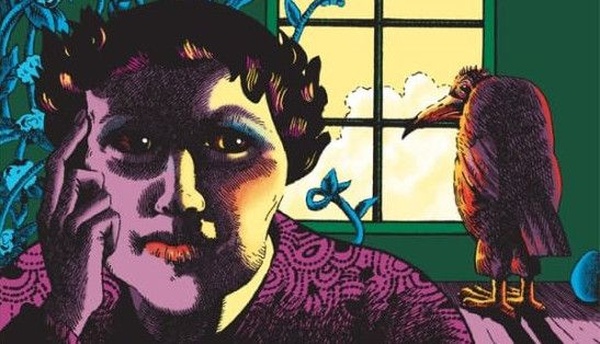
She does it, however, in her own way. She draws on boards identical in size to the final print, first using colors with inks, gouache, and airbrush, and only then enclosing the figures within black lines. The result, which in its entirety comprises The Green Hand and the subsequent episodes of the story collected in the first part of the volume, is a series of breathtaking panels in which Claveloux controls the reader's emotions through a mix of acidic colors and ethereal figures that lead the reading through alternating phases of estrangement, anguish, psychedelia, and surrealism. Many years before someone coined the adjective Lynchian, Claveloux's drawings, rhythmically set to Zha's words, explore the same fascinating disorientation that envelops our brain when the tools for deciphering reality used daily lose their usefulness.
The unbalanced feud between a talking bird and a plant that has just arrived in the protagonist's apartment leads to a lysergic journey through the existential anxieties of both the bird and the protagonist, all forced to come to terms with the toxic residues of relationships, failures, the limits of human communication in contrast with the elusiveness of desires, impulses that go beyond the senses and drag us into hidden recesses of the unconscious from which emerge muffled terrors from the attempt to hide them.
The beautiful hardcover volume published by Eris Edizioni also features other, shorter stories, entirely written and drawn by Claveloux, through which it is possible to appreciate the author's different styles, both graphically and thematically. The amusing and cynical satirical distortions of classic fairy tales alternate with Lovecraftian suggestions and more dreamlike and surreal adventures, with a style that can change and adapt to the story, moving from very thin lines that pay homage to Moebius to sharper marks, inscrutable, grotesque or disturbing figures, and even imaginary creatures endowed with alien grace.

An important strength of the operation is also the editorial apparatus that opens and closes the volume. The introductory words by Jean-Luis Gauthey, a French publisher who reconstructs the genesis of The Green Hand and the other stories published in Metal Hurlant in the short opening essay, are followed at the end by the translator's notes, Boris Battaglia, who contextualizes the choices made on the text, including the title itself, as well as an essay by Paolo Interdonato who investigates the French author's over forty-year absence from Italian publications, not neglecting among the reasons the historically sexist dimension of the Italian comic world.
Not only, in short, has Eris offered the Italian public an unpublished, beautiful, and ahead-of-its-time work, but it has done so by ensuring that the reader is provided with all the tools necessary to enjoy and understand it. At a time when comics are enjoying unprecedented diffusion, credit must be given to publishers like Eris who take risks by printing works and authors far from the mainstream, often also drawing from independent talents, expanding the available comic offerings and, moreover, following a clear editorial line firmly based on well-defined values and purposes.
Similar articles