LEGO, Nostalgia, and Collecting: When Do We Stop Playing? - Special
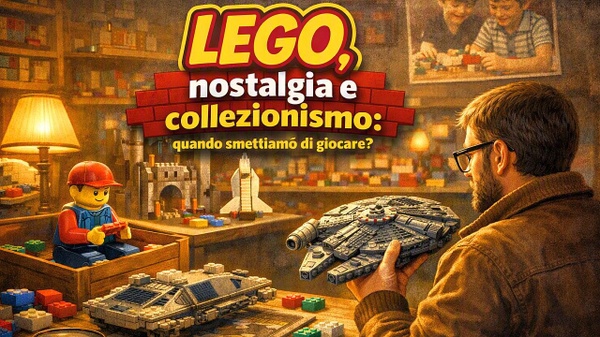


As children, we weren't particularly good at preserving things. Toys ended up under the bed, boxes were thrown away without much thought, comics got bent in backpacks, and what we would now easily call a “collector's item” might survive a few weeks before losing an accessory, a wing, a wheel, or any other detachable part. I don't think we cared much, because the value of an object lay primarily in what we could do with it, not in the condition it would be in thirty years later.
Then we grew up, and somewhere along the way, we started behaving in an almost opposite manner. We bought display cases, cleared shelves, kept boxes, and began mentally distinguishing between what could be used and what would be better not to touch too much. Some went a step further, purchasing items destined to remain directly in their original packaging, not necessarily to resell them or consider them an investment, but because owning them intact seems to have become part of the pleasure of owning them itself.
It's a curious transformation, especially because it often concerns the very objects and imaginaries we grew up with. What we once consumed, disassembled, scratched, or simply used can now become something to preserve and display. Nostalgia naturally plays a role, but it alone isn't enough to explain the phenomenon: in the meantime, the market has also changed, learning to cater to an already adult generation by transforming video games, comics, cartoons, and toys from their childhood into objects explicitly designed for collecting.
When the Toy Stopped Being Just a Toy
Collecting certainly didn't originate with our generation. Stamps, coins, models, comics, and many other items were collected and preserved long before anyone started talking about kidults. What seems to have changed is primarily the boundary between what is produced to be used and what is born with the idea of becoming part of a collection, perhaps ending up on a shelf even before it has fulfilled the function for which it was theoretically designed.
One only needs to look around to realize how this logic has permeated different sectors. There are action figures with statue-like prices, limited editions of video games where the disc almost risks becoming the least important element of the package, collectible cards that will never be put into a deck, and sneakers destined to spend more time in a box than on someone's feet. Even vinyl, which has made a strong comeback in our homes, is often purchased as a physical object to own, despite listening to the same music now taking only a few seconds and no physical medium.
In these cases, utility no longer necessarily represents the core of the purchase. A Batman figurine serves no practical function, yet it immediately conveys a passion. A physical copy of a video game already owned digitally can have a value that doesn't depend on the ability to launch it, just as a comic read twenty years ago can be re-bought in a more expensive, heavier, and bulkier edition simply because we now want it to occupy a specific place on our bookshelf.
Collecting thus progressively shifts value from use to permanence, and in this process, even the packaging changes meaning. As children, it was what separated us from the toy and therefore had to be eliminated as soon as possible. As adults, it can become part of the object itself, to the point where box condition, seals, completeness of accessories, and state of preservation enter the vocabulary of collectors. Opening something can even decrease its economic value, leading to the curious paradox where an object designed to be used becomes more valuable precisely when no one has ever used it.
A PlayStation That No Longer Needs to Turn On
The new LEGO PlayStation is an almost perfect example of this transformation, because it takes an object born exclusively to be used and deprives it of its main function without taking away its value, at least in the eyes of those who remember it.
The set contains 1,911 pieces, costs 159.99 euros, and reconstructs the first Sony console along with the original controller almost at a 1:1 scale. The Power and Open buttons can be pressed, the controller physically connects to the machine, and inside there are two small dioramas dedicated to Gran Turismo and Ape Escape. These are details that add no real functionality to the replica, but become fundamental precisely because they recall the gestures that accompanied the use of the original console.
That PlayStation will never read a disc, and the controller won't serve to issue commands, but we can still open the lid, connect the pad, and immediately recognize the shape of something that for years sat under the television. The work done on the opening mechanism also seeks to recall the physical sensation provided by the original button, a sign that not only the hardware is reproduced, but also the memory we have of its use.
Gran Turismo and Ape Escape work in the same way. They are not two names thrown into the box to add another license; rather, they belong to the period when PlayStation was defining its identity. In the case of Ape Escape, the connection becomes even more interesting because the game was closely linked to the spread of analog sticks and thus to the evolution of the controller itself. These are small callbacks that make sense primarily for those who lived through that generation, much less for someone observing the model without any associated memory of the console.
The original PlayStation, after all, has not disappeared and can still be purchased, connected to a television, and used. The LEGO model therefore does not serve to preserve otherwise irrecoverable technology, but transforms a tool into a representation of the tool, symbolically moving it from under the television to the bookshelf. It is still a PlayStation in our memory, but it no longer needs to do what a PlayStation was invented for.
Even Shenron Ends Up on the Shelf
The same principle emerges from an apparently very different direction with LEGO Icons Dragon Ball: Shenron & Goku, a set of 1,764 pieces and 139.99 euros that inaugurates the collaboration between LEGO and Toei Animation. Shenron emerges from the seven Dragon Balls while young Goku flies on the Flying Nimbus, composing a scene recognizable even by those who don't follow the most recent incarnations of Akira Toriyama's work.
The choice is significant precisely because LEGO could have started with one of the fights that became a symbol of Dragon Ball Z, relied on the Super Saiyan transformation, or focused on one of Goku's contemporary versions. Instead, it preferred to return to the imagery of the origins, choosing the child protagonist and one of the symbols that best summarize the entire adventure. For those in their forties or fifties who continue to have a relationship with Dragon Ball, Shenron represents the franchise even before representing a single scene.
Here too, the 18+ classification says a lot about the imagined audience in front of the box. There is naturally nothing “adult” in the content of the set, but the positioning, the price, and above all the way it is presented are. You build the model, adjust its pose, and find a place for it at home or in the office, transforming what once belonged to afternoon television, manga, or action figures with which we invented fights into an object primarily destined for display.
PlayStation and Dragon Ball come from very different worlds, but thus end up on the same shelf for surprisingly similar reasons. In the first case, a machine we remember because it allowed us to play is made static; in the second, a narrative universe that we consumed through cartoons, comics, and toys is condensed into an object to be observed. The LEGO brick becomes the medium through which a memory can take physical form, recognizable enough to take us back and elegant enough to coexist with the rest of an adult's home.
At this point, the most extreme part of collecting also comes into play: those who decide not to build the set at all. There may be a lack of space, a conviction that the product will increase in value, or simply that familiar “I'll build it someday” that ends up accompanying a box for years. This doesn't mean that all LEGOs purchased by adults meet this fate, of course, but the very fact that a set can be desired even without ever being opened demonstrates how much the relationship with the object has changed.
My Son, LEGO, and an Adult Who Had Forgotten How to Play
It was precisely while thinking about this transformation that a much simpler episode came to mind, and probably more effective than any market data in showing how much our perspective changes as we grow up. When my son was little and I gave him a LEGO set, I tended to behave as I believe many passionate adults do: I helped him build it, we followed the instructions together, and finally reached the last page with the complete spaceship, car, or vehicle in front of us.
For me, at that point, the work was essentially done. We had followed the instructions, every piece was in the right place, and the result finally matched the image printed on the box. So when my son shortly after started taking something apart, my reaction was almost inevitable: why dismantle it right now? We had just finished building it, and by continuing that way, sooner or later we wouldn't be able to restore it to its original condition.
The reasoning made perfect sense from the perspective of the adult I had become, but it contained a rather obvious problem that for some time I hadn't even considered. As a child, I did exactly the same thing he was doing. I built the model suggested by the instructions, played with it for a while, and then inevitably started modifying it, until that car or spaceship completely ceased to exist in its original form.
The curious thing is that LEGO itself had already told this conflict better than I could understand it at the time. In 2014, The LEGO Movie built much of its story on the contrast between a world where everything must follow instructions and the Master Builders, who are instead capable of looking at the same bricks and imagining something that doesn't appear in any manual. Emmet starts exactly from the first philosophy: he builds what he is told to build, lives by the rules, and considers instructions a guarantee that everything stays in its place. The film's journey progressively teaches him that those same rules can be a starting point, but they don't necessarily have to dictate where to stop.
It is especially in the final part, when the LEGO world gives way for a few minutes to the real world, that the discussion becomes surprisingly close to what we are doing here. Finn's father has transformed his LEGOs into huge, perfectly ordered dioramas, display models that the child should not interfere with. He even uses glue, the famous Kragle from the story, to prevent the constructions from being modified. Finn, on the contrary, does not see a city to preserve but an immense quantity of pieces with which to continue inventing. He is not trying to ruin what his father has built: he simply attributes to LEGOs the function that, as a child, came naturally to attribute to them.
Revisited as an adult, that ending takes on almost a different meaning. When the film came out, it was easy to read it as the classic celebration of creativity against rules, but growing up and becoming collectors, a much more interesting nuance emerges. The father hasn't stopped loving LEGOs; he has simply changed the way he loves them. He builds them, organizes them, displays them, and tries to preserve them exactly as they are. Finn does something different with the same bricks, because for him, the finished model does not represent the arrival, but the material from which to start building something else.
Looking at my son, I had ended up, without realizing it, on the same side of the table as Finn's father. I saw the complete model and thought it should be preserved, while he saw a reserve of possibilities to dismantle and reassemble. He wasn't ruining the newly built LEGO, as it might have seemed from my point of view, but was simply continuing to play with it in the same way I had many years before.
Perhaps the smartest lesson of The LEGO Movie was not that following instructions was wrong, nor that every construction necessarily had to be destroyed. It was to remind us that the last page of the manual does not necessarily coincide with the end of the game. A rather simple distinction when you are ten years old, but one that becomes curiously more difficult to remember when you start having shelves, display cases, and something that looks more and more like a collection.
When Nostalgia Becomes a Product
Naturally, the market could not have accomplished this transformation without nostalgia, because much of the value of objects like the LEGO PlayStation or Shenron exists even before the package is opened. You don't have to convince someone that the first Sony console played an important role in their adolescence if that person already associates an entire part of their life with its logo, just as it's not necessary to explain who Shenron is to someone who spent years waiting for Goku and his companions to finally collect all seven Dragon Balls.
A considerable part of the commercial work was therefore done decades ago, when those same people were children or teenagers and unknowingly built the emotional relationship that today makes it possible to sell them a replica, a reprint, or a commemorative edition. The industry primarily needs to find the correct form through which to return that memory, which can be a statue, an absolute edition comic, a miniaturized console, or almost two thousand gray bricks destined to reconstruct the machine we once kept under the television.
The risk is evident, because when any memory can be transformed into a product, memory itself inevitably ends up in a catalog. Every anniversary becomes an occasion for a new edition, every character for a variant, and every sufficiently recognizable object for a replica. The collector thus risks desiring not only what they genuinely lack, but also what the market continues to remind them they loved.
However, it would be equally simplistic to reduce everything to a commercial operation, because the emotional value of objects exists independently of who has learned to sell it to us. A comic preserved for thirty years can perfectly recall the moment we read it, an old console can take us back to a house we no longer live in, and a model can be important simply because someone gave it to us. Objects are extraordinary containers of memory precisely because they remain when many of the situations to which they were connected have disappeared, and collecting also arises from the desire to materially retain that relationship.
Perhaps that's why as we grew up, we started disassembling less and preserving more. We haven't necessarily forgotten how to play, although my attempt to prevent my son from taking apart his LEGOs suggests that sometimes we came quite close. We simply started asking objects for something that as children we weren't yet interested in: to remember for us.
And so a PlayStation that once gathered dust under the television can end up reconstructed on a shelf, while Shenron moves from the televisions of our childhood to a bookshelf in the living room. Then maybe a child comes along, looks at that perfectly arranged model, decides it would be much more interesting without a wing, and starts all over again. When you think about it, it's probably the best way to remind us of the difference between owning a game and truly playing it.
Similar articles