Pino: Takashi Murakami Seeks Humanity in a Robot
The author of The Dog Who Looks at the Stars returns with a science fiction story


Rereading or rewatching old science fiction works, one often gets the impression of encountering stories that resemble premonitions, descriptions of our current society outlined decades in advance. These cases, rather than paranormal phenomena, are instead symptoms of good science fiction, that is, a fictional story whose roots lie in current and concrete technological advancements and extend to their possible repercussions on society.
Today, writing a science fiction story with these characteristics is very complicated because the technological, social, and political evolution of contemporary societies is much more rapid and unpredictable than in the last century. Some have succeeded: Westworld, a television series created by Jonathan Nolan and Lisa Joy in 2016, imagines the awakening of consciousness by androids in a unique amusement park, in a techno-thriller where the emergence of self-aware artificial intelligence is linked to the spread of a surveillance society and the blackmailing dominance of mega-corporations over nation-states.
Pino and the Search for a Heart: What Truly Makes Us Human?
In recent years, ever since AIs began to carve out an increasingly everyday role in our lives, incorporating AIs into a science fiction story exposes one even more to the risk of going grossly astray, perhaps ending up being disproven within a few months. Yet, by choosing the right perspective, one can still create quality science fiction, telling stories of the day after tomorrow. This is demonstrated by Pino, a 2020 work by Takashi Murakami presented at Lucca 2025 by JPop, in which the author of The Dog Who Looks at the Stars ventures into a genre unfamiliar to him, tackling the hypothesis of the emergence of an AI capable of feeling emotions through the lens most familiar to him, that of sentiments.
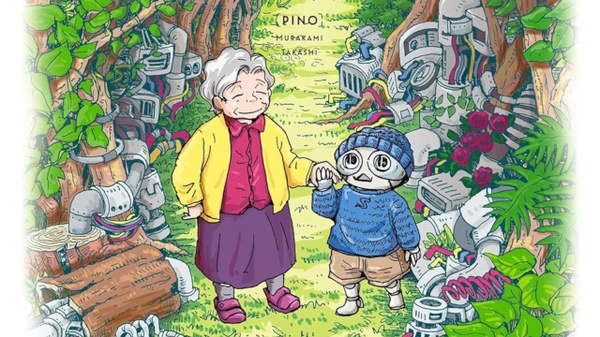
Pino, who gives the volume its title, is a humanoid robot model, developed by a pharmaceutical industry and later put on the market as an assistant for domestic or work tasks. The protagonist of the manga is a model mysteriously supplied to an elderly lady living in Snake's Nest, a degraded neighborhood to which such robots should not have access. On his trail is former police officer Iwata, expelled from the police force due to the results of his investigation into a famous incident that occurred years earlier, involving one of the first Pino models at a research center.
In reality, the moment of the original Pino's incident is shown to us readers in great detail, in a first chapter that Murakami uses to introduce us to his world (and to the science & marketing notions he studied to write this story) through the dialogue between Hana Takimoto, the researcher in remote contact with Pino, and a young, newly graduated colleague who has just joined the company. It's a formula that Murakami repeats several times throughout the 5 chapters (plus a short epilogue) that make up the work. There's the repairman who explains to the neighborhood girl what a Pino model is doing in those unusual parts, there are Iwata's investigations which are always a good opportunity to introduce new information.
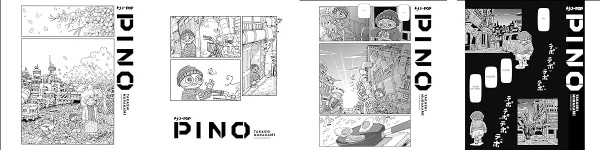
But the Japanese mangaka uses a simple and always effective trick: he distracts us from verbal worldbuilding with visual worldbuilding. When dense dialogues burst onto the scene, Murakami's panels slowly begin to thicken with smaller vignettes on which the eyes bounce, collecting the infinite delightful details, sometimes scattered in silent vignettes that punctuate the narration.

Murakami needs only a few ink strokes to outline faces, expressions, and emotions, but he always dedicates abundant quantities to backgrounds and scenarios, depicted with rich detail, telling the world of Pino even before words describe it. And Pino's world is decidedly close to a dystopia where mega-corporations enjoy widespread power and cities are stratified by social class, with the slums never truly admitted to the conveniences of modernity guaranteed to the wealthy. Yet every single page of the volume emanates energy, vitality, joy, and a zest for life, even in tragedy.
Can a robot develop a heart? The question is rhetorical, because as readers we are presented with the answer in the first pages. But as in old episodes of Columbo, what's interesting is the context: what can lead a robot to develop a heart? In this case, the answer is much more complicated, because any attempt must start from defining what makes us who we are. Murakami seeks the answer through the different examples of humanity that populate the slums of Snake's Nest, among the last, and incredibly finds it in what is for everyone the greatest fear, without shifting the tone of the story one iota from a bright and sincere hope that every adversity can be faced as a species by relying on each other.
Similar articles