They Call Me Jeeg – The Suburban Superhero in 4K
Mainetti's cult film in an unprecedented UHD version, good audio track, and plenty of extras
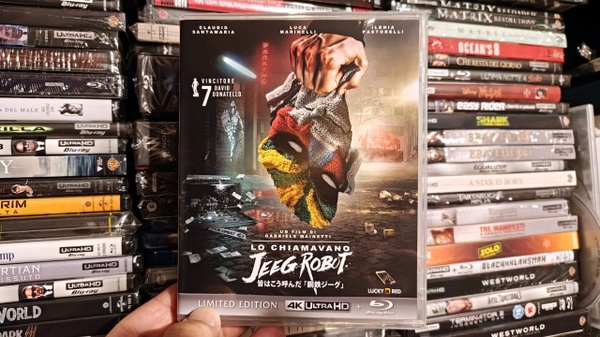


Superhero cinema has often favored larger-than-life figures and spectacular scenarios, but They Call Me Jeeg Robot chooses the opposite direction. Gabriele Mainetti transforms the Roman suburbs into a place where the fantastic is intertwined with everyday life, creating a film that remains credible even when embracing the genre's imagination.
Enzo Ceccotti possesses no heroic calling. He is an isolated man, accustomed to surviving by thinking only of himself. The acquisition of extraordinary strength does not immediately change his nature: that power initially becomes a useful tool to continue a life of expedients. It will be the encounter with the fragile Alessia that will crack his cynicism, paving the way for an unexpected change.
An Italian comic book movie that finds an original voice
While engaging with American comic book movies, Mainetti chooses a personal path. The Roman suburbs become the heart of the story, transforming the fantastic element into something surprisingly close to reality. The cast is also crucial: Claudio Santamaria offers a measured and convincing protagonist, Ilenia Pastorelli gives the story a vulnerable intensity, while Luca Marinelli delivers one of the most memorable villains in recent Italian cinema, over-the-top but never out of control.
More than telling the birth of a superhero, They Call Me Jeeg Robot describes the difficult journey of a man towards the rediscovery of his own humanity, demonstrating that even the genre can be renewed when it starts from authentic characters.
The technical information about the film is fragmented, and a complete workflow breakdown has not been published. From what emerges from technical sources and interviews, it seems that the native footage was 2.5K (RED Epic, RED Scarlet, Blackmagic Cinema Camera, Blackmagic Pocket, Canon 5D, GoPro Hero 3 Black) with finalization on a 2K master. Moreover, the film's budget (approximately 1.7 million euros) makes a 4K DI unlikely, especially in 2015, when almost all independent Italian productions worked at 2048 x 1080 resolution. It therefore remains very probable that this edition is a UHD rescaling, here with the advantage of HDR-10 and greater color fidelity and light dynamics.
Image format 2.35:1 (3840 x 2160/24p), HEVC encoding on a BD-66 dual layer. Compared to the FHD/SDR counterpart, the quality leap is relatively palpable, with further refinement of details and the sensation of observing the footage by cinematographer Michele D'Attanasio (Freaks Out) more closely. The blacks are not always deep, which is somewhat surprising, but here too artistic choices must have played a role.
Even if only 16-bit, the single DTS-HD Master Audio 5.1 track is engaging, with dynamic range and a soundstage featuring rear elements, echoes, excellent dialogue, and a decent subwoofer. The experience truly comes alive through Home Theater listening with a proper separate-channel system, beyond a soundbar.
The BD-50 with the 2K version includes: backstage (61'); 7 deleted scenes; actor auditions (19'); bloopers (6'); storyboard comparative (8'); director's short film; 2 trailers and a music video clip.
Similar articles