Maicol & Mirco's L'Isolo Puts Our Solitudes to the Test
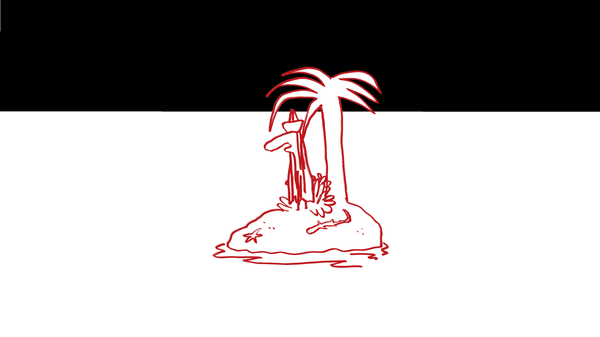


There's a man, alone, on an island: no, it's not the beginning of a joke, but rather the opening of L'Isolo, the new graphic novel by Maicol & Mirco (here on Amazon). A book somewhat different from his previous ones, not a collection of doodles, like the Opera Omnia, nor a very long volume, like Il papà di Dio. A concentrated story, in terms of time and space, born from a creative spark that found its form through editorial direction. The author himself recounts this, in dialogue with his editor Michele Foschini of Bao Publishing, at the Milanese presentation of L'Isolo hosted by Libreria Feltrinelli. It all started with an idea: the man alone on an island, precisely. “I always say: I don't write stories. At the risk of sounding crazy (or clever), but I draw the characters on the page and wait for them to come to life. And this book was born from the idea of telling what that man would do on the island, which is tiny, just like in jokes. The first idea was to make a series out of it, but it didn't work. I was excited that there was something to tell, but I had no idea what. I didn't know who this character was, why he was on the island, if he had fled, returned, or if he was looking for help”.
It is often said that imposing limits helps the artistic process to develop and, confirming this thesis, the guidelines from Bao contributed to shaping L'Isolo. Fearing to alienate readers with another imposing tome like Il Papà di Dio, Bao directed Maicol & Mirco towards a more traditional editorial format. A sign of the excellent relationship between Maicol & Mirco and Bao, built on a collaboration that has lasted for years through the creation of volumes that have often required considerable editorial care: “Looking back, it seems incredible to me that I can go into the office, ask for the things I can imagine, and find support. Working with me is truly a leap into the void and L'Isolo is the first book we've made following an ordinary, proper process from the beginning”.
“At first, I thought the page limit indicated by the editorial team was something I couldn't accept, but in reality, it was very useful. For once, I wanted to try to make a book that had no gimmicks, not even a beautiful gimmick, nor a hardcover or a crazy title. I simply wanted a book that was normally accessible, one of those you can pick up by chance in a bookstore and discover something unexpected”.
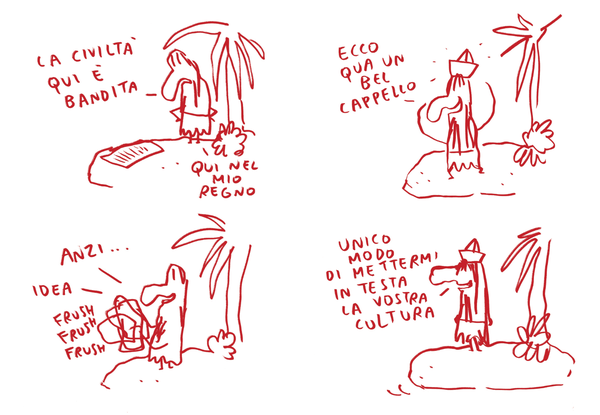
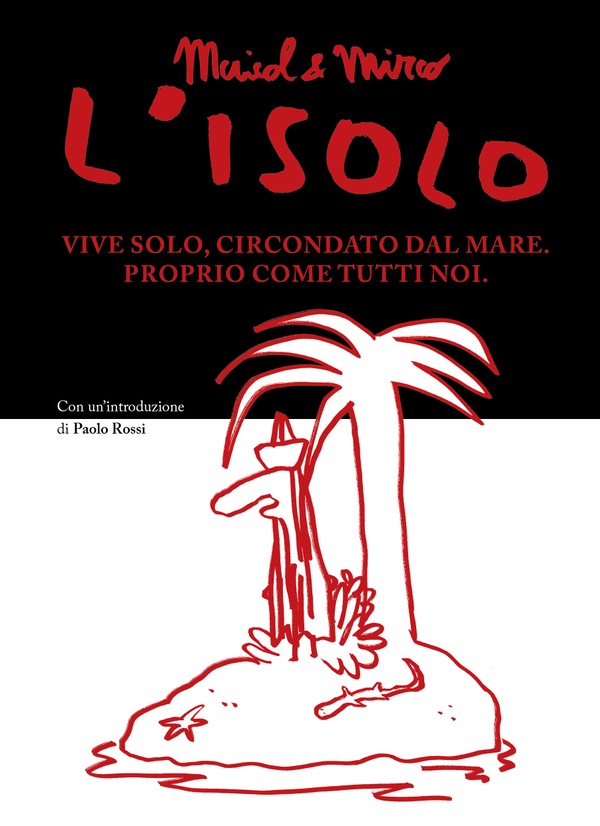
If the format is somewhat different, then, from what Maicol & Mirco has accustomed his readers to, in L'Isolo one finds all his poetics and his caustic nihilism, along with the surprising twists that are part of the cartoonist's arsenal. His protagonist is stuck on the island from the Settimana Enigmistica jokes. Happily stuck. Far from a society and culture he despises. “He lives alone, surrounded by the sea. Just like all of us” reads the tagline on the cover. It's clear from this that Maicol & Mirco plays with the stratification of meanings, staging a theatrical piece in which our contradictions explode in a very successful dialogue between sign and meaning.
Maicol & Mirco's canonical marker stroke, this time red on a white page, sketches a universe with a few trembling lines, subtracts and synthesizes until it reaches the core, the idea of what it intends to represent; but it is always with this stroke that he surprises the reader with the “televisual” wonders of his micro-island that explode on the page with the force of nature itself.
L'Isolo is in some ways an instant book, because the idiosyncrasies of its character are those in which a good part of us oscillate, those who today begin to no longer feel part of a society whose values they do not share, of a life model conceived to squeeze us dry, far from other human beings in whom it is difficult to glimpse sparks of humanity. A humanity, understood both as nature and as companionship, from which we cannot escape and which, through the theme of parenthood, strikes the reader with an ending that holds a significant emotional punch for almost everyone, illuminating the island's sunset with unexpected optimism.
“I always say that all authors are optimists, even when they disguise themselves as nihilists in the morning” Maicol & Mirco concludes at the end of the presentation in response to a question from the audience. “Any author who decides to draw, to move a pen, to make a sculpture, performs an act of incredible optimism. The true nihilist artist does not make art. I know some, they give up art, they don't touch a pen. Anyone who does something is an optimist, because the world does everything to convince you to do nothing. This is not a book of hope because I am better; in reality, all the works I have written, even before having children, I have always thought of as readable even by a child. Maybe secretly, of course!”.
Similar articles