Deadpool and Batman Open the Marvel/DC Crossover Season
Who is stronger between the Dark Knight and the Merc with a Mouth?
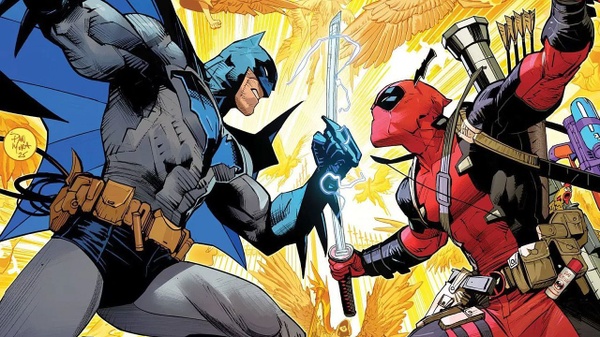


In the world of American comics, it's all "Nothing will ever be the same!", "The shocking death of…!" and "A new, very different universe," taglines that often hide an already planned return to normalcy within a few weeks. One of the few true rarities, the kind of event that genuinely appears once every few decades, is the meeting/clash between the two great American comic book publishers, namely Marvel and DC Comics. It took years and individual successes before the two major US comic publishers crossed paths for a first historic collaboration, Superman vs The Amazing Spider-Man. In the '90s, as the spirit of the decade dictated, it was time for DC vs Marvel, the crossover of clashes, followed by the last crossing of destinies between Captain America, Superman, and their respective allies, namely JLA/Avengers in 2004. Then twenty years of radio silence, interrupted by announcements in 2025 followed by the release of the first pair of new crossover albums, namely Deadpool/Batman published by Marvel and Batman/Deadpool published by DC Comics (and both recently brought to newsstands and comic shops by Panini in our parts).

The operation, in reality, is broader than the simple back-and-forth clash between the Merc with a Mouth and the Dark Knight, because the publication in two albums allows both publishers to include other small encounters, of rather different style and tone, in each of their publications, as if they were extra mini-crossovers. But the main course, there's no point in beating around the bush, are the two stories starring Deadpool and Batman: so let's start, in chronological order, with the one first published by Marvel with a script by Zeb Wells, pencils by Greg Capullo, inks by Tom Townsend, and colors by Alex Sinclair. As often happens in these cases, the team selected by the House of Ideas decided to play a conservative game, which doesn't mean they didn't craft a good comic.
Deadpool vs Batman, Round 1 & 2
The events indeed begin in the DC universe, in Wayne Manor in Gotham where the mutant who never shuts up bursts through one of the windows to offer his services to Batman. On the other hand, Deadpool is a character who naturally plays with the fourth wall and the multiverse; justifying his presence in the DC Universe with some deus ex machina, as will happen within a few pages, is decidedly simpler. Today, moreover, with the concept of the multiverse being mainstreamed not only in comic book movies but in much of mass entertainment, not as many explanations are needed as before for this type of event. And Wells knows this well, having co-written Deadpool & Wolverine for the MCU. And in fact, there's also a bit of the big-screen Deadpool in what Wells writes for Deadpool/Batman, an omniscient narrator and self-aware character capable of looking into the white space between panels. The triple game in which Deadpool traps Batman and Joker, only to be manipulated in turn by the world's greatest detective, has a simple structure, supported by the contrast between Deadpool's constantly over-the-top actions and Batman's moving under the radar, punctuated by a barrage of the mercenary's jokes, some quite effective (and no, they don't concern his relationship with Robin; those are overused). Capullo, then, is always a guarantee in stories like this, but Townsend's inks perhaps don't do him justice.

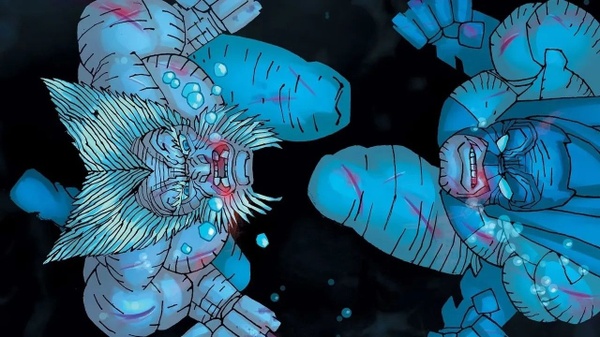
Much more articulated, profound, and rooted in the mythology of the two universes is the counterpart created by DC Comics, namely Batman/Deadpool by Grant Morrison and Dan Mora with colors by Alejandro Sanchez. The mere presence of the Scottish author in the script is news in itself, given that he had ended his relationship (quite amicably) with the publisher of Batman some years ago. Batman/Deadpool thus becomes Morrison's opportunity for a last dance with his characters, to close a multi-decade thread of stories across the two main US comic publishers, connecting his Batman stories with those of the X-Men, a common thread that runs through two narrative universes and originates from a night of fireworks between the two cosmic entities that embody them (created, moreover, in the JLA/Avengers crossover). There's even Morrison himself, or the Writer, his paper counterpart born on the pages of Animal Man, a puppeteer who descends to the (narrative, of course) plane of his characters and claims paternity of Damian Wayne.
Wonder Woman, Hulk & All the Others
As a corollary to both albums, occupying about half of their page count, Marvel and DC have added a handful of short stories, some very short, with further encounters between characters from the two universes imagined by the authors of the moment, with some inevitable concessions to nostalgia. Given the short duration of the stories, even in these cases, not too much time is spent explaining why the heroes of the two universes come into contact; each creative team takes its own path. Thus, in Deadpool/Batman, Chip Zdarsky and the Dodsons imagine Wonder Woman and Captain America as battle companions and mutual inspiration since World War II; Frank Miller translates his increasingly essential graphic style into a script, bringing The Dark Knight and Old Man Logan into a liminal space, that enclosed between panels, trapping the two beast-men in a synthesis of feral, lyrical, and powerful comics. The same cannot be said of Kevin Smith's (yes, that Kevin Smith) clumsy dialogues in the encounter between Daredevil and Green Arrow splendidly drawn by a top-form Adam Kubert. The award for best short story on this side of the crossover, however, goes to the beach game between Jeff the Land Shark and Krypto, written by Kelly Thompson and illustrated by Gurihiru.
On the DC side, however, a slightly different formula is followed, with four longer stories. The collaboration between John Constantine and Doctor Strange, written by James Tynion IV, Joshua Williamson, and Scott Snyder, is evocative, but above all graced by the drawings of Hayden Sherman who translates the encounter between different magical realms into images through the (de)composition of the page and his always very evocative style. For the crossing of destinies between Nightwing and Laura Kinney, no one else could have been at the writing table but Tom Taylor, an author very attached to both, with the support of Bruno Redondo on art, for a story in which the authors' affection for the characters is very evident, but which ends up being a bit too classic. The opposite of the colorful and ironic team-up between Harley and Hulk: Mariko Tamaki on scripts and Amanda Connor on art have fun transforming this improbable collaboration into a funny story with a young adult target that works by playing on the contrast, including expressive, of the characters. In short, while the DC version of Batman/Deadpool is preferred for the main story, it lacks some inspiration from the supporting short stories, as confirmed by the last one closing the album in which Willow Wilson and Denys Cowan tell us about Static's crush on Ms. Marvel.

Broadening the view to the entire Batman and Deadpool crossover, the operation worked, despite the sometimes chaotic mix of ideas. This almost total freedom, however, gave space and place for one of the most unthinkable stories of recent years to exist for its transversal importance and coherence across universes (Morrison's, of course), but also several simply good stories, great art on almost every occasion, and several interesting ideas. Obviously, given the success, another double round is immediately replicated, this time between Superman and Spider-Man, scheduled for the first months of 2026. It remains to be hoped that even this small oasis of rarity in superhero comics will not end up drying up due to the usual excess.
Similar articles