The Walking Dead: Streets of Survival Review: Pixel Art Isn't Enough
A visually successful adaptation, but too fragile in structure to leave a mark.



The Walking Dead: Streets of Survival is more convincing for its pixel art than for its combat. Odaclick Game Studio successfully recreates the world of the AMC series but struggles to make the battles equally engaging. The problem isn't the absence of major innovations: a beat 'em up can work perfectly well even with familiar mechanics. Here, however, the increasing pressure from enemies is met with a repertoire that is too limited to confront them with satisfaction.
Pixel art worthy of The Walking Dead: Streets of Survival's setting
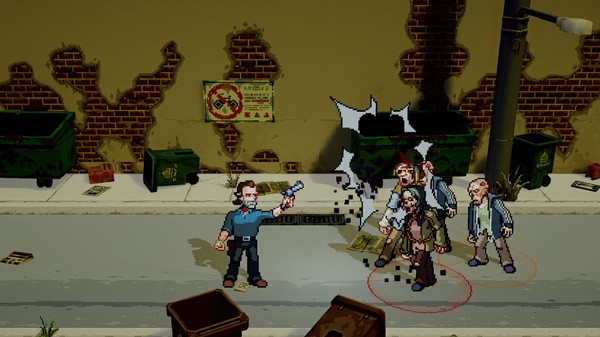
The campaign reworks the All Out War between Rick Grimes' group and Negan's Saviors. The pixel art makes the protagonists recognizable without aiming for photographic resemblance to the TV actors. Even settings like Alexandria and the Sanctuary retain their identity: the shift to stylized graphics works and renders the series' world in a form suitable for a beat 'em up.
Combat that struggles to evolve
Michonne's katana and Daryl's crossbow help characterize the protagonists, but the differences are much less noticeable when it comes to controls. The basic mechanics remain similar, and combos leave little room for experimentation. Changing survivors therefore requires minimal adaptation, reducing the incentive to restart with another character.
The shooting offers one of the most interesting ideas. The reticle changes in size, and shooting when it's narrower allows for greater damage. With limited ammunition, it's worth waiting for the right moment to pull the trigger: rationing shots introduces a small tactical choice into the action, without, however, compensating for the poverty of the offensive repertoire.
The interactions between walkers and Saviors deserved more attention. The undead can also attack human opponents, allowing one threat to be used against another. Encounters, however, are mostly linear and offer few opportunities to take advantage of this.
When progression must correct encounters
The balancing presents more annoying problems. Attacks coming from off-screen are difficult to anticipate, while hits that interrupt the action or knock the character down can make it difficult to regain control. Even at normal difficulty, enemy aggression weighs heavily. In boss fights, reinforcements also force players to divide their attention among multiple opponents. The difficulty increases, but the available tools remain too limited for the challenge to always be stimulating.
The dodge roll, for example, has a long cooldown: it must be used carefully. Some upgrades serve precisely to shorten the wait between dodges. Resources are thus spent to correct a defensive limitation, even before gaining new action possibilities. This is a questionable choice in a beat 'em up that already offers few options.
The currency is shared among all protagonists, but during the first campaign, the game forces you to use several. Investing primarily in your preferred character therefore risks leaving the one required later less prepared.

A short campaign with few incentives to restart
The campaign includes eleven levels and lasts approximately two or three hours. For an arcade beat 'em up, this wouldn't be a problem if the encounters encouraged replayability. Completing the skill trees requires additional playthroughs, but the combat quickly shows its limitations: having more upgrades to unlock doesn't make repeating the same levels more interesting.
The absence of co-op also weighs heavily. A beat 'em up can succeed perfectly well in single-player, provided it can engage with the quality of its encounters. Streets of Survival, however, must rely on combat that varies little, without the possibility of tackling it with another person. The desire to restart thus remains primarily linked to the development of the protagonists.
The Walking Dead: Streets of Survival Review - The Verdict
The pixel art gives Streets of Survival a visual identity, while the best combat ideas remain underdeveloped. The game asks players to repeat encounters to level up characters, but offers few reasons to want to do so. Affection for The Walking Dead can sustain initial curiosity, but there are no other reasons to embark on this adventure.
Score
Editorial team

The Walking Dead: Streets of Survival Review: Pixel Art Isn't Enough
The pixel art gives personality to the setting and enhances the protagonists, but it fails to compensate for a shallow combat system. The absence of truly new ideas wouldn't be a problem in itself: what weighs it down is the lack of variety in encounters, which makes the campaign repetitive before its conclusion.
Similar articles