Hideo Kojima's Favorite Films, as Told by Hideo Kojima
Dario Argento, Sergio Leone, and Japanese genre cinema classics: as a guest at Cinema in Piazza in Rome, Hideo Kojima spoke about his connection to a handful of films that changed his life.
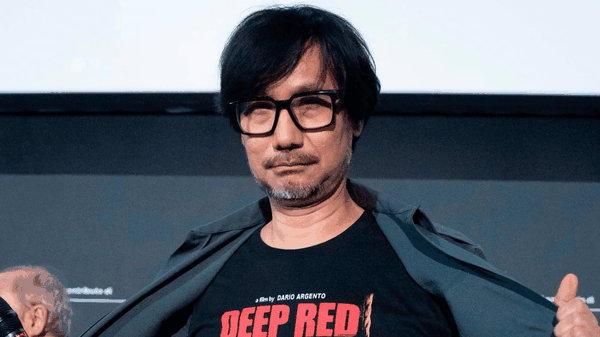


Anyone who follows Hideo Kojima on his social media accounts knows that his cultural interests extend far beyond the video game sphere. The director is a point of reference well beyond those who appreciate his work at the helm of Kojima Productions, thanks to the listening and viewing recommendations he shares on social media every week, not to mention his endless gallery of selfies with actors, stars, and directors he knows and admires, many of whom have since joined the cast of the two Death Stranding games, a saga that has drastically reduced the distance between watching a film and the interactive experience of a video game on console.
It's no surprise, then, that Kojima, as an avid cinephile, is among the rich array of events at the summer festival organized by Fondazione Piccolo America in the Capital. The attention given to Kojima was special, as was the public's response: at every stage of his three-day series of presentations and meetings with the public in front of the big screen, he was greeted by a crowd of fans who came from all over Europe, eager to meet him in person and see, through his interpretive lens, the films he chose for the screenings. The Japanese game designer's was a special Carte Blanche: three evenings during which he presented three films that shaped his artistic development, sharing them with the Italian audience, explaining why they were so important to him, both as a cinephile and a storyteller.
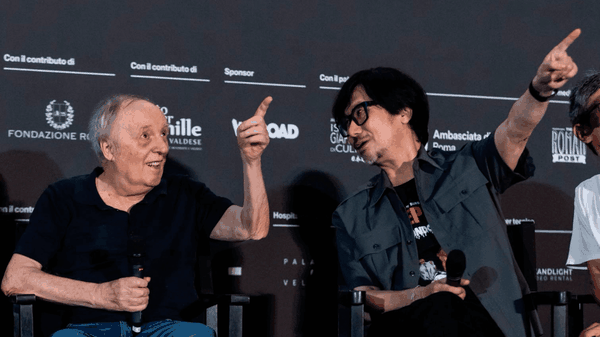
We followed Kojima's presentations day by day, as he alternated Japanese genre cinema classics with key titles from Italian production. The Japanese films Jigoku and Female Prisoner Scorpion: Jailhouse 41 are practically unreleased in Italy and provided a rare opportunity for the local audience to see them on the big screen, while the choice of Dario Argento's Profondo Rosso (Deep Red) and Sergio Leone's Il buono, il brutto, il cattivo (The Good, the Bad and the Ugly) once again demonstrates the enormous cultural influence of these Italian names worldwide.
For those who couldn't be there and are curious to understand how these works continue to influence Kojima's way of telling stories and constructing images today, here is a summary of what he shared with the fans present.
Female Prisoner Scorpion: Jailhouse 41: cinema born from poverty
Among the four titles chosen, the one Kojima dwelled on the longest was Female Prisoner Scorpion: Jailhouse 41 by Shunya Ito, the second chapter of the saga starring actress Meiko Kaji, of whom he is a big fan. The film, presented at Cinema Troisi, is a cult favorite among genre enthusiasts but difficult to find even within Japan, so Kojima's attempt was precisely to explain to an audience unfamiliar with the entire saga what its peculiarities are and what makes it so special.
For Kojima, the film perfectly represents an unrepeatable moment in 1970s Japanese cinema, when the very limited economic means of the productions of the time were counterbalanced by enormous creative freedom: "Japanese cinema of that period was poor and had scarce resources. Every author tried to create something original, often supported by a very young crew that continuously experimented with shots, lighting, and visual solutions."
According to Kojima, it is precisely this necessity to invent with few resources that has made the film still modern and unique, emphasizing how today's blockbusters, on the other hand, all have a very similar structure. The director also stressed how the work was profoundly political, given that it is a kind of allegory of female rebellion in 1970s Japan: "It's a film about feminism and rebellion against a Japanese society dominated by men. When I saw it as a boy, I didn't fully understand this aspect; I only understood it as I grew up."
The protagonist of the saga, which leans into the revenge movie genre, is Nami Matsushima, known as Scorpion, who is imprisoned in a women's correctional facility after being betrayed by her partner and condemned. The prison is run entirely by men who abuse their power and subject the inmates to continuous violence and torture. After a revolt, Scorpion manages to escape and enacts her revenge against those who destroyed her life.
At the end of the first film, however, she is recaptured and locked in a terrifying underground solitary confinement cell. The second chapter of the saga, the one presented to the Italian audience by Kojima, picks up exactly from this point in the story, recounting a new escape attempt by the protagonist. For Kojima, the second chapter represents the highest point of the series: "The first Scorpion is already a beautiful film, but the direct sequel is the most visionary, the most excessive of the entire series. In the first, Shunya Ito was making his directorial debut and was still getting a feel for being behind the camera: in the second, however, there are no more hesitations, and he is completely free."
Deep Red and the lesson on the plot twist
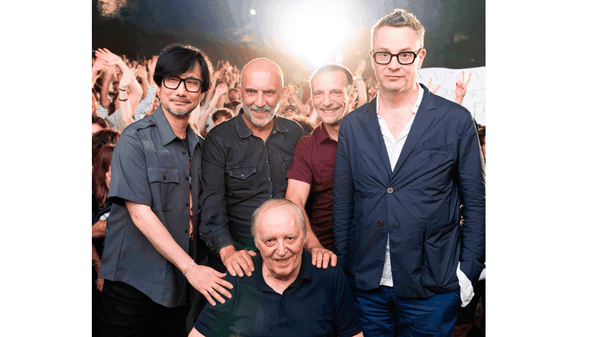
Among all Western directors, Dario Argento holds a special place in Kojima's imagination, so much so that he included several easter eggs related to his work as a young game designer from the very first computer games he created before moving on to develop for PlayStation. During the evening dedicated by the festival to the fifty years of Profondo Rosso (Deep Red), in the presence of Argento himself, Nicolas Winding Refn, Gaspar Noé, and Mathieu Kassovitz participated in a long debate on stage dedicated to the importance of this film. Kojima, of course, also participated, explaining what aspect of this work continues to fascinate him today: "The wonderful thing about Profondo Rosso is the moment when the protagonist and the viewer understand the truth practically at the same instant. It's something I try to do in my games too."
For the Japanese artist, that perfect synchronization between the protagonist's discovery and the viewer's represents one of the greatest lessons in directing he learned from Argento's cinema and which he has tried to replicate in his games. For Kojima, in short, that type of narrative construction represents one of the highest examples of how cinema can actively involve the audience in the narration, making them more than just a simple spectator.
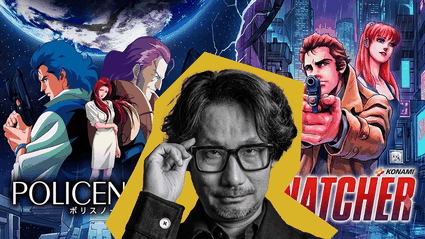
Argento's influence, however, concerns not only the narrative structure but also some particularly gruesome details that fascinated Kojima as a viewer and that he continued to insert into his work, as long as he could: "Since I was a boy, I noticed that in the Master's films there is almost always a decapitation: it happens in Profondo Rosso and also in Phenomena. I grew up with those images and, when I was designing my first PC games, I always ended up thinking that there had to be someone to decapitate. In the point-and-click games I worked on in the nineties, Snatcher and Policenauts, there is always a decapitation for this very reason, almost a kind of hidden homage. When I moved to PlayStation consoles, it was no longer possible to continue this homage of mine, even though I really wanted to. The companies I worked with kept telling me: "Enough with the decapitations, they're too violent!" I always replied: "But Dario Argento does them too!"
Kojima also recalled a curious detail: in Japan, Profondo Rosso was released under the title Suspiria 2, exploiting the success of Argento's previous film to attract audiences to cinemas.
The Good, the Bad and the Ugly: the western that speaks of man
The last evening of the festival was dedicated to Sergio Leone's masterpiece, presented together with actor Luca Marinelli, actor and protagonist of Death Stranding 2. For Kojima, it is not simply his favorite western of all time, but one of the films that helped shape his imagination from childhood.
The game designer once again recalled growing up in a family where cinema was a constant presence, as his parents often took him to the cinema to see great American classics. Precisely when he was a boy, the first westerns filmed and produced in Italy also began to arrive in Japan. Kojima explained that he grew up watching both American westerns and those that in Japan are called "macaroni westerns," slightly distorting their international name of "spaghetti westerns." As a young cinephile, he always found it fascinating how there is a clear difference in the worldview that the two schools of westerns have: "in the classic American western, the sheriff always wins. In macaroni westerns, it doesn't work that way: the characters are much more human, and even evil can end up triumphing at the expense of law and order."
The moral ambiguity of Sergio Leone's westerns captivated him, because it reminded him of that of Akira Kurosawa's classics. Both directors, in their pivotal works, question how to interpret good and evil in the human experience. For this reason, Kojima gave advice to the thousands of fans present at Monte Ciocchi: "when you watch this film, ask yourselves: are you the good, the bad, or the ugly? None of the characters are completely one thing, and understanding who is who turns out to be much more difficult than it might seem."
Kojima then revealed that what he admires about Leone's masterpiece is not only the confrontation between the three protagonists but also the way in which their personal story intertwines with grand History, during the years of the American Civil War: "I really like this film because it tells history from a very broad perspective. The setting during the Civil War gives the film a historical dimension that goes beyond a simple western. It is one of the elements that make me love it so much and that made me want to share it with all of you."
Finally, he emotionally recalled his first encounter with the film, which occurred when he was just three or four years old in front of the television at home: "The first time I saw it dubbed in Japanese, alongside my parents, when it was broadcast on TV. The funny thing is that in our version, when the characters are introduced, a voice even says "I am the good," "I am the bad," "I am the ugly." Today it makes you smile a little, but at the time it enchanted me."
Thanks to Fondazione Piccolo Cinema for the photos accompanying the article.
Similar articles