Nolan's Odyssey Will Be One of the Year's Events: Here's How to Prepare
The myth, the history, the author, the secrets to know, and the meaning.


Christopher Nolan's Odyssey brings to the big screen one of the stories that helped define the Western way of telling adventure tales. Knowing every stage of Ulysses' journey isn't essential to follow the film. However, understanding what lies behind that journey can profoundly change the viewer's perspective.
Gallery
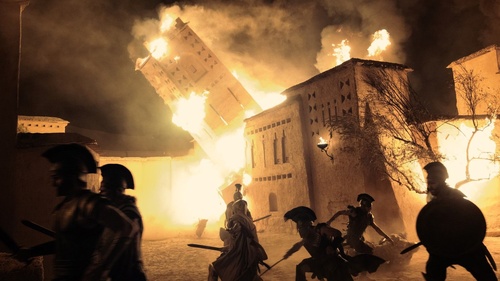
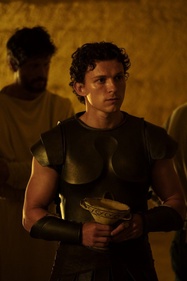
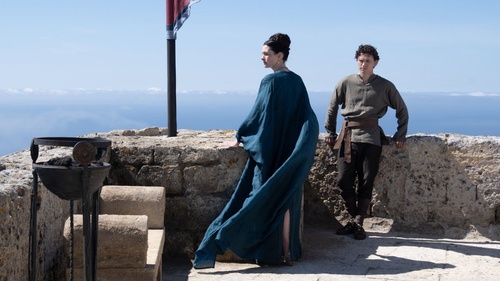
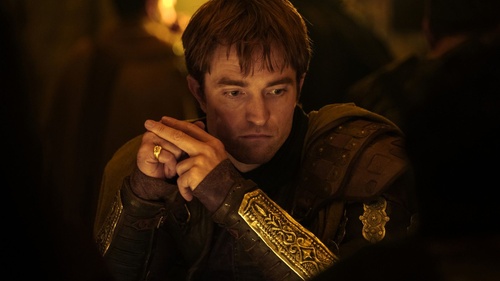
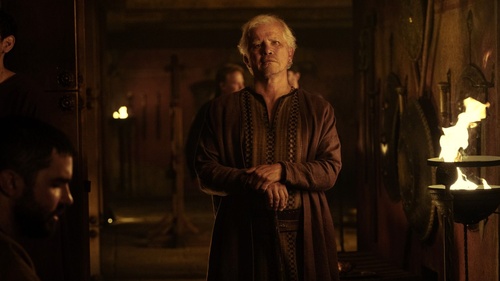
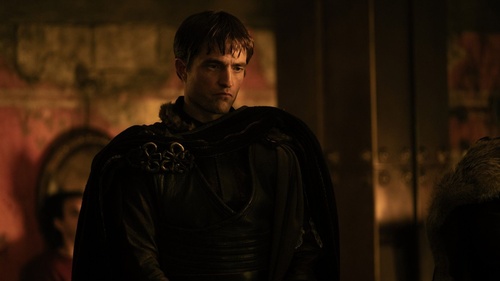
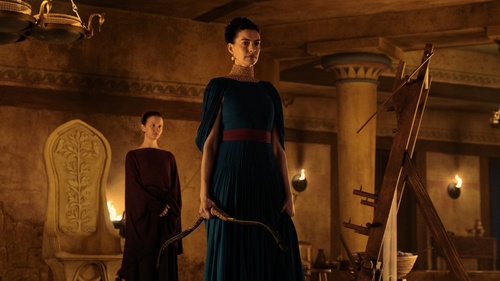
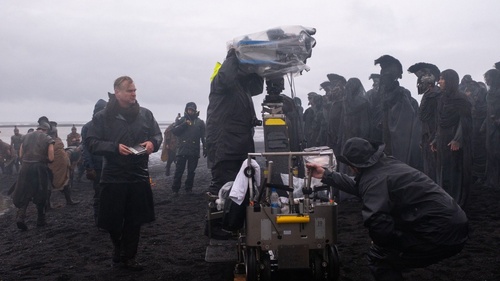
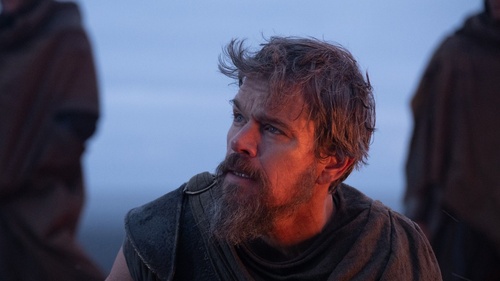
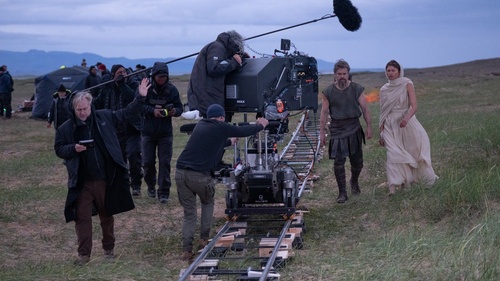
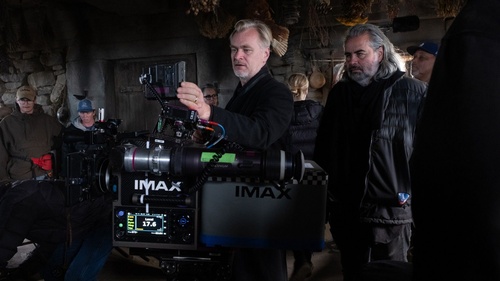
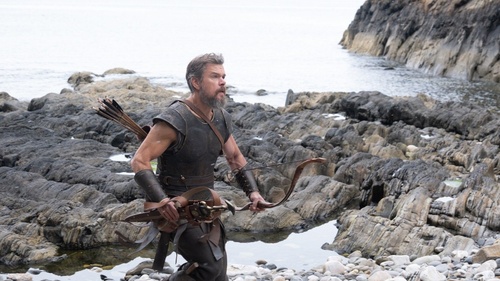
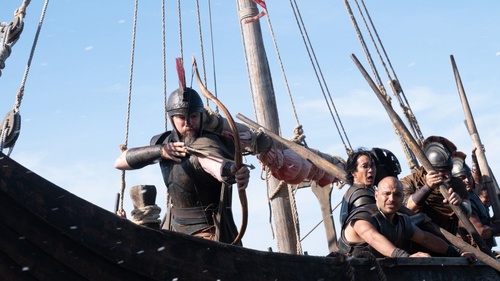
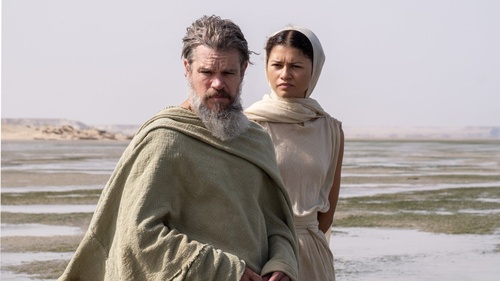
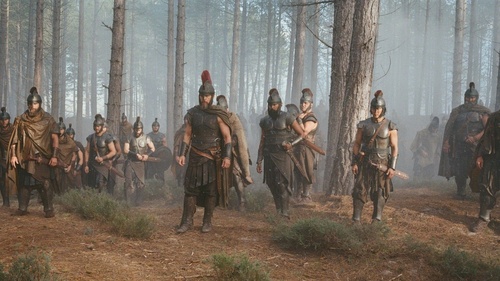
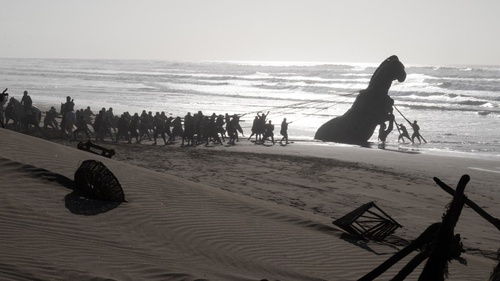
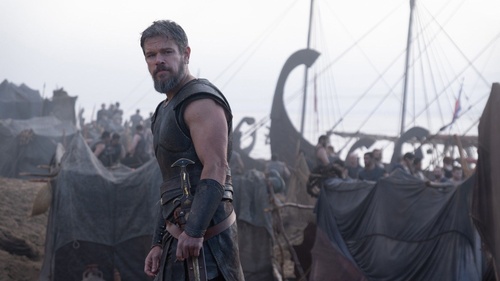
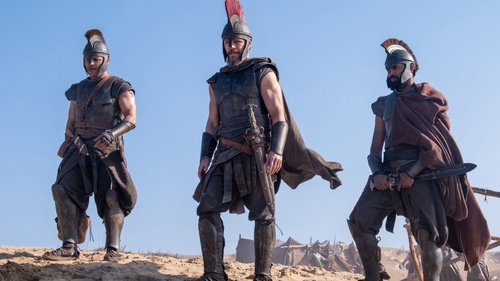
The poem attributed to Homer, only seemingly the tale of a man grappling with monsters and storms, is above all the story of a veteran trying to return to his life while time transforms his family and even his identity. Before entering the cinema, it's worth clarifying the origins of the work and the constantly crossed boundary between history and myth.
- What we know about the film
- Where does the Odyssey come from?
- Who was Homer really?
- Is the Odyssey a true story?
- What does the poem really tell us?
- What is the relationship between the Iliad and the Odyssey?
- Between myth, legend, and human responsibility
- Where was the film shot and why those locations?
- Other adaptations to know
- Why does the Odyssey continue to speak to us?
Christopher Nolan's Odyssey: What We Know About the Film
The film, written and directed by Christopher Nolan, will arrive in Italian cinemas on July 16, 2026. Matt Damon plays Odysseus/Ulysses, the king of Ithaca engaged in the long journey home. Anne Hathaway is Penelope, while Tom Holland plays their son Telemachus. The cast also includes Zendaya, Robert Pattinson, Lupita Nyong’o, Charlize Theron, Benny Safdie, Jon Bernthal, and Samantha Morton.
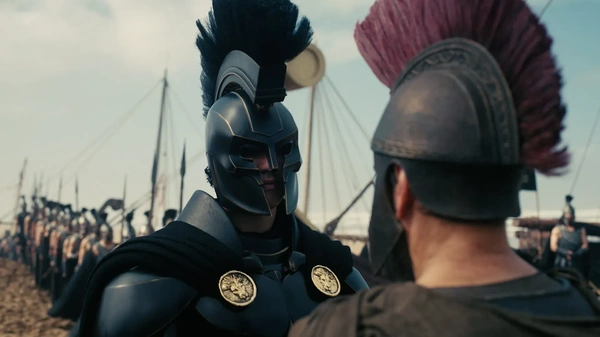
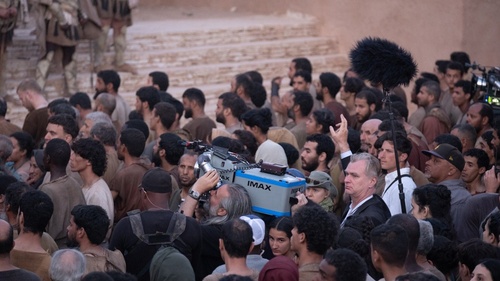
The production has spanned numerous countries and used IMAX cameras for the entire film. This is a choice consistent with Nolan's cinema, always interested in making even the most abstract stories tangible. In the Odyssey, this concreteness takes on a particular value: the sea becomes a physical force capable of isolating men and making every return uncertain.
The director also seems intent on immersing mythology in a recognizable physical reality. This doesn't necessarily mean eliminating gods and creatures, but rather showing how humans perceive the supernatural. In the Homeric world, after all, a storm could not be separated from Poseidon's will, just as a sudden decision could be interpreted as an intervention by Athena.
Where Does the Odyssey Come From?
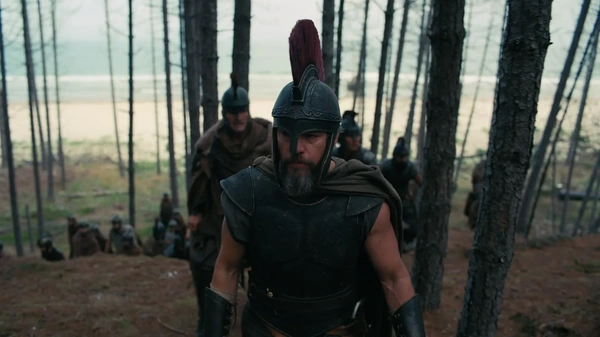
The Odyssey is one of the two great epic poems of ancient Greek literature, along with the Iliad. The form we know today probably dates back to the 8th or 7th century BC, but the stories that compose it had already been circulating for some time through oral tradition.
Before being read, the Odyssey was heard. Aedi and rhapsodes recited the deeds of heroes using recurring formulas and scenes, useful for facilitating memorization. Expressions like “Odysseus of many twists and turns” belonged to a narrative technique conceived for the voice and for an audience gathered around the singer.
The poem should not, therefore, be imagined as a novel written once and for all. It is the result of a long sedimentation. Episodes, characters, deities, places, and images can have different origins, only to be brought together in a surprisingly coherent structure.
This mobile nature makes the Odyssey particularly suitable for reinterpretations. Each adaptation selects a different face of Odysseus: the navigator, the liar, the sovereign, the veteran, or the man unable to resist the desire to know.
Who Was Homer Really?
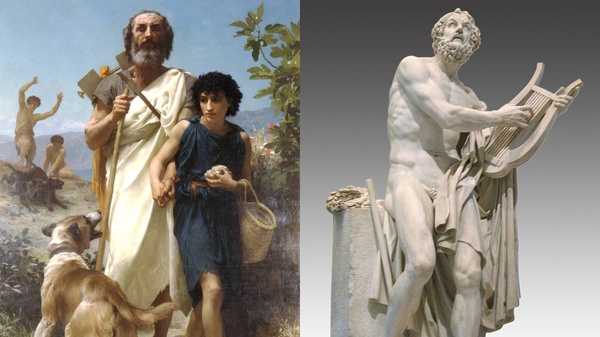
Tradition attributes the Iliad and the Odyssey to Homer, a Greek poet believed to have lived around the 8th century BC. Ancient biographies often describe him as a blind singer, but we have no reliable testimonies about his life, nor certain proof of his actual existence.
For centuries, scholars have debated the so-called Homeric question. We don't know for sure if the two poems were composed by the same person. They could be the result of the work of multiple singers, later organized and fixed in written form. Homer could have been a real poet, a name behind which various authors were hidden, a reference to a school, or the symbol of an entire tradition.
Asking who wrote the Odyssey remains important, but it doesn't lead to a definitive answer. The only certainty is that the text preserves many voices and many eras. Its strength also stems from this collective origin: it belongs not only to one author, but to the generations who narrated it before it became a book.
Curiosity: according to the most accredited etymology by scholars, the term "Homer" derives from the Greek word homeros. Another interpretation, linked to the legend that the famous author was blind, derives the name from the expression ho mè horôn, which means "he who does not see" (not seeing).
Is the Odyssey a True Story?
Odysseus is not a documented historical figure. There is no evidence of the existence of Penelope, Telemachus, Circe, or Polyphemus. The deities who intervene in the journey belong, naturally, to Greek religion and mythology.
The poem, however, does not arise in a vacuum. The city of Troy has been identified with the archaeological site of Hisarlik, in present-day Turkey, where several settlements and destructions have occurred. This does not prove that the war happened exactly as it is told in the poems, nor does it confirm the existence of their protagonists. It does suggest, however, that tradition may have preserved a distant memory of conflicts that actually took place.
Even the material world of the Odyssey mixes elements belonging to different periods. The poem may retain traces of Mycenaean civilization, but it also reflects the society known by the bards in subsequent centuries. Therefore, seeking a perfectly coherent historical reconstruction would be misleading.
The Odyssey is true in another sense. It recognizes that returning from a war does not automatically mean finding what one left behind. The veteran carries with him violence, grief, disorientation, fears, uncertainties, and a different perspective on life. The home, meanwhile, has learned to exist without him.
What Does the Odyssey Poem Really Tell Us?
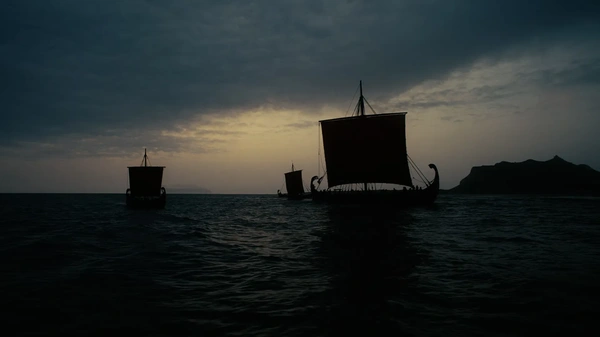
Odysseus's journey begins after the fall of Troy. The hero takes ten years to reach Ithaca, after spending as many in war. On his way, he encounters the Lotus-Eaters, the cyclops Polyphemus, the sorceress Circe, the Sirens, Scylla, and Charybdis. He also descends into the realm of the dead and remains for a long time on the island of the nymph Calypso.
However, reducing the poem to this succession of adventures means neglecting an essential part of it. While Odysseus is away, the Suitors occupy the palace of Ithaca and demand that Penelope choose a new husband. Telemachus, now an adult, sets out in search of news about his father.
The poem thus follows two journeys. Odysseus tries to reclaim his lost home, while Telemachus must build his own identity in his father's absence. Penelope, meanwhile, resists through intelligence and control of time, weaving by day and unweaving by night the shroud that should precede her new marriage.
When Odysseus finally reaches Ithaca, the journey is not yet over. He returns disguised as a beggar and must discover who has remained loyal to him. The true arrival does not coincide with the landing, but with recognition. To regain his own name, the hero must first renounce it.
What is the Relationship Between the Iliad and the Odyssey?
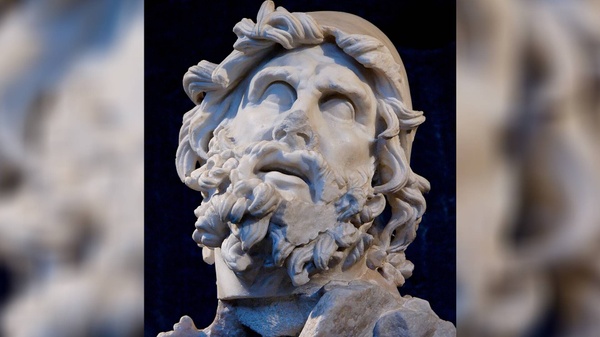
The Iliad narratively precedes the Odyssey, but it does not tell the entire Trojan War. It focuses on a few weeks of the tenth year of the conflict and centers on the wrath of Achilles, provoked by his clash with Agamemnon. Odysseus is also present, but acts primarily as an advisor and strategist.
The difference between the two poems emerges already from their respective protagonists. Achilles knows he can choose a short life accompanied by eternal glory. Odysseus, on the other hand, desires to survive and return. The first embodies the tragic greatness of the warrior; the second must rely on cunning and words.
The Iliad tells of man trapped in war. The Odyssey observes what happens when that war is formally over, but continues to live within those who fought it.
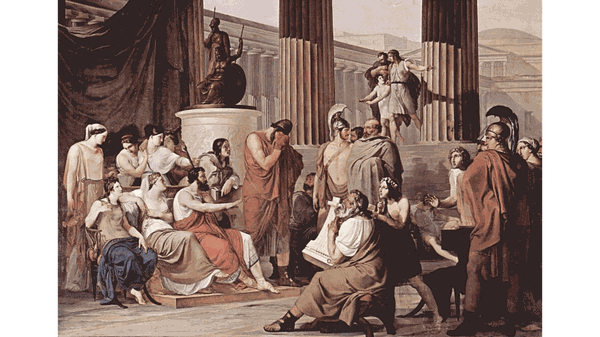
Even the famous Trojan Horse requires clarification. The episode is not narrated in the Iliad. It is briefly recalled in the Odyssey, when the bard Demodocus recounts the fall of the city before Odysseus. The hero listens to his own deed as if it had already become legend and reacts by weeping. It is one of the moments when the poem makes evident the distance between the public glory of war and the private pain of those who took part in it.
Between Myth, Legend, and Human Responsibility
The gods continuously influence Odysseus's fate. Athena protects him, while Poseidon hinders his return after the blinding of Polyphemus. Humans, however, are not mere pawns.
Odysseus saves himself thanks to his own intelligence, but often prolongs his suffering out of pride. After escaping Polyphemus's cave, he reveals his true name to the cyclops, allowing him to invoke the vengeance of his father Poseidon. His companions, in turn, repeatedly ignore prohibitions and end up causing their own deaths.
The poem thus maintains a tension that can appear surprisingly modern. Fate weighs on men, but does not absolve them. The gods open or close possibilities; it is human choices that transform them into salvation or ruin.
Where Was the Odyssey Film Shot and Why Those Locations?
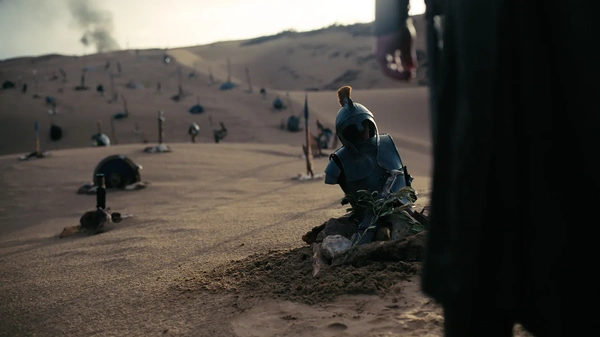
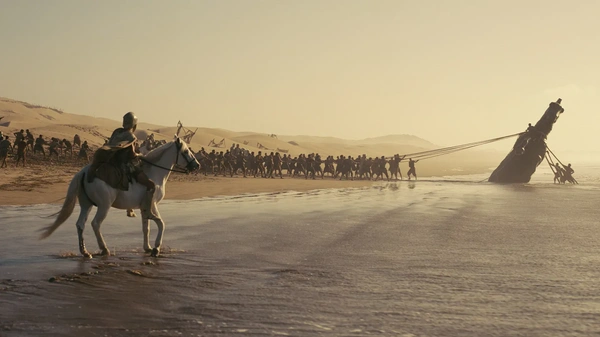
The filming touched Greece, Italy, Morocco, Iceland, Scotland, Malta, Western Sahara, and the United States. In Greece, production worked in the Peloponnese, including the area of Pylos and Nestor's Cave. In Sicily, it reached Favignana and several islands of the Aeolian archipelago. Other landscapes were used to represent Troy, Hades, and the numerous lands crossed during the journey.
The geography of the Odyssey has always been uncertain. Some places, like Ithaca and Troy, have a recognizable reference. Other stages, however, belong to a poetic space impossible to reconstruct with precision.
Over the centuries, Scylla and Charybdis have been associated with the Strait of Messina, the land of the Cyclops with eastern Sicily, and the island of Aeolus with the Aeolian Islands. These are suggestive identifications, not definitive coordinates. The poem offered its listeners a Mediterranean where what was known could suddenly open up to the marvelous.
By moving between real and different coasts, Nolan can convey precisely this sensation: the familiarity of the sea and, at the same time, the fear of what might lie beyond the horizon.
Other Odyssey Adaptations to Know
Cinema and television have often reinterpreted the myth according to the sensibilities of their time. Mario Camerini's Ulysses, released in 1954 starring Kirk Douglas, transformed the poem into a grand adventure spectacle, focusing on the hero's physical charisma.
The 1968 television miniseries Odyssey, directed by Franco Rossi and starring Bekim Fehmiu and Irene Papas, adopted a more relaxed pace. The serial format allowed for better preservation of the episodic structure and ritual dimension of the story.
The Coen brothers' O Brother, Where Art Thou? freely transplanted the Homeric model to Depression-era America. It didn't reconstruct the poem, but demonstrated how its structure could survive far from ancient Greece.
Uberto Pasolini's Still Life (original title: Itaca. Il ritorno), starring Ralph Fiennes and Juliette Binoche, chose instead to focus on the concluding part of the story. At its center is not the allure of fantastic creatures, but the encounter between a man scarred by war and a family that cannot welcome him as if time had not passed.
These are different interpretations because the Odyssey contains many stories. It can be read as an adventure, a family tale, a reflection on power, or a study of trauma.
Why the Odyssey Continues to Speak to Us
Odysseus/Ulysses is not a pure hero. He lies, manipulates, betrays, and resorts to violence. He is capable of resisting, but also of endangering others out of pride. This very ambiguity makes him closer to the modern protagonist than it might seem.
He wants to return to the place where everything began, but the return proves more difficult than the departure, because it requires accepting the passage of time and confronting what one has become.
This is probably the point to remember when watching Nolan's film. The Odyssey is a story about the impossibility of truly going back. Ithaca remains the destination, but the man who lands there is no longer the one who left.
Similar articles