Hearthstone Escape from the Violet Citadel: Blizzard Tries to Break the Meta Rules
Foresight, Bribes, Disguises, and Rulebreakers change the weight of mana, hand, and board. The expansion seems ambitious, but balancing will need to avoid an overly polarized meta.



Hearthstone is a game that truly changes only when a new expansion manages to alter the way decks are built and games are read. It's not enough to add strong cards: it's necessary to introduce tools capable of questioning established habits, from mana management to board presence, up to the relationship between drawing, risk, and tempo advantage.
Escape from the Violet Citadel, expected on July 7, 2026, seems to be moving in precisely this direction. The expansion introduces the new ability Foresight, Bribe cards, Disguised minions, and Rulebreakers, which are legendaries designed to circumvent some traditional rules of the game. We are not just looking at a set built to add new options to classes, but an expansion that tries to change the weight of decisions turn after turn.
The most interesting point is also the riskiest. Many cards don't just work on immediate strength, but on the possibility of preparing a future play, manipulating the opponent's space, or transforming a disadvantage into a resource. The result, at least from what emerged in the pre-launch material, is a set full of promising ideas, with some classes already candidates to start very strong and others more dependent on a favorable meta.
The main risk is clear: when an expansion tries to bend so many rules together, it takes little to turn audacity into imbalance.
Foresight Changes the Value of Unspent Mana
The most important mechanic in Escape from the Violet Citadel is Foresight, because it intervenes on one of Hearthstone's simplest principles: using mana well each turn. Normally, leaving crystals unused is almost always a negative sign. It means not having the right play, not being able to respond efficiently, or being forced to pass a weaker turn than expected.
Foresight changes this interpretation. A card with this ability can consume remaining mana to reduce its cost later. In practice, a less explosive turn can become an investment. It's not a complicated change to understand, but it can have profound consequences, because it shifts part of the game from the present to the medium term.
The player no longer has to ask only what the best card to play immediately is, but how much value they can get by giving up something now. Is it better to develop the board or prepare a bigger threat? Is it better to respond to the opponent or accumulate a discount for the next turn? Is it better to show your plan immediately or keep it hidden?
If Foresight remains a planning tool, it could make the meta deeper. If, on the other hand, it allows too much power to be compressed into a single turn, the risk will be to create games decided by sudden swings that are difficult to counter.
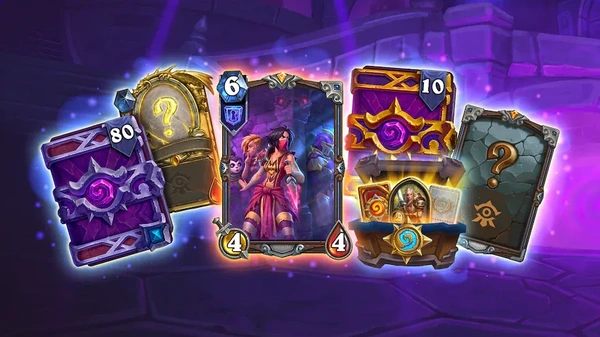
Bribes and Disguises Clutter the Board
Escape from the Violet Citadel doesn't just work on mana. Bribe cards introduce a logic of compromise: they offer a significant advantage to those who play them, but also grant a small reward to the opponent. It's a more delicate mechanic than it seems, because the value of the card doesn't just depend on its effect, but on the moment it's used.
Against an aggressive deck, giving away a resource can become dangerous. Against a slower deck, however, it can be an acceptable price if it allows you to accelerate your plan. Bribes therefore force a better reading of the match-up, i.e., the relationship between our deck and the opponent's.
Disguised minions, on the other hand, touch another fundamental element: board space. In Hearthstone, the board is not infinite, and occupying a slot can already be a form of pressure. Playing a minion on the opponent's side means disrupting summons, sequences, area removals, and space management. It's not just a curious gimmick: it's a way to turn the enemy field into a resource to manipulate.
Together, Foresight, Bribes, and Disguises well illustrate the expansion's philosophy. Escape from the Violet Citadel doesn't just want to reward those who play more cards, but those who can best bend the rules of the game.
Rulebreakers Are the Heart of the Expansion
Rulebreakers are the legendaries that best represent the set's identity. Their task is not simply to be strong, but to circumvent a basic Hearthstone rule: drawing more than normal, duplicating legendary cards, altering deck construction, or transforming a disadvantage into a resource.
It's a sensible direction, because the best legendaries are not always those with the highest numbers. Often they are those that force you to build a deck differently. From this point of view, Escape from the Violet Citadel seems to have a clear goal: to give each class at least one card capable of changing the way it is thought about.
The problem will be to understand how many of these ideas will truly remain competitive. Some already seem very concrete, others depend on more fragile combinations. This is normal in an expansion built around such particular cards: not all broken rules automatically produce a strong archetype.
The Most Ready Classes: Hunter, Paladin, Warrior, and Rogue
Among the classes that seem to have received the most solid tools is certainly the Hunter. The class does not start from a weak situation, and Escape from the Violet Citadel seems to give it even more consistency in terms of drawing, pressure, and flexibility.
Underground Web is a card to watch carefully, because it offers the Hunter a very significant amount of resources. In an aggressive or midrange deck, drawing without losing too much tempo is often what separates a good start from a truly difficult game for the opponent to recover. Added to this is Arcane Explosive Thread, which can function as both removal and potential damage.
The most striking piece, however, remains King of the Underground. The ability to choose Smuggled Beasts from other classes during deck construction is exactly the kind of effect a Rulebreaker should have: it doesn't just increase numbers, but changes the perimeter of deckbuilding. The Hunter can access threats that normally don't belong to them, and this flexibility will become more relevant with each new Beast available in the format.
The Paladin seems to be one of the most explosive classes in the expansion. Commander Beatrix is the center of the discussion, because she works on the generation and exploitation of low-cost minions. In Hearthstone, cards that combine value and cost reduction should always be watched carefully: they often don't win with a single play, but with the quantity of resources they produce without losing tempo.
Cards like Scarlet Recruiter, Holy Bolas!, Judgment, and Scarlet Brute suggest a Paladin with more possible paths. It doesn't seem like a class forced into a single archetype: it can work on pressure, value, specific synergies, and purer builds. This elasticity is important, because it makes it harder to prepare universal answers.
The Warrior, on the other hand, seems to focus on a more direct but no less dangerous plan. Hooktooth is a card to monitor: a minion with Charge that can be summoned from hand or deck when multiple allied characters take damage in the same turn. By itself it's not necessarily unmanageable, but the situation changes when it synergizes with Chainbreaker Widejaw, which adds an extra copy of legendary cards to the deck.
The combination can turn Hooktooth into a source of repeated pressure, also capable of thinning the deck and increasing the probability of drawing decisive cards. If the Warrior manages to activate it early and consistently, it could become much more aggressive than expected from the class.
The Rogue receives tools consistent with its historical identity: small accelerations, coin management, turns full of actions, and sudden finishers. Lotus Bookie is probably the most linear and at the same time most important card in the package. In Rogue, a Coin is not just a temporary mana crystal: it's fuel for drawing, activating combos, and compressing multiple plays into the same turn.
Murloc Holmes Inspector, on the other hand, adds a layer of opponent reading. If the investigated card is played on the next turn, the Rogue gets three Coins. The value is not just in the reward, but in the pressure it creates: the opponent can play the predicted card and give away resources, or avoid it and alter their curve.
Slice and Dice is the most spectacular piece. Replaying cards used in the turn against enemy targets, when possible, can become a win condition, especially if the deck is built around direct damage, Coins, and long sequences. The Rogue doesn't necessarily seem like the class with the most complete package, but it has some of the cards best suited to generating unpredictable games.
The Most Experimental Classes: Mage, Shaman, Druid, Demon Hunter, and Warlock
The Mage has two interesting cards: Universal Key and Smuggled Wands. The first allows you to discover spells and update options, accepting the risk of taking damage. In a class that thrives on the quality of spells, it can become a stable presence. The second, on the other hand, works on a more aggressive plan: accumulating spells, damage, and possible activations for cards that reward repeated spell casting.
The Shaman finds in Buddy one of the most flexible cards in the set. The weapon allows you to choose different elemental ammunition after attacking: freeze, deal area damage, summon pressure, or generate value through Battlecry minions. The important detail is that the same ammunition can be used multiple times, as long as it's not consecutively. This makes the card less random than it seems, because it allows you to alternate modes based on the situation.
The Druid seems divided between efficient cards and more experimental ideas. Staff of Cunning is one of the most interesting cards, because it allows you to discover Druid cards, reducing their cost based on the hero's Attack. It's a direction consistent with decks that want to turn the hero itself into an offensive resource. Chef Neth'rek, on the other hand, is harder to promote without reservations: reaching ten mana after five turns is strong on paper, but building the deck only with cards costing three or less might be too high a price.
The Demon Hunter works on a riskier plan. Irida Sinseeker sends the deck into the Void and allows you to get two cards from the Void at the start of subsequent turns. It's an extreme card, designed for aggressive or very focused strategies, where the deck doesn't want to reach a long, controlled game, but finish before fatigue becomes a real problem. The package related to Soul of the Void can add consistency, but the final value will depend on the quality of the Demons generated and the speed of the format.
The Warlock perhaps has the most elegant idea conceptually. Godfrey the Traitor changes the meaning of overdraw, i.e., cards burned when the hand is full. Normally losing cards this way is a heavy mistake; with Godfrey, those cards can return to hand when there's space and cost one less mana. It's a Rulebreaker in the full sense, because it transforms a penalty into a resource.
The synergy with Hidden Atlas can become very powerful, especially if the deck manages to draw a lot without losing control of the game. The doubt is whether Standard will offer enough tools to turn this idea into a stable deck. In Wild, the potential seems riskier, because the format has many more resources and combos available.
Death Knight and Priest Seem Less Defined
Not all classes emerge from the preview with the same clarity. The Death Knight has solid tools, but doesn't yet seem to have a new and immediately dominant archetype. Corpse Cannon appears as a reliable card for Unholy lists, because it generates pressure through minions with Charge and integrates well with cards that exploit the presence of minions on the field. It's a good card, perhaps even very good, but it alone doesn't give the impression of creating a new meta center.
Living Plague is more particular: instead of dealing immediate damage to the hero, it shuffles cards into the opponent's deck that deal damage when drawn. It's a logic similar to that of old bomb-based decks, so it depends heavily on the opponent's ability to draw those cards at the right time. Interesting, but less reliable than direct damage.
The Priest seems to have a more concrete card in Seer, especially thanks to the combination of Foresight, Taunt, healing, and Deathrattle. It's a card that can stabilize the game and generate value, so it has a clear role. Azalina Soulrender is much more fascinating, because it works on the value of opponent's cards and can produce unpredictable situations. Precisely for this reason, however, it's harder to evaluate: when it works it seems brilliant, when it doesn't find the right context it risks doing too little.
A Rich Expansion, But Difficult to Balance
Escape from the Violet Citadel has an obvious merit: it seems like an expansion full of cards that make you want to build decks. This is not a given. Some sets add power, but not imagination. Here, however, many cards suggest new playstyles: the Hunter who imports Beasts, the Warlock who uses overdraw as an advantage, the Rogue who turns Coins into threats, the Warrior who summons Charge from the deck, the Druid who experiments with curve restrictions, the Demon Hunter who plays with the Void.
The problem is that not all these ideas start from the same level of solidity. Hunter, Paladin, Rogue, and Warrior seem to have more immediate tools. Warlock, Demon Hunter, and Druid have more extreme ideas, perhaps less simple to stabilize. Death Knight and Priest, on the other hand, seem more dependent on how the format settles.
The risk is therefore an initial highly polarized meta, where a few efficient packages compress the space for stranger ideas. This is a typical risk of ambitious expansions: the most creative cards need time to be understood, while the numerically strongest ones win immediately.
The quality of Escape from the Violet Citadel will be measured precisely here. It won't be enough to have intelligent mechanics. Those mechanics will need to coexist without turning the ladder into a race between two or three archetypes that are too superior to the others.

Hearthstone Escape from the Violet Citadel: Blizzard Tries to Break the Meta Rules
Escape from the Violet Citadel seems like one of the most interesting Hearthstone expansions in recent years, not because every card is destined to be competitive, but because many cards try to change the way a game is thought about. Foresight changes the value of unused mana. Bribes introduce a compromise between personal advantage and resources granted to the opponent. Disguised minions clutter the board and make enemy space less safe. Rulebreakers, when they work, are not just strong legendaries: they change the rules of deck construction and management.
Similar articles