The Last Case of John Morley: An Elegant, Slow-Paced, and Imperfect Investigative Noir - The Review
An investigative walking simulator that focuses on atmosphere, environmental reconstruction, and visual coherence, but struggles to create a true emotional connection with its protagonist.


The Last Case of John Morley is a first-person investigative walking simulator that focuses entirely on a slow pace, observation, and atmosphere. It doesn't aim for mechanical complexity or action sequences, but builds an experience where every visual detail becomes part of the story and every room functions like a page from an open criminal diary. Gameplay is reduced to the essential, supported by very simple puzzles, and uses this simplicity to guide the player's gaze rather than their hands, transforming the investigation into a form of environmental investigation.
To understand its proposal, it's useful to think of the titles that defined this narrative approach. Like Everybody's Gone to the Rapture or What Remains of Edith Finch, Morley also builds a linear and contemplative path, but shifts the focus to a more classic investigation, made of clues and reconstructions. The atmosphere partly recalls The Vanishing of Ethan Carter, especially in the attention to spaces and their ability to communicate, but it does so with a more guided and accessible approach, designed for those seeking a story-driven experience rather than a complex logical challenge.
The result is a work that doesn't aim for immediate impact, but rather for the ability to slowly build a sense of quiet unease. Those who appreciate games that advance by subtraction will find here a narrative that breathes with its environments and invites gradual involvement, made of small details that add up over time.
Who killed poor Elody? John Morley can solve the case
The narrative of The Last Case of John Morley opens with a prologue that immediately clarifies the work's orientation: it's not a frantic thriller, but an investigation that starts from the protagonist's body and mind. Waking up in the hospital introduces a detective marked by events, still trapped between recurring nightmares and fragments of a professional past that gives him no peace. It's a sequence that doesn't claim centrality, but creates the right emotional predisposition before entering the main case.
The story takes shape when Lady Margaret asks to reopen a twenty-year-old murder, a cold case seemingly closed but full of omissions where it's unclear whether poor Elody's killer was caught or not. It is here that the plot establishes its priorities: a mystery that doesn't aim for a spectacular twist, but for a slow build-up of tension, where the threat is not violence, but what has been left unsaid. The narrative logic is almost surgical: everything proceeds calmly, but every detail seems to whisper that the truth has been compressed to the point of distortion.
Morley's arrival at Bloomsbury Manor represents the conceptual heart of the game. The rooms are not just environments, but chapters of a fragmented testimony: the half-finished tea, an overturned chair, lipstick on the rim of a cup, an abandoned note. The game entrusts much of the narration to the context, asking the player to act more like a reader of traces than an active protagonist. There is no redundant exposition: it is the objects, the silences, and the absences that tell the truth.
As Morley progresses, the player finds themselves doubting with him. Every memory, every detail, every testimony is a possible version of events, and the game deliberately insists on the truth distorted by time. Justice is represented as a fragile, permeable process, sometimes incapable of grasping what is in plain sight.
The concept also finds coherence in the work's contained duration: The Last Case of John Morley can be completed in about four hours, a choice that avoids dispersion and keeps the narrative taut and compact. This short format reinforces the authors' intention to build a noir that can be experienced in one sitting, without superfluous pauses.
The plot twist is good, but in our opinion, it's not enough...
The gameplay of The Last Case of John Morley follows a rigidly linear structure, with areas opening only after every clue has been found, an approach that guides the player in a very controlled manner. Interaction is reduced to analyzing objects highlighted by a green glow, which activate first-person reconstructions useful for understanding what happened in that room. It's an elegant solution, more cinematic than interactive, designed to maintain narrative cohesion, but which provides a primarily observational involvement.
The puzzles, based on codes and combinations derived from documents or environmental details, never present a challenging task. Their function is not to create obstacles, but to pace the investigation without interrupting the narrative. Everything proceeds clearly and linearly, without backtracking or moments of stagnation, but also without those peaks of surprise that could give the experience more bite.
An important aspect, and one I express consciously as my personal opinion, is the lack of empathy for Morley. The protagonist analyzes, observes, and deduces with impeccable professionalism, but rarely reveals an emotion capable of truly drawing the player into his story. The result is a more cerebral than emotional connection, consistent with the noir setting, but less effective in creating deep involvement.
The choice of a minimal HUD favors immersion, although the absence of a clear visual hierarchy means that some useless objects resemble significant ones, creating brief moments of disorientation. The same applies to attempts to infuse an "horror" vein: the game suggests shadows, unease, and distant noises, but without a real threat or increasing tension. The effect, in the end, remains unincisive, almost an echo that finds no counterpart in the gameplay.
From a directorial perspective, the choice of a first-person view and scripted shots at key moments builds a sober staging, completely devoid of intrusive cinematics. The aesthetic, dominated by a cold palette and environments reminiscent of the 1940s, effectively supports the melancholic tone of the investigation, contributing to a coherent atmosphere even within its limitations.
Overall, Morley offers an accessible and compact investigative experience, designed for those who appreciate narrative walking simulators and want to follow a story without obstacles or mechanical complexities. It is not suitable for those seeking freedom of action, strong tension, or a more pronounced emotional component. It has valid ideas, some refined solutions, and a recognizable aesthetic, but the execution remains controlled, almost restrained, just like its protagonist.
An ambitious, elegant but not always incisive noir
On a technical level, The Last Case of John Morley perfectly reflects the identity of an independent project: carefully crafted in atmosphere, attentive to visual coherence, but marked by evident production limitations. The graphics alternate suggestive glimpses with less refined textures, with environments that, while effectively evoking the 1940s, show a cold palette and soft lighting that favor the melancholic tone more than tension. The technical optimization is good: short loading times, constant fluidity, and no stability issues, although the quality of the assets is not always uniform, especially in more complex interiors.
This visual unevenness does not compromise usability, but creates a clear contrast between the more refined sections and the more essential ones. And it is precisely from this aesthetic alternation that a broader consideration emerges: the staging, though elegant, limits the game's ability to sustain suspense. The spaces are static, animations are minimal, and horror suggestions fail to evolve into real tensions, remaining simple atmospheric hints. These scenic limitations, combined with the deliberately minimal direction, have a direct impact on narrative perception, attenuating the sense of perceptual uncertainty that the work aims to evoke.
From an authorial perspective, however, the direction is clear and deserves attention. The developers choose a sober, introspective, and coherent staging, without intrusive cinematics, with a first-person view that invites the player to walk through the rooms with Morley's same analytical gaze. The noir identity is built through small details — objects, furnishings, color choices — that convey a story that is more emotional than spectacular. However, and here I express my personal opinion, I would have wanted more suspense, more plot twists, and above all greater emotional engagement, because Morley experiences an investigation where he can no longer distinguish between memory and perception, but the game doesn't always manage to make the player feel this ambiguity.
The sound compartment, on the other hand, represents one of the most successful aspects. The voice acting deserves particular praise: the voices are credible, measured, and never over the top, capable of conveying more emotion than the visual staging. This balance between tone and interpretation supports much of the experience, making an otherwise very static investigation more lively. The ambient audio also plays its role discreetly, contributing to a narrative experience on PC/console that, while lacking spectacular peaks, always remains consistent with the authors' intentions.
Ultimately, the technical and authorial aspect of The Last Case of John Morley shows a work that knows what it wants to be: an independent, contemplative noir, elegant in its limitations, more interested in storytelling and atmosphere than in tension or visual complexity. It works when you let yourself be carried away by the tone and voice acting, less so when it tries to evoke unease or perceptual ambiguity. It is a title that lives by its identity, even when it doesn't fully manage to make it breathe.
Score
Editorial team
The Last Case of John Morley: An Elegant, Slow-Paced, and Imperfect Investigative Noir - The Review
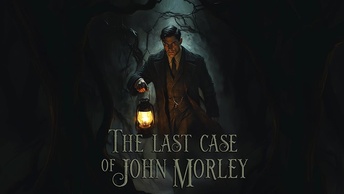
The Last Case of John Morley is an independent noir that focuses entirely on atmosphere, linearity, and environmental reconstruction. The experience is short, guided, and visually coherent, with surprisingly effective voice acting. However, the lack of suspense, the absence of real plot twists, and limited empathy for Morley reduce the emotional impact of the investigation. It's a title recommended for those who enjoy narrative walking simulators, less so for those seeking tension or freedom.
Similar articles