People of Note Review: An RPG to the Rhythm of Music
A turn-based JRPG that excels with an infallible ingredient: music!



There was a time when, at least in our beautiful country, the JRPG genre was not viewed so favorably, and some even didn't consider it a "video game" in the strict sense of the term. Perhaps it was difficult to assimilate at the time: the pace was dictated by battle turns, a formula so strategic that it completely diverged from pure action. However, thanks also to titles like Clair Obscure: Expedition 33, the turn-based RPG has returned to be discovered in all its facets, and, probably, People of Note could also ride this wave of enthusiasm.
Indeed, the video game by Iridium Studios, under the watchful eye of Annapurna, is a true declaration of love that tries to blend music in a more dynamic way: not just as an accompaniment to the events, but making it a focal point of the entire experience. As we will see, the rhythm game merges with battles, allowing us to follow a certain rhythm to hit even harder with our heroes.
Before diving into the world of People of Note, we want to emphasize one point: this particular experiment revolves entirely around music, but due to different rhythms, we believe it's almost impossible to make the fast tempos of various musical genres travel at the more "relaxed" pace of battles. In other words: we believe the developers' goal was not to create a musical combat system, but rather a pleasant harmony where the central theme always remains the role-playing game. And on this, the title is absolutely enjoyable.
People of Note's Ascent to Success
For many of us, music is part of everyday life: sweet melodies that accompany the various moments of the day. Now imagine finding yourself in a world where everything is music, where this art is even found in buildings and where animals have the features of instruments: have you ever petted a accordion-shaped dog? This is People of Note, a video game where we will experience the events of Cadence, an aspiring singer with a stubborn streak (in a good way) who wholeheartedly desires to achieve success in the music world.
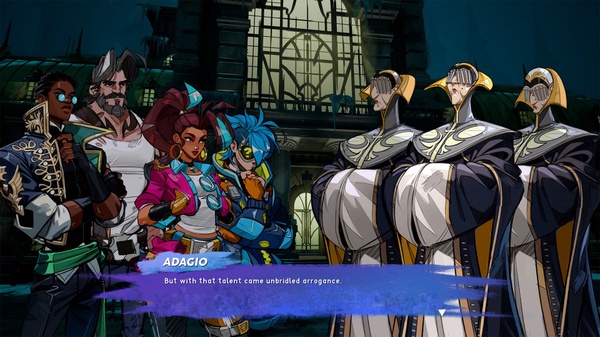
Fortunately, the Noteworthy Song Contest is approaching, and a victory could guarantee her a lucrative record deal. Unfortunately, to reach the top, she will need a band that allows her to mix multiple genres and create something unique and never seen before. To do this, she will have to leave her city and embark on a journey to recruit rather eclectic musicians, while (much to her chagrin) investigating some dark forces that are planning (when aren't they?) to throw the natural harmonies of the world of Note into chaos. Cadence is therefore that heroine destined to, with the power of her music (and a lot of technique), accomplish unexpected feats, or at least that's what the game's opening suggests.
The aspect that makes the journey more interesting is given by our pop star's "unfamiliarity" with other musical genres: in fact, each area will be marked by a different one, resulting in a discovery, and will allow her to add a new piece to her growing art. In itself, People of Note is an old-school RPG where you move through different scenarios with generally isometric views that, in some ways, follows the pattern used in Final Fantasy VIII (after all, we're talking about a JRPG).

The visual impact is almost unique, with brilliant scenarios and textures so sharp they look hand-painted. The graphic style is perhaps one of the major strengths of this production, in addition to having a convincing soundtrack that ranges from K-Pop to mainstream Rock. However, let's not forget the combat system, which incorporates the core principles of the genre, adding a few more scores that change something in the melody as a whole.
Taking Down Villains with the Power of Music
As a good JRPG should, People of Note features a combat system that is overall functional and characterized, needless to say, by timing. As you know, a turn-based RPG bases its foundations on strategy, on choosing the best attack option and understanding when it's the right time to step back and defend. Each turn will be marked by a verse that will also give us details on the number of actions our team can perform and those of the villains (who will attack much more than us).
Combat is nothing more than a musical performance where we will have to follow a certain rhythm: in short, when we perform an attack, we will be called to overlap two circles to achieve a perfect hit, somewhat like rhythm games. This means that maintaining the rhythm will allow us to inflict maximum damage from the ability and be more effective in more challenging fights. Thinking about rhythm, one might spontaneously ask: do you have to be a musical ace and have rhythm in your blood to be good at People of Note? Well, not exactly. On one hand, having an ear for music will give us an advantage, that's clear, but we can also do well if we follow the indicators with our eyes.
As anticipated, we believe that the developers' goal was not to create a musical game based on an RPG, but rather an RPG set in a musical world that appeals more to fans of the genre. And, after all, we think it was an excellent way to deliver a good video game to those who love both old-school RPGs and music in its smallest facets.
In addition to remaining energy, we will always have to keep an eye on the BP indicator to perform perfect solos (special abilities in battle) after equipping the appropriate melodic gem. Cadence and the other band members can perform special attack techniques (and here you have to pay attention to the musical rhythm) or gain different strategic advantages such as increased defense or boosted attacks. This aspect works somewhat like FFVII's "materia," which we can also power up for more disruptive effects.
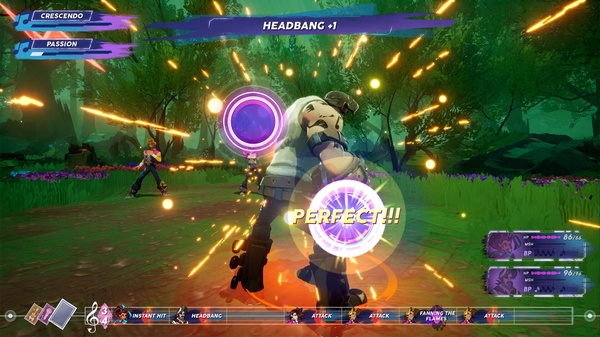
Thinking of defeating opponents by simply attacking didn't seem like a wise move: in fact, it would be good and right to rest and recharge musical notes (BP points) to have more grit and deal incredible damage to other aspiring artists, or to hybrids of animals and musical instruments. As you may have guessed, People of Note also focuses entirely on strategy, with increasingly difficult battles and inspired boss fights, not to mention that the most powerful opponents can exploit the power of crescendo. The latter will increase its strength over time: as each section of the crescendo bar fills, the enemy will become lethal and use devastating attacks. The best strategy would be to get rid of the villain before the situation gets out of hand, and needless to say, at the highest difficulty level, they will shatter our "riffs" in no time.
Unlike other turn-based RPGs, People of Note does not feature healing items. After each battle, residual energy will return to maximum, and we won't have to worry about "recharging" it in any way. This aspect seems quite original, effectively eliminating a unique characteristic of RPGs, but it makes progression faster and without worries about our allies' health. The rest remains faithful to the genre: in the game world, we can find various shops to buy new musical instruments and accessories to improve the character's basic stats.
A World to Explore Like a Classic RPG
After understanding People of Note's combat system, which proves to be quite robust (although sometimes not so immediate in the use of various abilities), let's move on to the second part of the experience, namely the puzzles. Throughout the various events, Cadence will have to deal with some environmental puzzles to continue her noble mission, interacting with levers, lasers, or platforms to create a path. We greatly appreciated this feature, and it blends well with the game world and the various dungeons: but if puzzles are not your strong suit, the game will allow you to disable them and thus avoid them.
The puzzle battles that can be found everywhere are also interesting: in practice, you take part in a simulated battle with predefined abilities and must meet certain requirements. In addition to earning many additional experience points, these fights also serve as an excellent tutorial for experimenting with functionalities and new features. Another aspect we appreciated about People of Note is the management of encounters, which do not happen randomly. At any time, you can "unleash the rhythm" and summon enemies to defeat. This feature is functional because it doesn't distract the player, perhaps busy solving a puzzle, while also giving them the option to decide how to proceed with progression.
People of Note is, all in all, a convincing JRPG that works quite well. Obviously, the production's limitations are visible, as it doesn't stand out for greater depth: the game goes in a single direction and doesn't allow for a 360-degree exploration of the game world. And perhaps that's fine, given that it doesn't stray too much and delivers a complete experience to the player that doesn't delay the credits more than necessary.
Score
Editorial team

People of Note Review: An RPG to the Rhythm of Music
People of Note presents itself to the public in a genre that, lately, has been receiving a lot of praise. The work published by Annapurna is truly ingenious: a musical RPG that indeed centers music in every aspect, from rap to country to pop, but doesn't forget the combat system, which appears more robust than expected. Of course, there are limitations in this production, mainly due to the lack of collateral activities that would expand the brilliant world of Note, not to mention a reduced variety of adversaries in the various zones.
For everything else, the time spent with Cadence and her friends was pleasant, with a cast of iconic characters and a well-told story in its simplicity. If you love turn-based RPGs, then People of Note could be a title to seriously consider, also at a decidedly interesting launch price (€23.99 on PC and consoles). Ready for your best musical performance?
Similar articles