Jotunnslayer: Hordes of Hel, a bullet heaven that turns myth into challenge - The Review
From the mists of Niflheim to the flames of Muspelheim, Jotunnslayer: Hordes of Hel transforms survival into a mythological ritual, amidst chaos, strategy, and the eternal echo of Norse legends.


The bullet heaven and action roguelike genres have undergone a surprising transformation in the last decade. Starting as an experimental niche, with the Vampire Survivors phenomenon demonstrating how simplicity and immediacy could conquer a vast audience, it now represents fertile ground for independent studios and mid-sized teams looking to innovate without betraying the fundamental rules: survive incessant hordes, power up your character, and push further and further in terms of challenge and progression. Into this crowded landscape steps Jotunnslayer: Hordes of Hel, developed by Gamesfarm and Artillery and published by Grindstone, with a clear objective: to breathe new life into the genre through the solemn and dark imagery of Norse mythology.

From the first impact, Jotunnslayer doesn't just replicate the known formula, but seeks to reinterpret it through a more realistic aesthetic and a growth system that focuses on variety. We are not facing a serial clone, but a project that intends to link the chaotic dynamics of the bullet heaven to a more structured context, where classes, abilities, and divine entities contribute to defining the customization and longevity of the experience. The idea is clear: to combine the immediate satisfaction of the first runs with the depth of a path that encourages experimentation and rewards those who choose to master the different systems.
Compared to similar products like Achilles: Survivor, which demonstrated how mythological epic can enrich an otherwise repetitive gameplay with meaning, Jotunnslayer chooses an even more ambitious approach. It not only borrows Scandinavian imagery but uses it as a backbone to build settings, enemies, and powers, giving the player the impression of being in a coherent universe, capable of sustaining dozens of hours of gameplay without losing its appeal.
With this setup, Gamesfarm and Artillery's title is poised to be not just an alternative, but a new benchmark for those seeking a bullet heaven capable of combining chaos, strategy, and mythological identity in a single, compelling experience.
Jotunnslayer tries to reinvent Norse myths in a bullet hell sauce
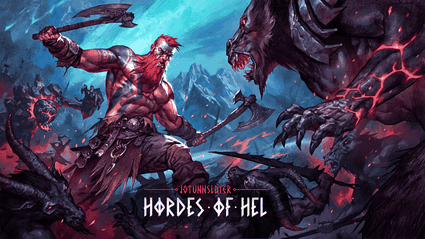
If the introduction clarifies the project's ambition, it is with the narration and the background story that Jotunnslayer: Hordes of Hel defines its identity. It is not a linear tale, with animated sequences or long dialogues, but rather a mythological framework expressed through the setting of the Norse realms and the profiles of the playable characters. Each warrior is not an anonymous avatar, but carries a curse or a malediction, and throws themselves into battle with the goal of achieving freedom or victory in a universe that grants no respite.
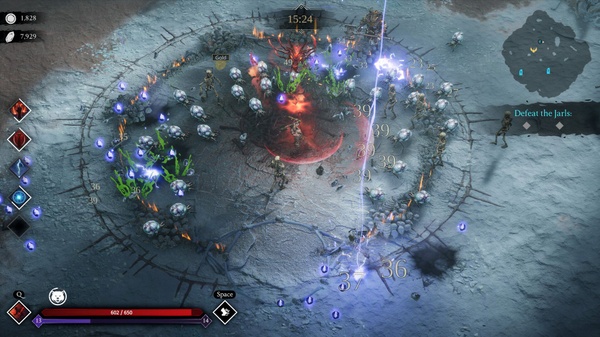
The worlds the player traverses are not mere decorative maps: Niflheim, Muspelheim, Svartalfheim, Jotunheim, and Helheim embody the very trials of the journey. Each of them reflects an archetype — eternal frost, unquenchable fire, the dark mine, the land of giants, the darkness of the afterlife — translating Norse myths into concrete gameplay challenges. This approach ensures that progression is not perceived as a succession of interchangeable levels, but as a journey that alternates landscapes, rhythms, and enemies capable of strengthening the coherence of the narrative.
The minimal plot, which leaves ample room for player interpretation, merges with the roguelike mechanics. Each run becomes part of a cycle that doesn't tell a new story, but repeats and renews the myth of the struggle: falling, being reborn, and returning to fight with new strength. In this sense, the narrative is intimately linked to the game structure, transforming repetition into ritual. It is not a story of plot twists, but a path of resistance that gains depth precisely in its continuous iteration.
As for longevity, the title demonstrates a precise vision. It doesn't just rely on the volume of content, but builds its duration on the variety of possible combinations. Each hero offers different styles, each divine ability opens up new scenarios, each realm introduces unique conditions. Added to this is the permanent progression between runs, which encourages return without eroding the sense of challenge. The result is a longevity that doesn't arise from simple grind, but from the curiosity to discover how each game can transform into a new experience.
Everyone would like to be Thor! But Jotunnslayer does something more...
The heart of Jotunnslayer: Hordes of Hel is the gameplay, and it is here that the title demonstrates the solidity to stand out in an oversaturated genre. The basic structure remains typical of bullet heaven: the character attacks automatically, and the player must focus on movement, dodging, and growth choices. It's a simple setup to learn, but it's enriched by a series of systems that add variety and depth to each run.
The main difference lies in the classes, designed to offer truly different playstyles. Personally, the Revenant was the one I enjoyed the most: its abilities allow for better field management, maintaining good control even in the most chaotic situations. I didn't perceive any unbalanced classes; in fact, each seems built to suit a certain type of player: those seeking resilience find satisfaction with the Berserker, those who prefer distance can rely on the Seer, and those who want pure aggression choose the Fire Sister. It's a balanced system that encourages trying different approaches without the feeling that there's a "best hero" among them.
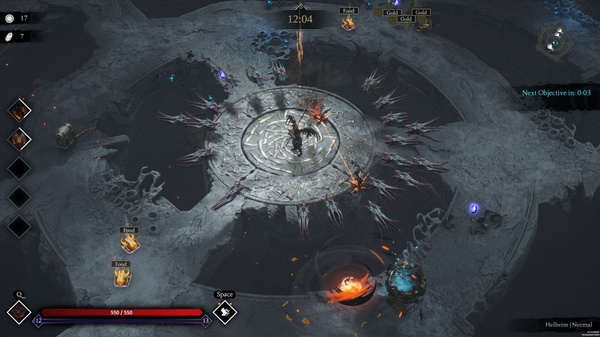
An equally successful aspect is that of the divine abilities, which integrate with those of the classes and give rise to ever-new combinations. The most effective ones, in my opinion, were those linked to Thor and Freya, especially for field control: devastating lightning and passive buffs ensure a balance between offensive power and safety. Loki or Nidhogg also offer interesting possibilities, but require more attention in development, because the trick is to match the god's abilities with those of the chosen hero. It's a system that stimulates experimentation, and when the right synergy is found, the feeling is that of having "broken the game," in the most satisfying sense of the term.
Each run allows you to accumulate gold coins, which can be spent to permanently upgrade heroes and deities. This mechanism ensures that even poorly concluded games still leave tangible progress. However, progression tends to become slow in the long run: this isn't a true flaw, as it reflects the roguelike philosophy, but it should be kept in mind by those who don't enjoy prolonged repetition.
The pace of the matches is dictated by timed objectives, which lead to boss encounters. This is a useful and interesting addition, as it forces players to vary their strategies, although over time they become a bit predictable. The boss fights deserve a separate mention: those in the more advanced levels even feature several phases, and the most rewarding one I faced was in Helheim, thanks to its zone-based division that demands a tactical approach.
Overall, the gameplay works because it doesn't limit itself to the frantic chaos typical of the genre, but rewards those who want to think about their choices. It's not perfect, and rarely gave me the feeling of a "memorable game," but the variety of combinations between classes, deities, and abilities keeps the desire to restart alive. This is where Jotunnslayer earns its place in the roguelike landscape: not for the quantity of enemies on screen, but for its ability to make each run feel different and meaningful.
The clear goal, besides fun, is to try and complete runs at different difficulties, perhaps even throwing oneself into endless massacres with the aim of unlocking dedicated achievements (like surviving sixty minutes on the same map!)
Realistic and captivating graphics, how it does it
If gameplay represents the soul of the title, graphics constitute its visual and identity framework. Unlike many competitors who choose a minimalist pixel art approach, Jotunnslayer: Hordes of Hel opts for a more realistic and detailed aesthetic, capable of conveying weight and consistency to the Norse world it aims to represent. From the first entry into a match, the realms convey a sense of thematic coherence: the suffocating frost of Niflheim, the devouring flames of Muspelheim, the dark depths of Svartalfheim, up to the inhospitable gloom of Helheim. Each scenario is not just a backdrop, but becomes an integral part of the challenge, because the chromatic density, particle effects, and choice of palettes contribute to defining rhythm and atmosphere.
The developers' work stands out especially for its attention to visual clarity in contexts of extreme chaos. In moments when the screen is crowded with dozens of enemies and effects, the design maintains readability without sacrificing spectacular impact. The choice not to push towards the exaggerated quantity of adversaries, typical of pixel art titles, is a technical compromise that pays off: the smaller number of units is compensated by the quality of the animations, the proportions of the models, and the feeling of still being overwhelmed by a hostile mass.
A further merit lies in the technical optimization. In my tests conducted with an RTX 4060 Ti and on a 2K ultrawide monitor, the game maintained constant fluidity even in the most hectic situations, without significant frame drops. This is by no means a given, considering the amount of on-screen effects and the variety of environments. In this sense, the work done by the developers ensures solid accessibility even for those who do not have top-tier machines, without sacrificing a convincing visual impact.
Score
Editorial team
Jotunnslayer: Hordes of Hel, a bullet heaven that turns myth into challenge - The Review
Jotunnslayer: Hordes of Hel manages to stand out in a genre often accused of repetitiveness, offering a convincing balance between arcade immediacy and strategic depth. The choice to anchor the gameplay to a mythological imaginary is not just aesthetic, but becomes a key to understanding and a driver of coherence: every class, every divine ability, and every realm contributes to a picture that speaks to both the casual player and those seeking a more refined experience. Of course, not all solutions are perfect, and the risk of saturation remains intrinsic to the roguelike nature, but the solidity of the system, the variety of combinations, and the overall technical quality make the title one of the most interesting proposals in the modern bullet heaven landscape.
The final result is a game that doesn't just entertain, but invites you to return, to experiment, and to measure yourself again and again against its cyclical challenge. It is in this continuous return, in this loop that mixes fall and rebirth, that Jotunnslayer's strength is recognized: an experience capable of leaving an impression not only for the chaos of battles, but for the identity it manages to build around them.
Similar articles