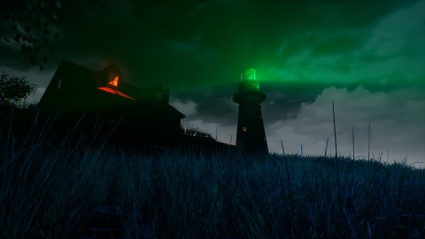
The Shore: Enhanced Edition, review of a psychological horror that wastes its valid premises
A fisherman wanders in search of his lost daughter, in this Lovecraftian horror attempting a console relaunch


The arrival on the gray, desolate, and stormy beaches of The Shore represents a new, violent journey into the most traditional and desperate cosmic horror. Originally developed in 2021 as a passion project by solo creator Ares Dragonis, the title now lands on current consoles in a re-edition that should have smoothed out the imperfections of its debut to offer the definitive Lovecraftian experience. Unfortunately, once you step into the shoes of the fisherman Andrew, desperately searching for his missing daughter on a cursed island, the overall impression is anything but positive.
While in the very first moments the coastal setting effectively manages to convey a tangible sense of oppression, fitting perfectly into the literary context of reference, the spell breaks as soon as you venture beyond the shoreline. The work quickly transforms into a disordered cauldron, a container in which the developer tried to force in as much material, creatures, and quotes from the Cthulhu Mythos as possible. This citational bulimia, however, ends up sacrificing any real coherence or logical progression.
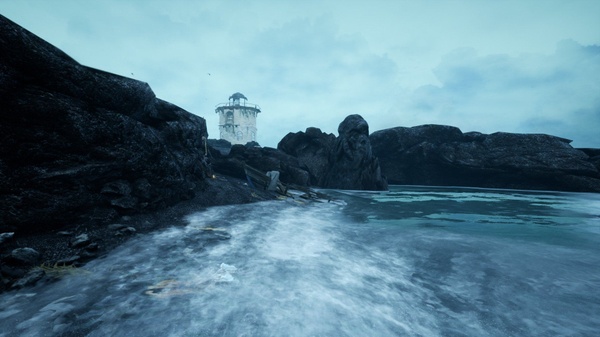
The further you go, the more you get the feeling of witnessing a chaotic parade of Lovecraftian fan service devoid of a true center, an accumulation that ultimately suffocates that genuine and creeping sense of mystery that the premises had skillfully set up. A conceptual shipwreck that, combined with a shaky gameplay structure and annoying technical uncertainties, inexorably drags the experience towards a bitter conclusion.
A Story Swallowed by the Abyss
The narrative trigger of The Shore rests on a classic, intimate, and potentially devastating premise: the desperate search for a missing daughter in circumstances never fully clarified, presumably during a fishing trip with her father. Our protagonist, Andrew, awakens on this unknown, wind-swept island, driven solely by paternal instinct and the need to piece together a fragmented picture. On paper, all the elements are there to build a thriller where the descent into madness goes hand in hand with the discovery of unspeakable horrors.
In the very first moments, the game effectively tries to build a solid environmental narrative. The discovery of desperate messages in bottles, left by those who walked those same beaches before meeting a gruesome death, helps to instill a genuine sense of terror. Unfortunately, this apt expedient quickly runs out, confined exclusively to the initial phase; the painstakingly built tension remains suspended in the air, only to fade into nothing without ever finding a true outlet. From this point on, the script literally stumbles over itself. The developer seems to have succumbed to the temptation to transform the journey into a gigantic and chaotic diorama of H.P. Lovecraft's universe. Titanic entities and abyssal creatures are thrown into the scene without a real common thread, trivializing the myth and depriving these visions of their intrinsic alien charm. Cosmic horror works when the unknown gradually reveals itself, when the human mind struggles to comprehend its scope; here, instead, the abundance of material ends up flattening it, despite some inspired settings, transforming ancient deities into mere "extras" in a theater of the absurd.
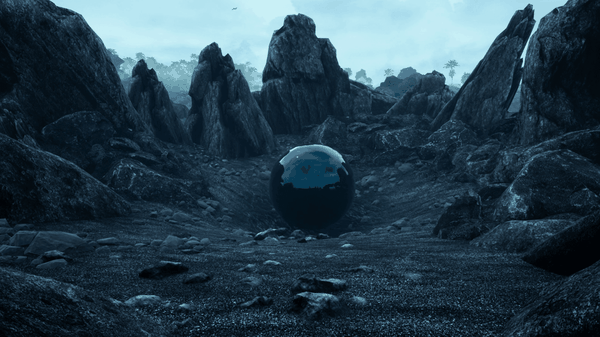
Within this parade of monsters, Andrew's attitude is limited and passive, a trait that nevertheless finds its sadistic and macabre coherence. Guiding his steps is an entity that tolerates no contradiction, ready to mercilessly silence any attempt by the man to understand the situation. Exploiting the fisherman's visceral need to find his daughter as a weapon of moral blackmail, this voice forces him into blind obedience. An interesting psychological intuition, which is however nullified by an increasingly confusing progression that inevitably reflects on the epilogue: in a strongly story-driven adventure, the conclusion proves dramatically anticlimactic, completely unable to tie up loose ends or provide a satisfactory close, leaving the player with the bitter feeling of having wandered aimlessly.
Navigating Cosmic Horror
From a purely gameplay perspective, The Shore builds its foundations on measured exploration and item collection, echoing the canons of walking simulators with horror undertones. In this exploratory phase, one of the most bizarre and unjustified game design choices of the entire production immediately emerges: Andrew's basic motor skills, such as jumping, running, or crouching, are not available from the start. They are unlocked fragmentarily and completely arbitrarily, made accessible only when the game decides they are necessary to proceed. A rigidity that breaks immersion and makes exploration unnecessarily mechanical.
Along the way, progress is punctuated by a series of puzzles: these mostly involve rotating mechanisms, fitting objects into altars, or using specific tools to unlock passages. The difficulty is never a real obstacle – rarely does a puzzle block progression for more than five minutes – but the execution stumbles due to poorly calibrated initial crypticness. Some puzzles offer no immediate logical clue, reducing them to bland trial & error rather than true deductive reasoning.
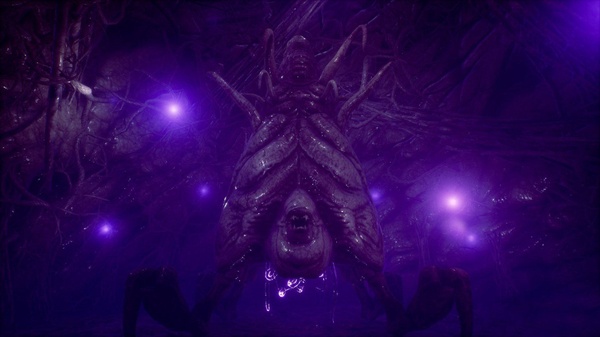
The pace undergoes an abrupt shift towards the second half of the adventure, when a specific Artifact is acquired. From this moment, the title abandons its slow rhythms to introduce combat sections and daring escapes within insane alien labyrinths, where one is constantly pushed by the voice acting as narrator. In this case too, however, the gameplay execution proves trivial. Encounters require no deep preparation or strategy: not all monstrosities can be defeated, and often using the Artifact merely serves to stun and slow down enemies to gain a brief window for escape. The key to survival is limited to maintaining the right distance and having good spatial awareness to avoid getting stuck in blind corners of the scenario, a dynamic unfortunately weighed down by the annoying presence of various bugs and problematic clipping.
If there's one element that manages to save itself in this limping framework, it's the artistic component. The creature design is undoubtedly valid, disturbing, and perfectly aligns with the horror imagery of reference. Similarly, the sound design fares decently, accompanying the visions with effective effects. Yet, precisely because of the shaky narrative structure and superficial gameplay, this aesthetic care is wasted, transforming deities and cosmic horrors into a mere exhibition carousel devoid of true impact.
Score
Editorial team
The Shore: Enhanced Edition, review of a psychological horror that wastes its valid premises
Despite the Enhanced Edition label suggesting a work of refinement and polishing compared to the turbulent original PC launch, The Shore's arrival on consoles fails to reverse the course of a conceptually flawed project. Ares Dragonis's work is undoubtedly driven by a genuine passion for the source material, evident in the excellent creature design and a very early phase capable of instilling a real sense of oppression. However, these good intuitions are soon swallowed by superficial gameplay, bizarrely unlocked mechanics, and, above all, a narrative that transforms the terror of the unknown into a confusing carousel ride through Lovecraft's monsters. In a video game market now saturated with themed productions, this excursion to the shore unfortunately lacks the necessary cards to emerge, stranding itself just below the passing grade.
Similar articles
Black Jacket: Review of an Alternative Balatro That Holds Its Own
Terrinoth: Heroes of Descent - Review: A dungeon crawler that only works if you accept its rules

Rainbow Legends: Review of a Card Game with Good Premises but Mediocre Representation