In Their Shoes: We Are Muesli tells the story of Milan and the present
Who wants to live a day as a Milanese?



"Milano sguardo distratto, bacio di ghiaccio; capto frequenza di intolleranza e mancanza di tempo e di vento, intenso traffico denso e ripenso al motivo per cui vivo tra il grigio di questo cemento" sang Articolo 31 in the album Domani Smetto in 2002, and although more than twenty years have passed, it's a description that has held up very well over time. As a Milanese (of provincial origin, before investigations begin) who has moved in and out of the borders of the Milanese metropolis for the last 40 years, I believe that almost anyone has found themselves asking, between a jolt on the cobblestones and an aperitivo that cost as much as a weekend getaway, the fateful question: "But why do I insist on living here?". Never before, however, has it been so difficult to find a solid answer to this more than legitimate doubt, especially for the 30-40 year-old generation, for whom the job market now resembles a circus where safety nets have been abolished, while the real estate market is a gala dinner to which almost no one has an invitation.
I can easily imagine, as I write these lines, the veil of derision curving the lips of the reader: from outside Milan, the story of Milan always seems exaggerated, grotesque. To truly understand it, one would have to experience it, which, in the end, I wouldn't wish on anyone. Thanks to the (Milanese, of course) team We Are Muesli, however, there is a less traumatic alternative: In Their Shoes
In Their Shoes: put yourself in their shoes
I know it's complicated to try and ask for a form of empathy for Milanese people, especially after the national "cultural" debate of recent weeks has been monopolized by the dramatic cry for help from a rich descendant of bourgeois who can no longer afford a penthouse in the city center. Beneath the tall towers, however, there is an entire generation, or rather two, between Gen X and Millennials, who work their butts off to make ends meet, who were promised a future swept away in a flash by the collapse of other tall towers, and whose concerns (far more founded and understandable) do not find the spotlight of glossy cultural magazines. This is the generation that We Are Muesli tries to portray – with considerable effectiveness, anticipating the final judgment – in their new game, In Their Shoes.
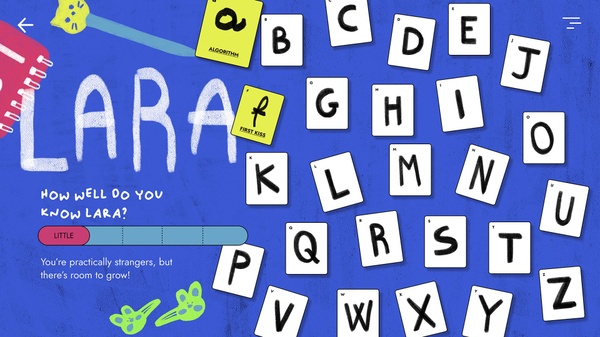
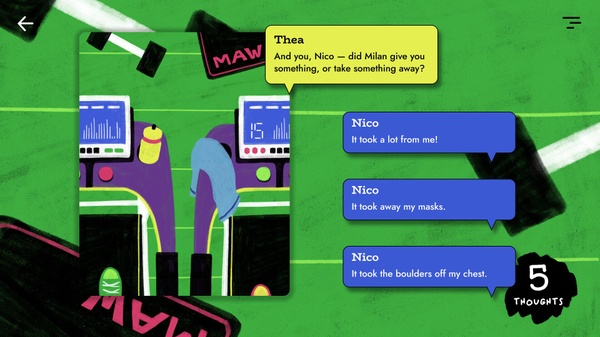
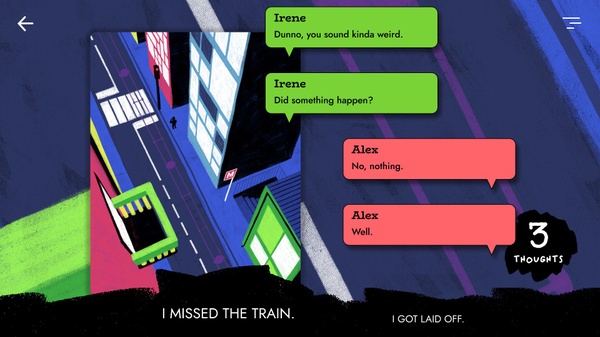
We Are Muesli is an anomalous studio, "unconventional" according to the definition on their official website, outside the box. Their previous work is an interactive book that translates the dynamics of an escape room between paper and screen (which in turn recall those of Paper, please). And even In Their Shoes, although it has a form that is decidedly more familiar to gamers, shows all their peculiarities in their approach to video games. Reducing it to its mechanics, In Their Shoes could be defined as a graphic adventure. The game offers us a series of cards for each character. Within each card, various moments can be relived: these are conversations in which the player is asked at specific moments to choose the dialogue option they deem most suitable. In addition, in each conversation, there is one or more Thought Tokens, a glimpse into our character's intrusive thoughts that can guide us in choosing their reactions. Cards and episodes, cataloged according to the pair of shoes of the moment, are unlocked by progressing in the game: the ultimate goal is to embed them in an event timeline, revealing how the lives and events of young men and women scattered throughout the city are actually much more intertwined than one might imagine by observing them individually and from afar.
How hard is empathy
In Their Shoes is an English expression that effectively summarizes the inspiration behind We Are Muesli's game: to push the player to put themselves in someone else's shoes. After all, it's the mechanism behind every game, allowing us to live a few hours in the shoes of a pirate, an astronaut, or an exterminator marine. This time, however, the scale is much smaller: the shoes to wear are those of precarious workers, out-of-towners who can afford a room in the suburbs, non-binary (or non-white, or non-ordinary) people who experience the small or large daily discrimination of others on their own skin every day. In fact, rather than a reduction in scale, for some it can be a change in perspective: what is it like to be in the shoes of those who struggle on the lowest rungs of the social ladder?
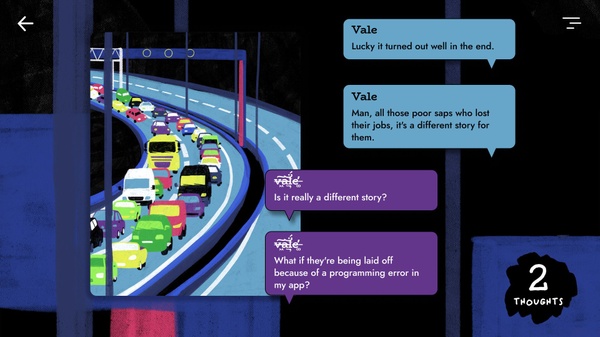
The highest risk, in these cases, is that of generalization, trivialization, or a pitiful and caricatured representation by those who describe a world they do not experience firsthand. This is not the case. We Are Muesli's writing, which in itself represents the beating heart of the game, is down-to-earth, frank, sincere, and popular (like neighborhoods, not celebrities). The game's conversations are those you unwillingly overhear on public transport ("Yes, mom, in Milan they're called 'i mezzi', I'm on the subway"), at a bar table with friends, or at home arguing with roommates. These are daily, ordinary, concrete problems; there's no assassins' guild conspiring, just a city increasingly less suited for the common person, crushed between real estate speculation and the performativity of a job that always demands you to be on point, brilliant, successful, even if life is falling apart, because the facade of Milan to be bought tolerates no losers.
Despite a rather lighthearted gameplay structure, but no less refined than other games of the same genre, In Their Shoes offers genuine writing, rooted in everyday life and (at least in Italian) sounding very little artificial. Although its stories, terminology, and characters are deeply Milanese, it also offers a glimpse into a generational status: it photographs with ruthless sincerity the transition to adulthood. The concrete one, made of merciless bills, precarious social relationships, and a burden of mental health issues that threaten to bring everything down. And I can't think of a scarier villain faced in a video game.
Score
Editorial team

In Their Shoes: We Are Muesli tells the story of Milan and the present
In Their Shoes is a narrative adventure that achieves the main goal of video games: to put the player in someone else's shoes. Only this time, the "someone else" is not a pirate, an astronaut, or a space marine, but an ordinary person (in fact, 7 of them), who lives in a big city like Milan and has to face daily problems such as the high cost of living, the cost of rent, precarious work, or discrimination against minorities. Its strong point is undoubtedly credible, sincere, and recognizable writing: the same language that ordinary people speak on the subway car that takes them to the office in the morning.
Similar articles