Highguard, Post-Update Review: A Two-Phase Raid Shooter, Brilliant and Irregular
After the latest launch tweaks, Highguard on PC showcases excellent gunplay and an siege that can ignite, but remains sensitive to density, coordination, and downtime, especially in solo queue


Highguard enters the market with an ambition that doesn't simply coincide with the desire to “be just another shooter,” but with the riskier idea of compressing the complexity of raids to their basics in a competitive format that is readable and resolvable in under half an hour. Presented at the close of The Game Awards 2025 and released on January 26, 2026, Wildlight Entertainment's debut brought with it an unusual level of attention, with expectations fueled by both the launch operation and the team's pedigree.
And yes, the references are recognizable: certain movement reflexes and weapon “reads” recall Apex Legends, as does the idea of traversing a map to prepare for the peak of a decisive clash. The problem is that here, that familiarity isn't enough to guarantee immediacy. The experience isn't built to keep the fire constantly lit: the match is a forced crescendo, with a preparatory phase that demands discipline, rotations, and timing, and a final siege that punishes mistakes with a severity closer to an objective-based game than a “pure” arena. In other words, what in other shooters is absorbed by the natural flow of frequent skirmishes, here becomes a design condition: if the team doesn't align intentions and timings, preparation risks being perceived as friction rather than strategy.
What emerges is a title with clear insights when density and team decisions align, but also with structural frictions that, under certain conditions, make the promise seem less accessible than the “modern FPS” surface suggests. The question, then, isn't so much whether Highguard “works” in the abstract, but under what conditions its formula truly manages to transform waiting into payoff: when does the siege become strategy and not routine, and what happens instead when the rhythm empties out?
Highguard's Plot and World: Why the Wardens Don't Leave an Impression
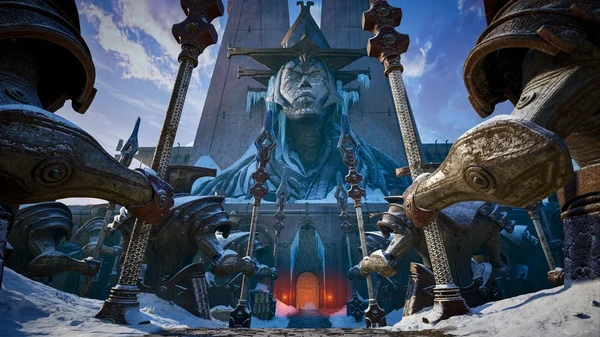
Narratively, Highguard builds a mythical continent traversed by technological ruins, arcane relics, and hinted feuds. Much of the context comes through the language of the maps and an environmental worldbuilding that suggests more than it explains. It's a legitimate approach, theoretically even elegant, but in its current state, it struggles to transform into engagement, because it lacks a true device for character attachment. In Apex Legends and Overwatch, the story didn't just live “within” the match: it was extended and made memorable through shorts, seasons, micro-narratives, and character-driven content capable of giving weight to a gesture, a silhouette, a line of dialogue.
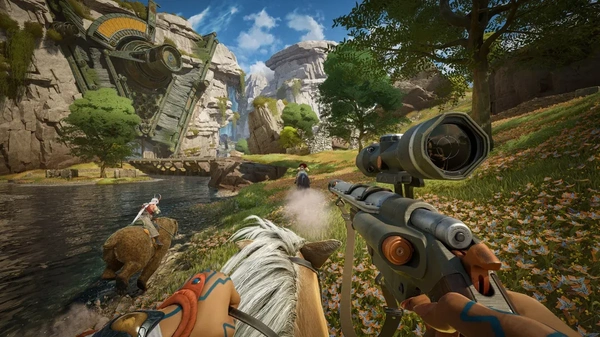
Highguard, however, leaves the Wardens in a gray area: their identity is suggested by aesthetics and some diegetic references, but without biographies, a lore archive, and substantial descriptions that connect abilities, factions, and motivations to a stable mental image. The result is not so much a “weak” lore, as it is a universe that doesn't settle, because it doesn't offer enough emotional or symbolic hooks to make the Wardens recognizable and desirable beyond their competitive function. And when the competitive component already demands attention, communication, and timing, the absence of an extra-game connection ends up being a burden: not because the plot must drive the experience, but because, without a narrative that accompanies and crystallizes the faces, even charisma becomes a transient, replaceable detail, thus easier to forget.
Highguard Gameplay: When the Two-Phase Loop Accelerates, and When It Slows Down
Highguard relies on a two-phase architecture that immediately declares the project's goal: to build a crescendo instead of a continuous combustion match. First, there's preparation, with fortress selection and a brief fortification window. Then comes map exploration, where resources are gathered and the team's power level increases; only after this does the game “close in” on itself and become siege, objectives, life management, and space control. It's a readable structure and, when it works, also satisfying, because it makes decisions consequential: what is done in the first half of the match comes back to be accounted for in the second.

The gunplay is the most immediately convincing part. Weapons have a metallic and crisp feedback, command response is precise, and movement provides that fluidity that allows a well-read rotation to be transformed into a real advantage. Slides, ziplines, and engagement management work especially when the map stops being simple “space” and becomes a geometry of approaches and lines of fire. In this sense, Highguard clearly shows an expert hand in crafting gunfights; the limit, if anything, is that it doesn't always put the conflict in a position to occur with the frequency and density expected by those seeking a more direct FPS.
The Vesper collection phase is where this philosophy is most exposed to risk. The idea of linking on-the-fly progression to loot and power-ups has its logic, but it can generate noticeable downtime: some matches require minutes of extraction and crate opening before the tension truly rises. In a title that presents itself as competitive, preparation then risks resembling a routine more than a choice. The difference is made by the level of contention: when rotations lead to frequent skirmishes and a “tug-of-war” over resources, Vesper becomes fuel for decisions; when teams remain separate, it becomes a mandatory step that slows down the pace.
This is where the Shieldbreaker comes into play, the true catalyst of the match. Its appearance breaks the quiet economy of collection and forces teams to expose themselves, take risks, and choose whether to force a clash, attempt an interception, or give up to avoid compromising the next phase. In theory, it's a strong idea, because it creates a point of gravity that orders the match; in practice, its effectiveness depends on the density of contact. If the Shieldbreaker generates chases, ambushes, and repositioning, Highguard finds its most recognizable identity.
The second phase, the Raid on the base, is where the game stops being a “promise” and becomes a system. The siege introduces clear objectives and an asymmetric respawn model that, at least on paper, adds tension without turning the experience into a sudden round. Attackers must manage a life budget; defenders can respawn, but with timings that punish useless deaths, and control of corridors and bottlenecks becomes central again. The limit is that some fortification and destruction mechanics don't always produce the hoped-for tactical impact: the feeling of “building” a defense can be diminished by solutions that break barriers too quickly, with the risk of reducing the preparatory phase to a more symbolic than decisive gesture.
The Wardens and roles complete the matrix, because Highguard thrives on utility, control, and synergies, not just aim. The classes, including assault, defense, support, reconnaissance, and destruction, give the team a clear tactical lexicon, but the initial balancing tends to clearly reward choices capable of altering space and information: stealth, area damage, targeted destruction, and support tools prove more decisive than simple suppressive fire. This isn't a flaw in itself, but it's an indication: the title demands “team play” even when matchmaking doesn't guarantee coordination.
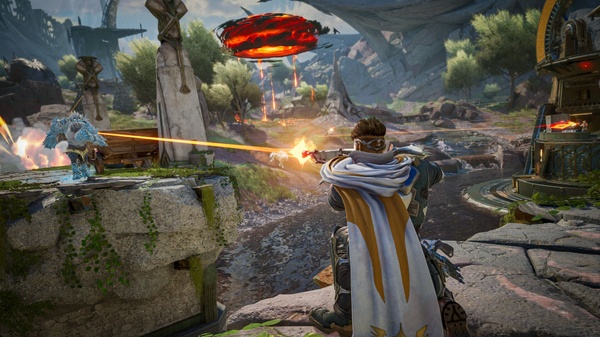
The abilities layer is what transforms gunplay into team play, because it introduces tools for space denial, information, and support that determine when and how an engagement truly “pays off.” A defensive Warden like Kai, for example, makes this philosophy tangible: his ice barriers don't just “protect,” but rewrite corridors and lines of fire for a few seconds, creating clear windows to plant, defuse, or simply gain time. On the other hand, a more offensive profile like Atticus shows the other side of the system, that of area denial and pressure spikes: when an Ultimate is used to clear a point or break a rotation, the siege acquires an almost MOBA-like grammar, made of readable setups and payoffs. It's also here that coordination becomes critical: if cooldowns and Ultimates are spent haphazardly, the system loses structure and the match reverts to individual initiatives, less effective in a format that rewards timing and convergence.
The most evident friction arises in the transition between 3v3 and 5v5 and, above all, in how the game is played. In 3v3, the map can appear more stretched out and the empty spaces are felt more: rotations have greater weight, but a single misread or lack of synchronization is enough to make the match slide into a sequence of waits and recoveries. The 5v5 mode, on the contrary, increases density and tends to make the experience more “present,” with more contacts and more opportunities for repositioning; it gains rhythm, but can lose some of its tactical clarity in tighter rooms, where the volume of fire and effects tend to overlap.
In solo queue, this systemic nature is amplified: without shared communication and timing, many choices that should be consequential become opaque, and the tactical readability of the match is reduced precisely when the game demands coordination.
Highguard PC Performance: Ultrawide, DLSS, and Stability
Technically, at least within the scope of the PC test, Highguard proved solid and consistent, with a stable performance profile. On a configuration based on RTX 4060 Ti, with an ultrawide screen and DLSS active, the experience consistently maintained around 50–60 fps, without oscillations that would compromise the readability of combat or the responsiveness of gunplay. This is relevant because Highguard thrives on timing, repositioning, and micro-decisions: when fluidity remains regular, the game can leverage its movement system and weapon precision, whereas any technical uncertainties would amplify precisely those frictions of rhythm and density that are already part of its nature.
No significant operational issues emerged: no crashes, absence of perceptible stuttering, and no anomalous behavior capable of altering match outcomes. In practical terms, this means that the evaluation of the title, in this specific configuration, can focus on design choices and loop balancing, without the technical aspect becoming a distorting filter. Whether Highguard is convincing or not, in this scenario, it is because of how it constructs the match, not how it runs it.
The War Chest and the Economy of Desire
Highguard's seasonal progression revolves around the War Chest, a local variant of the battle pass that, in the first season, was offered for free as a gesture of goodwill towards the community and, above all, as an invitation to evaluate the title long-term. The economic system is structured around three currencies with distinct functions: Vigil tokens (purple), linked to the War Chest; Silver, used for a rotating cosmetic shop; and Gold, a premium currency purchasable with real money. A non-secondary aspect is that Vigil and Silver are obtainable by playing, while Gold is used for direct access to premium content and bundles.
Overall, the impression is of a model that alternates transparent choices with more calculated solutions. On one hand, several prices appear “cleanly” constructed, because they are aligned with currency pack denominations: you buy a bundle of coins and spend it without artificial residues, reducing that feeling of indirect pressure for additional spending. On the other hand, examples of more malicious pricing emerge, particularly in legendary bundles that also include mounts: here the threshold tends to be just beyond standard denominations. The effect is to force the user to choose a pack larger than necessary, generating leftover currency and thus implicit pressure to “complete” the spending with an additional purchase. This is a known dynamic and not scandalous in itself, but relevant because it clarifies the direction: Highguard, while avoiding blatant excesses, operates as a live service, and asks the player to distinguish between earned progression and purchased progression with the same attention with which, in-game, they distinguish between preparation and assault.
Score
Editorial team

Highguard, Post-Update Review: A Two-Phase Raid Shooter, Brilliant and Irregular
Highguard is a lucid and imperfect experiment: when the two-phase loop finds density and coordination, the Shieldbreaker ignites tense matches and the gunplay sustains a credible siege. But the same structure, in 3v3 and especially in solo queue, can stretch out in preparation and downtime, with frictions that dull the promised immediacy. Technically, on PC, it holds up well; in terms of identity, Wardens and the world remain less memorable than needed. In summary: good, but with reservations, recommended for those seeking a thoughtful raid shooter rather than an always-on FPS.
Similar articles