Dark Quest 4 Review: The Digital Dungeon Crawler That Brings HeroQuest to PC and Consoles
Between nostalgia and innovation, the fantasy adventure that transforms the board game into a modern video game experience.
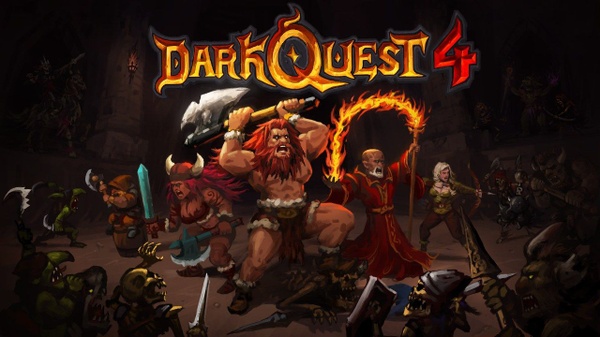


The allure of dungeon crawlers has never faded. From the '80s and '90s, when board games like HeroQuest and Risk! brought families and friends together around a board, to modern digital reinterpretations, the genre has maintained its ability to captivate. Into this landscape comes Dark Quest 4, the new installment in the indie series developed and published by Brain Seal Ltd., an independent British studio that has chosen to focus on nostalgia and a passion for fantasy board games. The title is available on PC via Steam and on all major consoles, from PlayStation 4 and 5 to Xbox Series X|S and Nintendo Switch, with the aim of reaching a wide and varied audience interested in experiencing the board game directly on screen.
A Tribute to HeroQuest
The Dark Quest saga has always oscillated between a tribute to the famous board game HeroQuest and an attempt to update the formula with modern elements. With the fourth installment, Brain Seal Ltd. takes a decisive step towards maturity, offering a campaign composed of thirty hand-drawn missions that replace the procedural dungeon generation of previous episodes. The aesthetic explicitly recalls the physical board, with a HUD that simulates squares, the presence of a digital dungeon master, and virtual miniatures that evoke game pieces. However, it's not just a simple retro homage: Dark Quest 4 builds its own narrative and gameplay identity, capable of speaking to both nostalgic players and new ones.

The heart of the experience is the gameplay, which takes the digital board game formula and makes it more immediate. Matches take place on isometric grid maps, where each hero has a limited number of movements and actions per turn. Abilities are managed through a personal deck of cards representing attacks, heals, buffs, and special powers. The traditional dice roll mechanic is replaced by a Random Number Generator system linked to cards and character stats, which provides a sense of uncertainty similar to that of a board game but channeled into clearer and more immediate rules for the video game player.
The management component develops in the camp, a central hub where the player can interact with blacksmiths, merchants, and trainers to purchase and upgrade cards and equipment. Resources are accumulated by exploring dungeons, but if a mission fails, the loot is lost, increasing the tension and weight of strategic choices. A fatigue system penalizes the health of characters used multiple times, encouraging the player to rotate the available roster of heroes. Throughout the campaign, up to ten heroes are unlocked, but the active team consists of three members, controlled by a single player or by participants in cooperative mode for up to three people, both locally and online. This structure creates a tactical loop that is simple to learn but rich in depth, thanks to team composition, card management, and positioning on the board.
Particularly interesting is the Creator mode, which allows players to design maps, place enemies and objectives, and share their creations with the community. Replayability is greatly enhanced, transforming Dark Quest 4 into a potentially infinite title thanks to user-generated content.
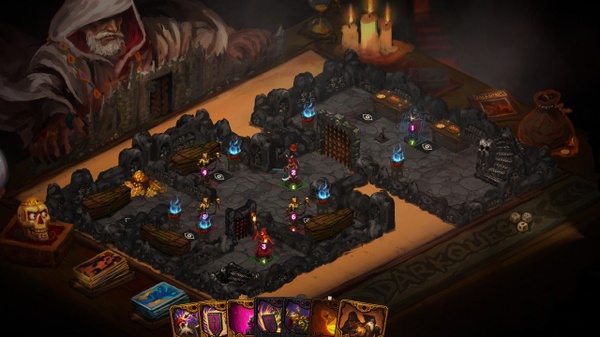
From a technical standpoint, Dark Quest 4 doesn't aim for photorealism but an isometric aesthetic that resembles a "living board game." The graphical details reinforce the feeling of having a physical board around the play space, while the soundtrack effectively accompanies the pulp-fantasy tone typical of Sword and Sorcery. Performance is generally solid, with a stable framerate and no significant crashes on the tested platforms. However, there are some critical issues: the interface is not very intuitive for selecting specific tiles like trapdoors or doors, and equipment management in the camp is cumbersome, with user experience steps that slow down the pace of the game, such as reassigning potions and items. The technical balance remains positive, but the ergonomics of interaction limit fluidity in longer sessions.
A Comparison with Modern Action RPGs
It's important to clarify what Dark Quest 4 is not. It's not a modern action RPG with super-fluid interfaces and rapid micromanagement. Those looking for an experience similar to Diablo or Baldur's Gate might be disappointed. Dark Quest 4 is instead a title that rewards tactical simplicity and the cooperative dimension, closer to a board game than a hardcore video game. Its strength lies in its ability to evoke nostalgia and offer immediate yet deep gameplay, thanks to cards, hero rotation, and hub management.
Dark Quest 4 is a relative but significant success for those looking for a digital "tabletop" dungeon crawler. The campaign of thirty hand-drawn missions, the well-characterized roster of heroes, and the creator mode that extends the game's life beyond the main campaign represent the strengths of a title that focuses on tactical simplicity rather than an excess of mechanics. It is not without flaws, especially concerning the interface and equipment management, but its indie nature and the presence of a community editor suggest room for future improvements. For fans of HeroQuest and cooperative board games, Dark Quest 4 is a valid digital alternative. For those seeking a modern action RPG, the experience might be less satisfying.
Score
Editorial team
Dark Quest 4 Review: The Digital Dungeon Crawler That Brings HeroQuest to PC and Consoles
Dark Quest 4 proves that tabletop role-playing games never go out of style. After the golden age of the '80s and '90s, today's consoles and PC bring us back to the same table, if only in our imagination, where we were protagonists alongside family and friends. It's a title that celebrates tradition and renews it, offering an experience that combines nostalgia, tactics, and creativity.
Similar articles