Dragon Quest VII Reimagined, the review of the JRPG to rediscover and reimagine!
The seventh episode of Dragon Quest brings us back to play with Akira Toriyama's immortal design


Dragon Quest VII Reimagined, what's new?
Square Enix's work dedicated to recovering great JRPGs of the past continues, and today we are here for our review of Dragon Quest VII Reimagined. The game is, as the title suggests, a version of the seventh chapter of the historic Dragon Quest saga rethought with current technologies and expertise, coming to Xbox, Nintendo Switch 1 and 2, and PlayStation 5, the platform on which we were able to play it well in advance. Originally released in 2000 on the first PlayStation, Dragon Quest VII is the last episode of the saga never to have reached Europe in its original form, although a Nintendo 3DS edition arrived in our hands in 2016.
We know well that it was the eighth chapter that brought the brand to the general public in our country and introduced it to many local gamers, but today Square Enix has decided that DQ 7: Fragments of a Forgotten World (this is the subtitle of the original work) deserved a revisit, or rather, a “reimagination”. With the consultation of Yuji Horii, the original creator of the saga, Square Enix and the support team HexaDrive took the native material to create an experience capable of re-proposing Dragon Quest VII with new graphics, quality-of-life improvements in-game, and cutting some less functional sections while adding elements capable of enriching and embellishing the protagonists' lore.
Our hero, mute as per brand tradition, lives in a fishing village on the island of Estard. What doesn't give him peace, however, is the fact that beyond the small island, the whole world seems to be covered only by the sea, so much so that the desire for adventure and to discover if there really is anything beyond the known lands, pushes him to explore ancient ruins. In his company is his best friend Kiefer, heir to the throne of the kingdom, much more interested in an adventurous life than in learning to become a good ruler.
They are joined by Maribel, daughter of the mayor of Baia Sardina (Sardina, Sardina, not Sardinia, with all due respect to us Sardinians), not so much moved by the sacred fire of discovery, as by not wanting to be left behind by her two friends. From here begins an adventure where our heroes discover a way to travel back in time thanks to tablet fragments that, once joined and a single tablet completed, transport them to the past on an island that, for some reason, has disappeared from the present. From time to time, our party will have to face the problems of the lost land to which they will be transported, and by solving them, it will reappear in their timeline. Once the work is done, the protagonists can return home and visit the re-emerged islands, thus discovering how they have evolved over time and finding new tablet pieces to access other areas, in a long (count several tens of hours depending on your play style) journey towards the search for the truth about what actually happened to the world.
Dragon Quest VII Reimagined: graphics and gameplay
The time-travel structure is still interesting today, with the individual stories of the various islands almost always pleasant and stimulating the player to move forward to see what will happen. You shouldn't expect unforgettable narrative quality, as you will find predominantly adolescent tones, but the curiosity to discover new areas in the past and their evolution in the present manages to keep you glued to the controller. In its nature as a “reimagined” title, this new Dragon Quest VII brings the original experience back to gamers, but revised and corrected according to current standards, also from the plot's point of view. Some secondary elements have been eliminated, others have been added and give some more color to the protagonists. The same fate for the minigames where there has been a revision, but some situations will return to keep you company and make you detach a bit from the rhythm of the main plot. Naturally, the great protagonist is the technological leap, with Dragon Quest VII Reimagined moving from the two dimensions of the original to a delightful, very colorful 3D style, where Akira Toriyama's creations come even more to life and revel in the developers' work.
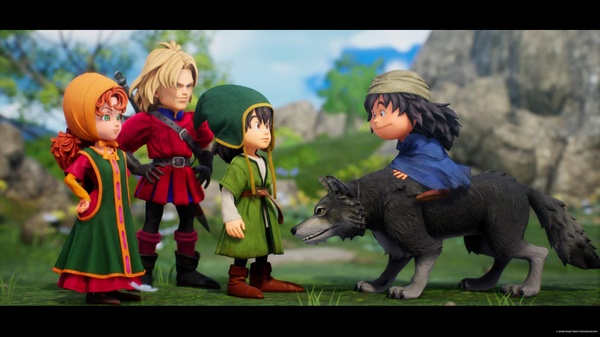
The various menus and chats with vendors have also been redesigned, now much more convenient. The characters are rendered in a very particular style, thanks to the developers' work who created them by hand in reality, like dolls, and then scanned them and brought them into the game, with almost always excellent results... despite the proportions being in rare cases questionable, like the “big jaw” of the blonde Kiefer. The environments look like dioramas and allow for complete exploration thanks to the ability to move the camera 360 degrees, always maintaining the isometric view. Unfortunately, this doesn't work in all situations, such as dungeons, but the rendering remains excellent also from the frame rate point of view, where I didn't notice any problems. In addition to excellent graphics, Dragon Quest VII Reimagined features orchestral and rearranged versions of Koichi Sugiyama's original music, a hallmark of the saga since its inception and once again very pleasant to listen to. There are two quality voice-overs, Japanese and English, with the addition of Italian texts, really well adapted and very useful, given the large amount of lines to read.
Dragon Quest VII Reimagined: why buy it?
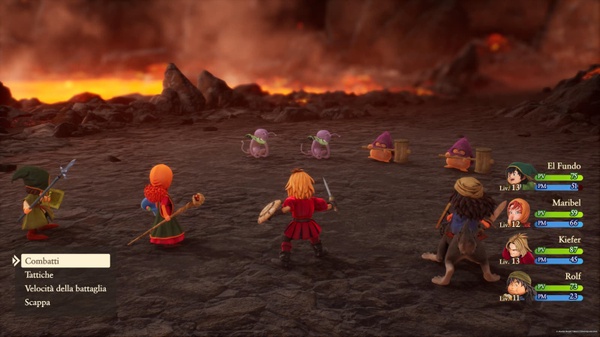
The combat system is extremely traditional and sees a maximum of four characters challenge opponents (clearly visible on screen during exploration) following a rigid turn-based system, using attacks, defenses, items, spells, and special moves. When you see an enemy, you can anticipate their attack by hitting them, gaining the first turn of action which proves to be a significant bonus. If you have even a basic knowledge of JRPGs, you will have no problems, as the system follows the original one with health points, magic points, and the possibility for each character to enter Frenzy mode. If several consecutive attacks are landed or too much damage is taken, each character enters “Frenzy” and can activate a special blow linked to their vocation. Vocations are a different way of calling jobs, and each protagonist, by fighting, will gain experience points to level up and vocation points to improve their specialization. You start with well-defined classes, and at a specific point in the plot, you will be able to vary them, thus unlocking new abilities.
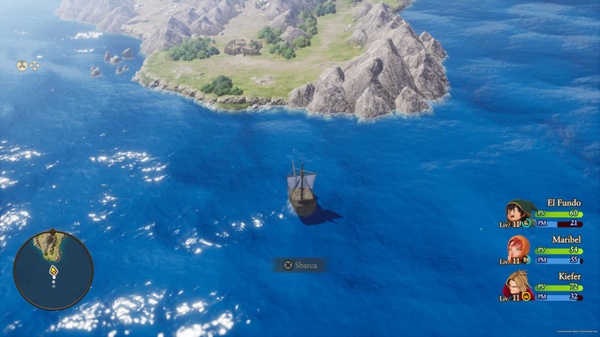
As for the party, it offers no variables and you play with the available characters, plus some external help in specific situations. The plot will bring some surprises, but don't expect much variety. To streamline the combat system, some new features have been introduced, such as defeating weaker enemies with the first blow during exploration, being able to increase combat speed, and automatic battle, with artificial intelligence proving very functional and capable of defeating even the fiercest bosses, if the party is adequately evolved and equipped, but it is obvious that by exploiting it too much you will lose much of the beauty of Dragon Quest VII Reimagined.
As for the difficulty, I had no particular problems playing under normal conditions, so if you want to increase the challenge, you have to go to the options, where you can increase or decrease the damage dealt, received, and the amount of experience points given by each victory. At the dawn of 2026, the combat is solid and functional, but decidedly outdated and with few variables, except those we have already seen dozens of times, without synergies between characters and limited mechanics. Let's be clear, this is not a fault, since if something had been changed, we would certainly have heard the scandalized cries of purists, but a fact that, for better or worse, delivers the combat system of Dragon Quest VII Reimagined with few insights.
In short, Dragon Quest VII Reimagined is an intelligently executed recovery operation, where Square Enix has deployed its resources to give new life to a title that in the past, especially in Europe, did not have the right fortune. Would we have preferred to see titles of the caliber of Chrono Trigger? Certainly, but this does not detract from the goodness of what has been done, although there are intrinsic limits. If you have doubts, you can play the demo, especially since you can export your saves to the final version of the game. In short, you have no excuses not to give Dragon Quest VII Reimagined at least a chance.
Score
Editorial team
Dragon Quest VII Reimagined, the review of the JRPG to rediscover and reimagine!
Dragon Quest VII Reimagined breathes new life into a historic title, even if the original product wasn't all that unmissable. The operation carried out by Square Enix is truly good and shows all the capability of the Japanese company which, by now, has become more than expert in this field. The three-dimensional graphics blend perfectly with the isometric view and the design of the original title, where Akira Toriyama's pen never disappoints. While the technical execution is impeccable, the fact remains that Dragon Quest VII Reimagined carries with it the structural limitations of outdated gameplay, and the new features added to streamline it, while appreciable, cannot work miracles to make it current. The plot is pleasant to follow (between additions and cuts), the cast is a bit limited but sufficiently characterized, while the music is of high quality, as is the textual translation into Italian. There are many other Square Enix titles waiting to be re-released, but Dragon Quest VII Reimagined manages to be appreciated, especially by those who don't disdain extremely traditional gameplay.
Similar articles