Heroic Exams in My Hero Academia: All's Justice
The anime's final battles become a video game


To explain the decline (perhaps inevitable after more than 20 years) of Marvel Studios' productions, people often talk about superhero fatigue, that sense of weariness and saturation widespread among all audiences in relation to the stories of costumed superheroes. Even if we take this hypothesis as true (and it's yet to be proven; more likely, boredom is a reaction to the evident drop in MCU quality), this rejection must be confined to movie theaters, because superheroes are still doing quite well in other formats. Not so much in the States, where sales of Marvel and DC comic books have never truly benefited from the media exposure of the protagonists (only James Gunn has recently been trying to do something with his social media posts), but rather in Japan where superheroes have found new fertile ground in the aesthetics and grammar of manga.
My Hero Academia: More Powers for Everyone!
One of the most representative titles of the success of the manga adaptation of the superhero concept is My Hero Academia, a manga written and illustrated by Kōhei Horikoshi and published in the weekly Shonen Jump since 2014. The reason for its success, perhaps, is the reversal of perspective: in a society where almost everyone (about 80% of the population) has developed powers, called Quirks, the protagonist is Izuku Midoriya, a boy born without talents who dreams of becoming a superhero. Izuku is also the protagonist of My Hero Academia: All's Justice, the franchise's debut on this generation of consoles, arriving in February (after a last appearance at the end of 2023 in the Battle Royale free-to-play My Hero Ultra Rumble).
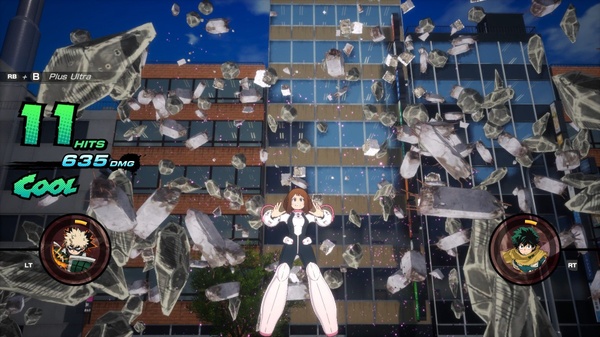
My Hero Academia: All's Justice, the sixth video game set in the universe created by Kōhei Horikoshi, is set in the advanced stages of Izuku Midoriya's story, more precisely in the climax of the anime's Final Season (if you're behind on reading/watching, you still have some time to catch up!). In recent days, we had the opportunity to try a beta version of the game for PC, so we can give you some first-hand previews of the game's content and modes.
My Hero Academia: Not Just Story Mode
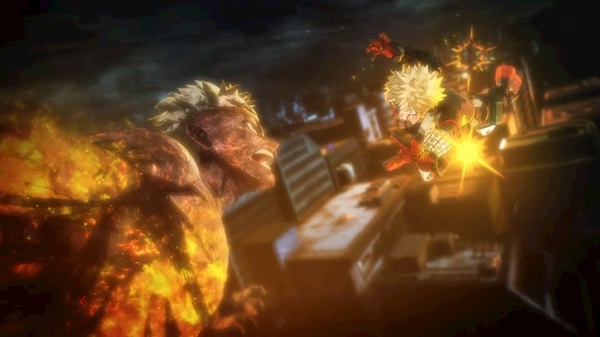
As Izuku, we found ourselves in a town, which we soon discovered to be a virtual space, a kind of hub where a portion of the game still takes place. However, by using the phone, you can access the other available modes at any time. Given the references to such a specific moment in the series' plot, the first mode we decided to try was Story Mode. We were then thrust into the shoes of Katsuki Bakugo in the heart of the Final Season, more precisely in the storyline titled Final War, to face a younger version of All For One. The four chapters we were allowed to access were equally divided between cutscenes and combat. The former, the cutscenes, are made with the game engine, animating scenes and dialogues from the manga: useful for giving us the right context (and quite exciting, at least in the Japanese dubbing which we preferred for its setting and epicness over the American one), but the main course is the fighting. And there's plenty of it between Katsuki and All For One: battles take place on large, destructible scenarios, with blows generating gigantic explosions among collapsing buildings. Don't expect Battlefield 6; here, the polygon count is much lower and the effect decidedly more simplified, but in the game, we are in a virtual environment, and the cell shading with its cartoon effect helps make the choice stylistically coherent.
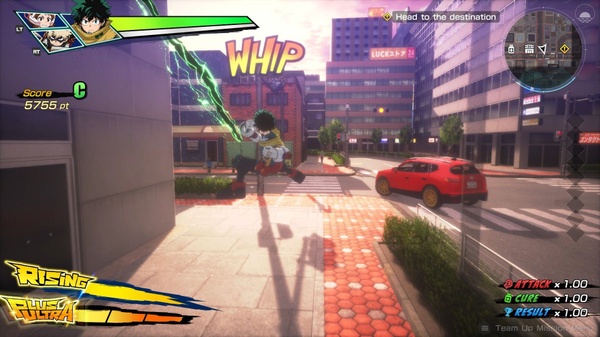
The cell phone in Izuku Midoriya's hands, however, allows us to explore other available modes. The first we landed in was Team Up Mission (from the spin-off manga of the main series) which takes us to a simulated environment (once again!) to test ourselves with training missions written specifically for the game. This time, in addition to the main hero, we can also rely on two other characters, switchable by pressing a button. The two Team Up Missions we tried allowed us to explore the city a bit, using each hero's Quirk to move faster, alternating exploratory tasks with some group battles against gangs of thugs and assorted villains. Hero's Diary, a mode found within the Character Memory section, also offers new narrative insights. Each page is dedicated to minor characters from the series, whose small behind-the-scenes events can be explored in short chapters that hide mini-games, simple battles, or fun quests, such as searching for a group of cats in a garden.
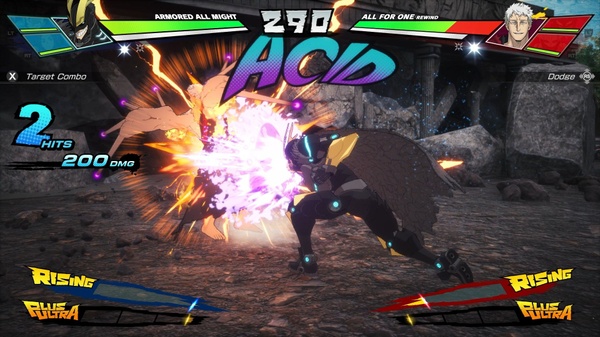
The last mode we were able to try, Battle 1P vs CPU, is the classic free mode where you can stage all possible clashes (but 3vs3!) by drawing from the generous roster of My Hero Academia: All's Justice. It is in this mode that the game's purely fighting game soul emerges, which elsewhere appears mixed with action/adventure mechanics, and where the differences between the two control systems are most noticeable. Each fighter, in fact, has various tools, offensive (including unblockable attacks) and defensive. The "normal" control system (designed primarily for those new to this type of game) allows you to perform Quirk attacks, character changes, Ultra Plus moves, and more automatically, by pressing just one button. Obviously, manual controls allow you to execute and contain every single move individually, with significantly greater strategic depth.
Finally, a note on the PC version's requirements: we tested the game on a system with an RTX 5070 laptop and 32GB of RAM (with all graphics details at maximum), but the recommended configuration for the final version should be significantly less demanding. We don't have more precise data; currently, Steam only lists a generic 64-bit operating system as a requirement; but for this and other details, we'll get back to you in a few weeks, closer to the release.
Similar articles