Valor Mortis: The Napoleonic Soulslike Has Personality, But Needs to Become More Legible - Preview
One More Level brings first-person punitive combat to a plague-ridden Napoleonic Europe. The atmosphere is strong and the parry system works, but enemy groups, controls, and stutter show a demo still in need of refinement.
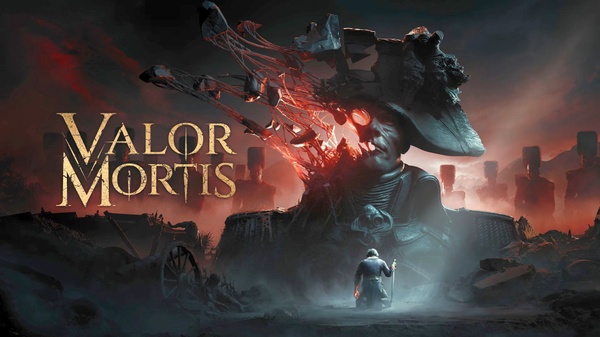


One More Level built Ghostrunner on an idea as simple as it was effective: in first-person, the action feels so "close" that it makes you perceive danger even better. With Valor Mortis, the Polish studio tries to bring that same idea into a much more complicated genre to adapt: the soulslike.
The public demo available on Steam already makes it clear why the project is interesting. Valor Mortis doesn't seem like a simple "Dark Souls in first-person", nor a slowed-down Ghostrunner dressed as a horror game. It's a riskier hybrid, set in an alternative version of Napoleonic Europe, where war, death, and esotericism blend into a world corrupted by a mysterious plague.
The result, at least in this test, is clear: Valor Mortis has a strong identity, a good atmosphere, and a combat system that works better than expected in duels. At the same time, the demo shows concrete problems. The first-person view makes clashes more physical, but complicates readability when multiple enemies arrive. Controls are not always comfortable. The technical side, especially on PC, still needs work.
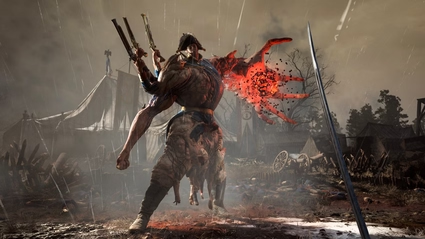
The Napoleonic setting is the most convincing part of the demo
Valor Mortis puts the player in the shoes of William, a soldier of the Grande Armée brought back to life after death, but the world he awakens in is no longer the one he fought for. The Europe traversed in the demo is a dirty, sick territory, filled with deformed soldiers, aggressive creatures, and the remnants of a war that seems to have never truly ended.
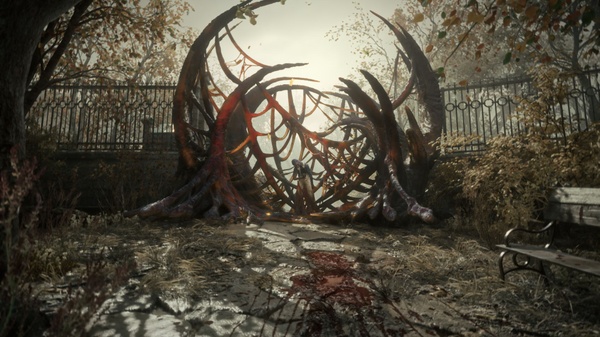
The strong point is that the Napoleonic setting is not just used as an unusual backdrop. One More Level takes uniforms, battlefields, weapons, horses, and military remnants, then bends them into an immediately recognizable horror imagery, made of corrupted flesh, mutated soldiers, and creatures that still retain something of their human origin. At times, especially in the face of certain more pronounced deformities, it's hard not to think also of a biological horror closer to Resident Evil 2, rather than the usual medieval dark fantasy. The difference is important, because Valor Mortis doesn't try to distinguish itself only by changing historical eras, but uses that context to give the game a more original and less overused flavor.
The demo works especially when it manages to make you feel the weight of the battlefield. The creatures William faces don't seem like simple enemies inserted to fill a room or create obstacles along the way: they are corrupted soldiers, beings still linked to the same military machine from which the protagonist comes. This makes the horror more effective, because it doesn't put William in front of a generic evil, but a deformed version of the world he belonged to.
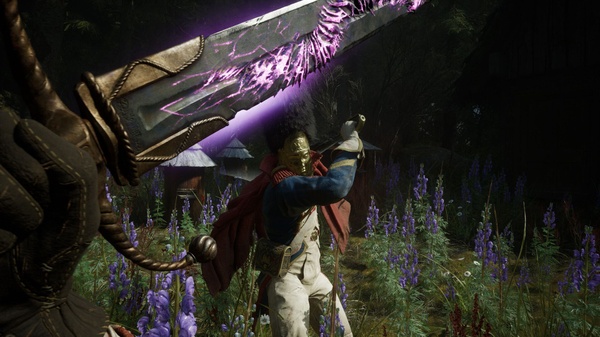
The presence of Napoleon, voiced by Vincent Cassel, also works. The emperor does not appear as a historical reference placed there to give prestige to the setting, but as a menacing figure who accompanies William and seems to influence his every step. His voice permeates the demo with a cold, almost inevitable authority, and clarifies one of the game's most interesting narrative tensions: this resurrection does not seem like salvation, but a new form of control. William doesn't simply come back to life; he is put back into motion, once again, in a war he didn't truly choose.
The writing will need to be evaluated in the full game, because a demo can only hint at characters, mysteries, and conflicts, but the initial setup already holds up with a certain confidence. The atmosphere is strong, the idea is clear, and the Napoleonic horror context immediately distinguishes Valor Mortis from many recent soulslikes, still too tied to medieval imagery, ancient ruins, and decadent fantasy worlds.
The parry system works best in one-on-one duels
Valor Mortis' combat revolves around parries, dodges, melee attacks, firearms, executions, and supernatural powers, but its core remains easy to read: observe the enemy, intercept the blow at the right moment, break their stability, and strike when they are exposed. It's a logic closer to Sekiro than Dark Souls, because the weight of the clash is not just in managing distance or waiting for the right opening, but above all in the timing with which you respond to the opponent's attack.
In one-on-one duels, this setup works with surprising clarity. The enemy occupies the center of the screen, the blade becomes the main point of contact between player and opponent, and every incoming blow is legible enough to make parrying a concrete response, not a gesture left to chance. When the timing is correct, the game clearly communicates the advantage gained: the enemy's posture gives way, the opening becomes evident, and the subsequent execution provides a good sense of impact (and there are parries too!). It's in these moments that you best understand what One More Level is trying to do, which is to make the soulslike duel more direct, more physical, and less filtered by the distance of third-person.
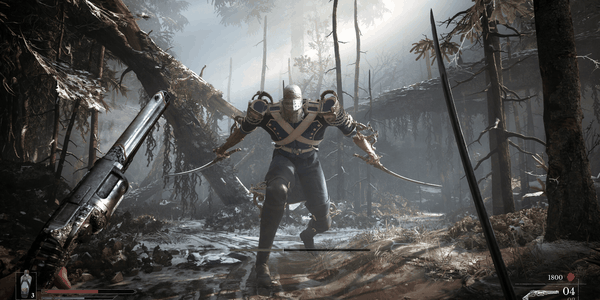
Firearms also find a consistent role within this system. Pistol and musket do not transform Valor Mortis into a shooter, nor do they seem designed to strip melee combat of its weight, but they function as support tools to be used carefully. They can interrupt certain actions, hit weak points, or provide breathing room in the riskiest situations, without shifting the core of the experience away from the blade. This is an important choice, as it keeps combat anchored to close-quarters dueling and prevents ranged weapons from becoming too convenient a shortcut.
The plague-related powers add another layer to progression. In the demo, it's possible to use supernatural abilities, such as fiery attacks, to manage certain enemies or interact with specific obstacles, hinting that William's growth will not only come from new weapons or higher stats. The protagonist doesn't come back to life the same as before: his body has been changed by the same force that corrupted the world around him, and the gameplay tries to translate this transformation into usable tools during exploration and combat (and seeing it this way, the reference to Bioshock is a must!).
The combat system, therefore, has a promising foundation. It's not yet perfect, but in its cleanest moments, it shows rhythm, impact, and personality. The problem arises when Valor Mortis moves beyond controlled dueling, fills the space with multiple enemies, and asks the first-person perspective to communicate too much information at the same time.
In multi-enemy combat, first-person becomes a limitation
The first-person perspective is Valor Mortis' most important choice, but also the one that creates the most problems. Against a single enemy, it increases tension, because every blow seems to land directly on the player. Against larger groups, however, the situation changes. The field of view doesn't always allow for precise understanding of what's happening to the sides or behind, and this is a serious problem in a soulslike.
In this genre, the player must understand why they were hit. They might miss a parry, misread an attack, mishandle distance, or use a dodge at the wrong moment. All of this is fine. In fact, it's part of the genre's appeal. However, the error must be clear. If you take a hit without understanding where the danger came from, the difficulty no longer seems like a rule to learn: it just seems like confusion.
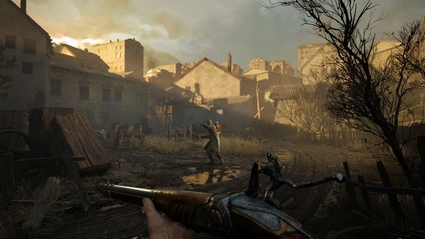
The Valor Mortis demo occasionally falls into this gray area. When two or three enemies surround William, the readability of the encounter becomes less precise. The player may find themselves reacting more to sounds, sudden movements, and general chaos than to a truly understandable pattern. It doesn't always happen, but it happens enough to become a point to correct before release (and this is where the advantage of third-person and a functional camera emerges).
The problem isn't just difficulty. Valor Mortis can be tough, and probably should be. The point is that it needs to be tough in a legible way. If first-person is to work within a soulslike structure, it must give the player clear tools to control space: better indicators, more recognizable animations, cleaner group management, or enemies designed not to attack all at once from blind spots.
For now, the demo shows that the idea works better when the fight remains frontal. When the arena becomes more complex, Valor Mortis loses some of its precision.
Parkour and soulslike still need to find a balance
Ghostrunner's legacy is most evident in movement. Valor Mortis is not a static game: William can move quickly, use a grappling hook, reach elevated positions, and traverse some sections with mobility closer to action parkour than classic soulslike. It's an understandable choice, because One More Level knows this type of movement well and it wouldn't have made sense to completely ignore their previous experience.
In the demo, however, this part is only half convincing. The vertical and more dynamic sections work when they serve to open up exploration, create shortcuts, or add variety to the pace. The grappling hook, in particular, helps to move with more freedom and makes the environment less flat. The problem arises when the game transitions too quickly from slow, heavy, close-quarters dueling to more acrobatic mobility.
It's not an impossible contradiction to resolve, but it's a delicate coexistence. Soulslikes thrive on attention, measure, and reading the opponent. Parkour thrives on speed, impulse, and continuity of movement. If these two souls are not well integrated, the game risks appearing divided: on one side the punitive duel, on the other the faster sections inherited from Ghostrunner.
The demo doesn't yet provide a definitive answer. In its best moments, Valor Mortis manages to use mobility to make exploration more interesting. In its less successful moments, however, the change of pace breaks the atmosphere and seems to pull the game away from the tension it had built just before.
The point to verify in the full game will be this: will movement truly serve to make encounters and levels more intelligent, or will it remain a spectacular but not always necessary addition? Much of Valor Mortis' final identity will depend on this answer.
The controls are still too uncomfortable for a timing-based game
The demo also shows a more immediate problem: the controls. On mouse and keyboard, some mapping choices feel unnatural for a game that demands quick reflexes, precise parries, and continuous reactions. When a title bases its combat on timing, the command must be comfortable even before it is customizable.
The point is simple: if the player misses a parry because they misread the attack, the error is theirs. If they miss it because the command is uncomfortable, or because the hand has to assume an unnatural position, then the problem shifts from the player to the game. In a punitive action game, this distinction is fundamental.
The controller reduces some of this feeling, but doesn't erase all doubts. First-person changes how distances, angles, and reaction times are perceived, so even an acceptable mapping in a more traditional action game can feel less immediate here. Valor Mortis needs clearer presets and a critical command layout that places parry, dodge, and attack in the most natural positions possible.
The good news is that this is one of the most correctable aspects before launch. There's no need to rewrite the game: it's about understanding which actions the player uses every few seconds and putting them in the best position. The demo, from this point of view, signals an obvious but solvable problem.
Valor Mortis: The Napoleonic Soulslike Has Personality, But Needs to Become More Legible - Preview
The Valor Mortis demo shows a project with identity, atmosphere, and interesting potential. However, it also shows how difficult it is to bring a first-person soulslike without losing legibility. From now until October, the main task will not be to make the game more ambitious, but clearer, more comfortable, and more stable. If One More Level manages to fix these aspects, Valor Mortis could become one of the most interesting experiments of the year. If, however, the problems remain central to the experience, the risk will be simple: having a game with a great idea, but too tiring to read while playing it.
Similar articles