5 Snow-Set Films to Watch, According to Forecasts
As the weather forecast predicts a harsh spell for several parts of our country in the coming days, here are five films for you to enjoy in the warmth of your home.


Snow on the Way According to Forecasts? Films to Watch
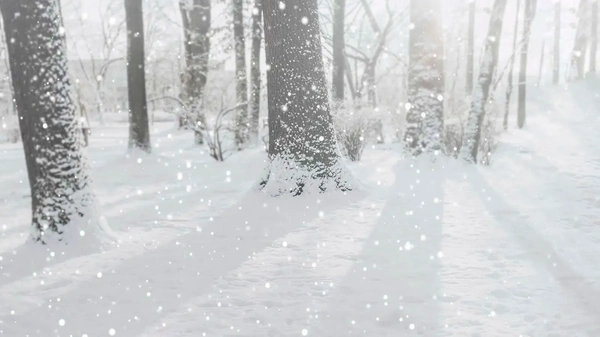
Anyone who checks the weather online every day knows that a disturbance is expected to bring a wave of cold and possible snowfall to several parts of our country. And when going out in the cold becomes difficult, what could be better than staying indoors, sitting on the sofa with a warm herbal tea – or mead, depending on your taste – and watching some good films? In this special feature, we've decided to accompany you on a (re)discovery of five titles where snow itself is a key element of the setting or even the narrative.
After all, there has always been something atavistic and primordial in the relationship between the camera and the white blanket. Far from being a simple meteorological element or Christmas decoration, in cinema it has often taken on the contours of a silent and omnivorous entity capable of isolating, hiding, and revealing at the same time. The blinding white becomes a tabula rasa on which the darkest human impulses are inscribed, a frozen desert that amplifies the sense of solitude or forces protagonists into a forced and claustrophobic coexistence, where physical survival goes hand in hand with psychological survival. Whether it's the scene of heinous crimes, the impassable boundary of a post-apocalyptic prison, or the cold mirror of a family crisis, snow transforms the landscape into a state of mind.
Wind River (2017, Taylor Sheridan)
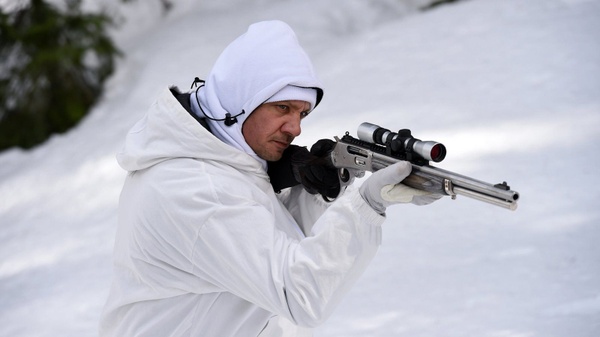
In the desolate Wind River Indian Reservation in Wyoming, experienced hunter Cory Lambert discovers the frozen body of a Native American girl, barefoot and with her lungs literally exploded due to the icy air inhaled during a desperate escape attempt. Joining him in the investigation is Jane Banner, an FBI agent as eager as she is unprepared to face the unwritten laws of that land forgotten by God and men. Together, the two must dig into the silence of a wounded community, where violence is an everyday language and justice seems an abstract concept, buried under feet of snow and indifference.
The second film directed by acclaimed screenwriter Taylor Sheridan, Wind River is a glacial and poignant neo-western, which uses the snowy landscape not as a mere backdrop, but as a metaphor for an America that has erased the traces of its sins. The snow here is a shroud that covers shame and preserves pain, a hostile natural element that punishes those who do not respect its rules. A solid and tense thriller, which rises to a powerful social commentary on the condition of natives, a tragic mask of a social drama that knows no thaw.
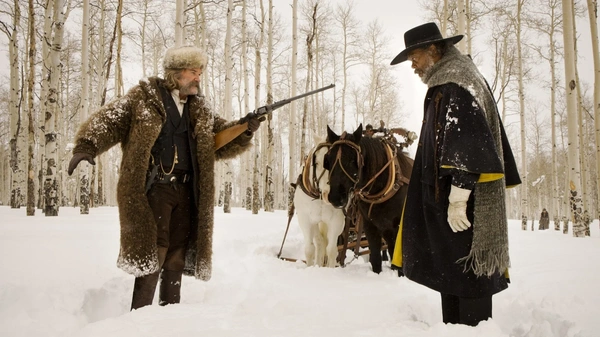
The Hateful Eight (2015, Quentin Tarantino)
Some years after the end of the Civil War, a stagecoach speeds through the winter landscapes of Wyoming, trying to outrun a violent blizzard. On board are bounty hunter John Ruth, his prisoner Daisy Domergue, and two strangers met along the way: former Union Major Marquis Warren and the presumed new sheriff Chris Mannix. Forced to take refuge in Minnie's Haberdashery to escape the storm, the four find themselves sharing the space with other mysterious travelers. As the storm rages outside, cutting off all escape routes, inside the cabin, tension progressively rises amidst lies, suspicions, and old grudges.
Quentin Tarantino transforms the Ultra Panavision 70mm widescreen format into a paradoxical tool for a claustrophobic chamber play, where the immensity of the white exterior only serves to seal the horror unfolding within. The Hateful Eight is an Agatha Christie-style mystery in a Western sauce, steeped in blood and cynicism, a theater of cruelty where snow acts as an impassable curtain, forcing the characters into a brutal confrontation with the lies upon which the United States was founded. Between razor-sharp dialogues and the notes of an Oscar-winning Ennio Morricone, the film is a descent into the coldest hells of the human soul, where the white of the blizzard inexorably turns blood red.
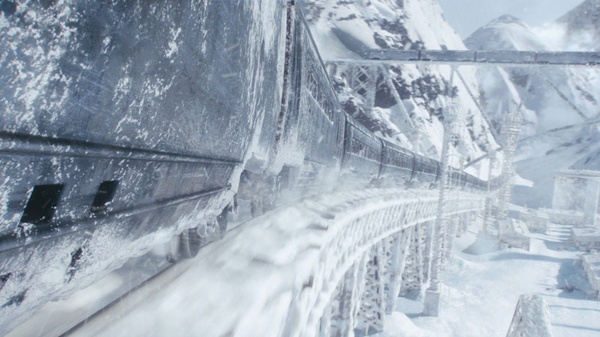
Snowpiercer (2013, Bong Joon-ho)
In the not-too-distant future, a failed experiment to counteract global warming has plunged Earth into a new, lethal ice age, which has wiped out almost all life forms. The only survivors are aboard the Snowpiercer, a train that moves in perpetual motion, continuously traversing the planet lashed by endless storms. Inside the convoy, a rigid class division prevails: while the rich live in vice at the front, people in the last carriages die of hunger and cold. Curtis, leader of the outcasts, leads a bloody revolt to climb car by car to the top and overthrow the established order.
South Korean director Bong Joon-ho makes his Hollywood debut and delivers a visually stunning dystopia on rails, where the concept of class struggle becomes kinetic and furious matter. The snow and absolute cold dominating the exterior represent instant death, making the train a closed and suffocating ecosystem, the only possible Noah's Ark in a world victim of the apocalypse. Snowpiercer is an auteur blockbuster that alternates brutal action sequences with moments of grotesque social satire, using the perennial white that streams past the windows as a constant bogeyman, reminding us that the true monstrosity is not the cold outside, but the cruelty that man has safely preserved inside the carriages.
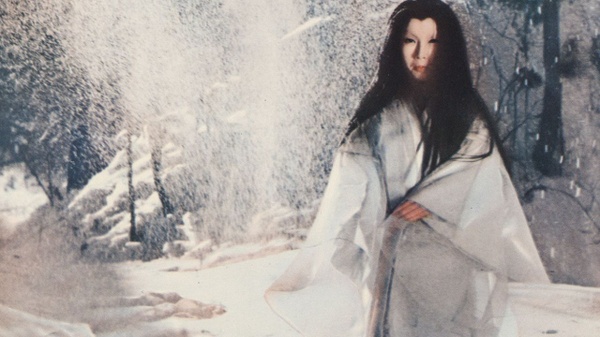
The Snow Woman (1968, Tokuzo Tanaka)
During a terrible snowstorm in a forest, young sculptor Yosaku and his elderly master seek shelter in an abandoned hut. In the night, a woman of spectral beauty and skin as white as ice appears and kills the old man with her icy breath, sparing the young man on the condition that he never reveal what he has seen to anyone. Years later, Yosaku, now married to the sweet Yuki and a happy father, is tormented by the memory of that night. The breaking of that oath will unleash tragic consequences.
Based on one of the most famous tales of Japanese folklore, already part of the anthology Kwaidan (1964), The Snow Woman by Tokuzo Tanaka is a gem of the kaidan-eiga genre that blends supernatural horror with gothic melodrama. Here, snow is not just a setting, but the very essence of the protagonist, an embodiment of a beautiful and deadly nature, ephemeral yet eternal. With cinematography that enhances chromatic contrasts and a staging of icy elegance, the film transforms the legend of the Yuki-onna into a poignant reflection on love and betrayal, where the purity of the landscape reflects the impossible purity of a feeling destined to melt like ice in the sun.
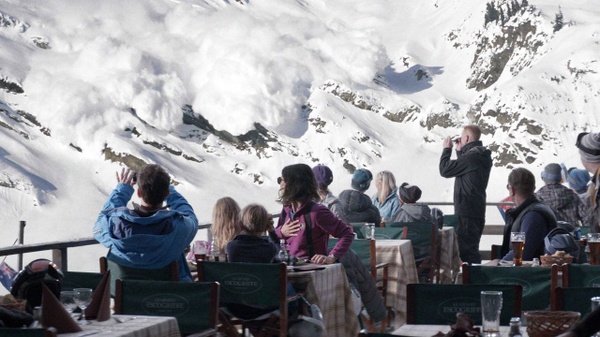
Force Majeure (2014, Ruben Östlund)
A model Swedish family, consisting of a father, mother, and two very blonde children, spends a week's vacation at an exclusive ski resort in the French Alps. During lunch on the panoramic terrace, an avalanche seems to be heading menacingly towards them. While the mother instinctively tries to protect the children, the father, seized by panic, grabs his cell phone and runs away, abandoning them. The avalanche ultimately proves harmless, stopping just before the tables, but the man's act of cowardice will have profound repercussions on the family balance, triggering a crisis not easily resolved.
Before the Palme d'Or for The Square (2017), Ruben Östlund had already demonstrated his ability to expose the hypocrisies of contemporary bourgeoisie with this psychological drama disguised as a black comedy. In Force Majeure, the snow and the aseptic, controlled environment of the ski resort serve as a social laboratory in which to microscopically observe the disappearance of modern masculinity. The dazzling white of the landscape reflects the cracks of a marriage founded on appearances, with the avalanche metaphorizing a betrayed trust. An uncomfortable film, as sharp as the cold it uses to expose human frailties.
Similar articles