The Reign of Talon and Overwatch's Narrative Turn: Why 2026 Aims to Be a Complete Arc
From "marginal" lore to multi-channel direction, Season 1 as an inaugural act and Talon as a power infrastructure within the live service
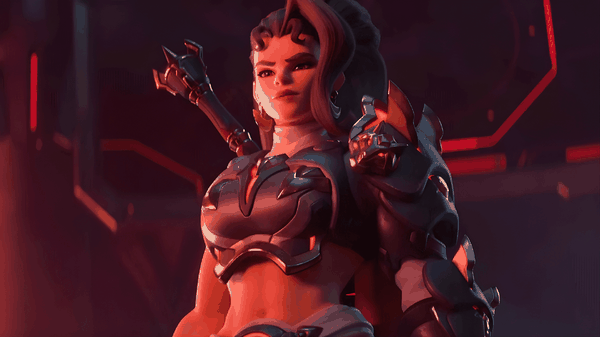


The Reign of Talon should not be read as just another seasonal coat of paint, a “strong” title slapped onto a battle pass and a handful of skins: it is, more concretely, an attempt by Blizzard to impose on Overwatch an annual “full-arc” structure, with a beginning, development, and conclusion, and to do so by immediately declaring a transmedia distribution (cinematics, motion comics, short stories, voice lines, in-game events) that spans the entire year 2026. Here, the rupture is methodological before it is narrative: for years, lore has been an archive of highly recognizable fragments with low operational continuity; now it is presented as an editorial framework that demands to be followed, and above all, measured.
The interesting point is that Blizzard arrives at this architecture with the stride of someone who has observed their neighbors and decided to stop pretending. Apex Legends has long normalized “seasonal” storytelling that doesn't just live in trailers: it infiltrates dialogues, maps, micro-relationships between characters, and uses serialization as a live service glue without expecting everyone to consume every external asset. Fortnite, on the contrary, has transformed the “season” into a pop culture device, a platform capable of absorbing events and crossovers and producing collective moments, often more memorable than the internal coherence of its lore. Overwatch, with The Reign of Talon, seems to want to take a piece from both formulas: the idea of a year as a long season with narrative progression and appointments, and at the same time the desire to link the story to a communal gesture, that is, to measurable participation.
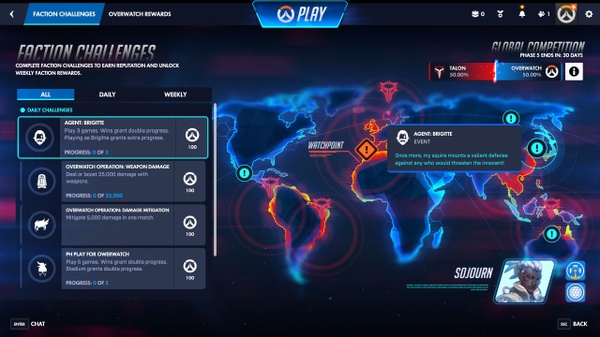
And in fact, Season 1, launching on February 10, 2026, doesn't just “contextualize” Talon: it introduces Conquest, a multi-week meta-event that formalizes the Overwatch vs Talon choice, linking weekly missions and rewards to the collective outcome, with the possibility of changing affiliation once the weekly pass is completed. This is not a minor detail, it's the thesis: the story tries to become behavior, that is, designed participation. The “reign,” then, ceases to be an ornamental noun and becomes a signal of territorial gain, of control and progression, with Talon deliberately placed in an offensive posture as the engine of the year.
Lore returns to the game: 2026 as multi-channel direction
If the thesis was clear in the first movement, here the task is to explain the how without resorting to a shopping list: Blizzard is not simply adding narrative content, it is designing a distribution chain where each medium has a precise function and, above all, a rhythm. Cinematics and motion comics become the visual pillars that establish turning points and iconography, short stories add density where images are not enough, voice lines are repeated micro-narratives, almost insinuated into the daily loop. The point, however, is more cynical and more concrete: in 2026, lore is no longer treated as an extra that the curious player seeks outside the client, but as a component that must touch the live service, contaminating its objectives, progression, and weekly rituals. And it is here that the change of pace becomes readable even for those with long memories: the story “returns to the field,” attempting to recapture that initial feeling of the franchise where the link between universe and game was not an attachment, but a perceptible subtext while playing.
Here enters the truly operational part, the one usually missing in “themed seasons”: orientation. A reader doesn't need you to tell them that motion comics exist; they need to know how not to get lost, that is, how to distinguish the backbone of the year from the peripheral material. The right idea, and also the most honest, is to treat the official index of narrative media as a canonical bibliography, not as a link at the bottom of the page: an axis that allows for building a readable chronology without resorting to amateur reconstructions. In other words, the operation does not rely on the quantity of assets, but on the possibility of consulting them as an archive with clear labels, where “what matters” is not decided by fan enthusiasm, but by a controllable editorial criterion.
From this choice follows a necessary renunciation: instead of feigning a total timeline of Talon, the special must assume The Reign of Talon as a narrative season with a minimum reading kit. Few high-impact texts, each with a function. A comic that acts as a contemporary trigger, because it carries the title and framing of the moment and makes you understand where the year begins. A comic that serves as a historical foundation, not for nostalgia but for the grammar of conflict, because it clarifies that Talon is not an antagonist invented yesterday and that its scars are structural. And a comic that serves as a “serial” bridge, useful for showing Talon as an operational presence in the present, not just as an abstract chessboard of leaders and plans.
At this point, it is worth mentioning the difference that governs every live service and is often hidden under marketing: a synchronous narrative and a diachronic one. The first is what happens while you play, with appointments and seasons that demand your presence; the second is what you catch up on whenever you want, through consultable media. Blizzard is trying to make them converge: in-game appointments that advance the plot and, in parallel, an archive that makes it reconstructible. If it works, you'll know not by the beauty of a cinematic, but by the feeling that seasons are no longer islands, but chapters that refer to each other.
New faces, new functions: Talon after Doomfist, between alliances and “system” weapons
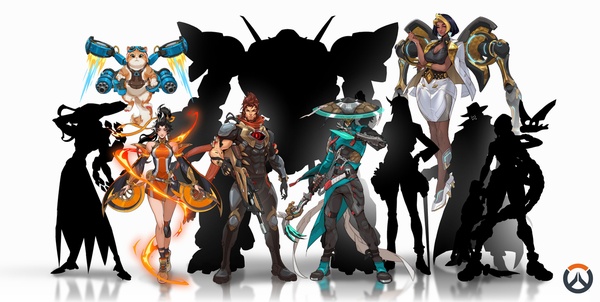
The first sign that Talon is changing is not a logo, it's a grammar: if Doomfist was the ideologue of selection through conflict, a leader who legitimized violence as a method, his ousting shifts the organization towards a more dynastic and performative power, where authority is not argued, but imposed. In this framework, Talon ceases to be just a shadow network and becomes a device that demands territory, resources, contracts, that is, administration disguised as conquest. It is here that the new characters should not be read as simple additions to the roster, but as operational functions of a recomposing Talon: industrial alliances, clan infiltration, defections from the Overwatch ideal, and a visible striking force.
Domina is the clearest declaration of this mutation: she is not “pure” Talon, she is Talon buying a portion of the world through a corporate partner. Her control tank kit is consistent with the idea of a power that stabilizes: elegant poke, segmented barriers that create angles, space control, temporary prisons. In the hands of a patient player, Domina risks turning fights into a legal matter: where you can be, where you cannot be, and how much it costs you to try. It is a form of soft oppression, and it is precisely the type of oppression that a “reign” prefers, because it lasts.
Emre, on the other hand, works on the dirtier side: he is the living friction between Overwatch and Talon, a former symbol returning as a weapon. His “run and gun” profile with burst, zoom that extends credibility at medium range, and especially lifesteal on explosives, suggests a DPS built to stay in the fight longer than common sense advises. Here the opinion is simple and not very diplomatic: if his ultimate is really as destructive as it seems, the balancing will depend more on activation times, response windows, and resource rhythm than on pure damage. Either you keep him readable, or he becomes a switch.
Mizuki is the type of support that designers like and lobbies fear: offensive ricochets, bouncing healing, positional return, targeted hinder, and an ultimate that heals and “negates” projectiles from the outside. It's a kit that speaks of Talon as an infiltration infrastructure, but at a meta level it introduces a concrete theme: how much is the zone worth, and who decides where to fight. If Mizuki enters compositions that already love space control, the risk is that the game will be played more on the perimeter than on the target. It works, but it can become claustrophobic.
On the Overwatch front, Anran is an aggressive, almost polemical response: fire, mobility, operational invulnerability, and a dual ultimate mode that even includes an explosive resurrection. Here the feeling is that Blizzard is testing how far it can push the concept of a flanker without it collapsing into frustration. If Anran is too autonomous, it becomes a “time” problem, not a damage problem: she enters, forces cooldowns, exits, and does it again. If, however, her windows are punitive, then she is a specialist character, and her real value will only emerge when the community understands when it is right to take risks.
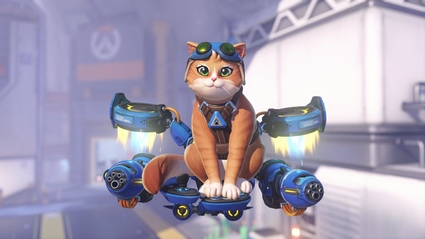
Finally, Jetpack Cat is the gamble that reveals the intention: Overwatch wants to regain lightness and identity, but it does so by inserting a permanent flying support with allied towing, i.e., a kit that can rewrite rotations, peels, and saves. Here the opinion is clear: the idea is brilliant as long as it remains manageable. If towing and mobility create too much elasticity, you risk nullifying choices that currently matter, such as positioning, commitment, and punishment. If, however, fuel limits and vulnerabilities in flight are calibrated, then it is a support that changes the rhythm without trivializing it.
Season 1 at the gates: what The Reign of Talon truly promises
With Season 1 approaching, The Reign of Talon presents itself as a structured attempt to bring order back to Overwatch's narrative, transforming the year into a readable trajectory instead of a sequence of themes. The promise is not so much “more lore,” as a more operational lore: an arc that proceeds in stages, relies on canonical media but, above all, re-enters the client through events and progression, seeking to make engagement and storytelling coincide without confusing the two. It is here that Season 1 tries to stop being a showcase and behave as an inaugural act: not just an opening of tone and lexicon, but the activation of mechanisms that make the conflict perceptible while you play. The first example is Conquest, a multi-week meta-event that formalizes the Overwatch vs Talon faction choice and translates it into “themed” missions with rewards and progression, i.e., measurable participation that attempts to make the narrative coincide with collective behavior, instead of relegating it to trailers and synopses.
In the background, system updates also arrive, which are not mere decorations: functions like Praise and the return of Accolades post-match (in an updated form) aim to intervene on the social climate and the way the match “ends,” i.e., on that micro-narrative made of recognition, friction, reputation; and in parallel, a refresh of the lobby experience and audio controls admits, with rare sincerity, that the live service today also lives at the margins of the match, in that downtime that nevertheless defines habit. Finally, there's Stadium, which is treated as part of the same push: revised competitive rhythm, tools for building builds, and a Hero Builder that promises agency and readability, almost an attempt to make “strategy” explicit instead of leaving it solely to community culture. If the framework holds, the measure of success will not be the quantity of assets released, but the ability to make it feel that “reign” is not a label, but a progression: Talon as a force advancing, Overwatch as a response recomposing, and a year that tries to close the circle without demanding faith, but offering continuity.
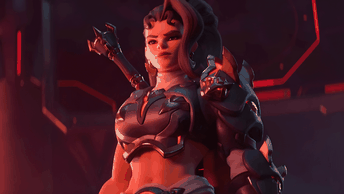
The Reign of Talon and Overwatch's Narrative Turn: Why 2026 Aims to Be a Complete Arc
The Reign of Talon is interesting not because it “enriches” Overwatch, but because it tries to change the live service contract: story not as a backdrop, but as an infrastructure that organizes the year and demands continuity. If Blizzard keeps its promise, it will do so on three very concrete fronts: readability (understanding the arc even by just playing), coherence (no dissonance between what the year tells and what the “basic” canon continues to suggest), and impact (events and choices that are not just rewards, but a perception of an advancing conflict). Otherwise, it will remain a more ambitious seasonal theme than usual, with an archive of external content acting as a crutch. The question, then, is not whether Talon “will dominate,” but whether Overwatch will finally manage to reconcile gameplay and universe without asking the player to become an archivist of their own entertainment.
Similar articles