Xerxes, the Myth and the Glory According to Frank Miller
From the Battle of Marathon to Alexander the Great
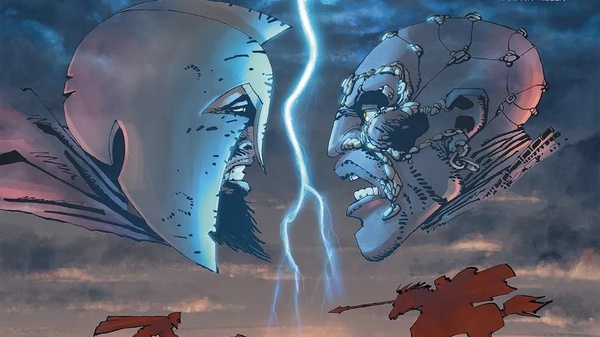


A new comic by Frank Miller is always big news, regardless of what one thinks about his career (and the positions expressed through his comics) over the last couple of decades. Everything before the 2000s is frankly indisputable, and that line of separation is curiously drawn by 300, a work that seemed to introduce a new phase in Miller's career, after his successes at Marvel & DC and the enormous popularity gained by his Sin City, even in cinema, even on the big screen. 300 remained for a long time an anticipation of a Frank Miller that never materialized, a timeline cut short by the 9/11 attacks and the much more political and cinematic turn the American cartoonist subsequently took. Xerxes - The Fall of the House of Darius and the Rise of Alexander, is a glimpse into that hypothetical future.
Xerxes - The Fall of the House of Darius and the Rise of Alexander
Published in 2018 between April and August (and brought back to Italy by Star Comics these days with a beautiful hardcover edition in horizontal format, the same format with which the Perugia-based publisher has already published 300), Xerxes is a five-part miniseries conceived to be the sequel (spiritual heir perhaps would be more accurate) to 300. As the long subtitle suggests, Miller's intention is to continue History, after the Battle of Thermopylae previously recounted, up to the boundless empire of Alexander the Great. And as often happens in Miller's more recent productions, however, Miller doesn't seem to care so much about the what, as much as the how.
Miller reweaves the threads with the narrative universe of 300 by rewinding the hourglass to 19 years before Thermopylae: a couple of pages to introduce the fleeting casus belli and bring the reader to Marathon, the site of the eponymous battle between Athenians and Persians that occupies the entire first chapter. Miller's style already contains in nuce that extreme synthesis displayed in his more recent works (mostly covers), but here it finds greater completeness in the broader context of the work and what it intends to tell.
Historical narrative, understood as a succession of events, causes, and effects leading to turning points, is of little interest and this is immediately clear. The temporal scanning of the various events covered occurs in jumps, not always marked by a date, but rather by a wide shot, by sequences of silent splash pages that mark the change of scene. From Darius to Alexander is the trajectory imposed by the subtitle, but it arrives like an avalanche, like a crack that causes a handful of stones to roll first slowly, then at an increasingly overwhelming pace, swallowing places and names, dynasties that flow in a handful of pages towards a Greek tragedy ending.
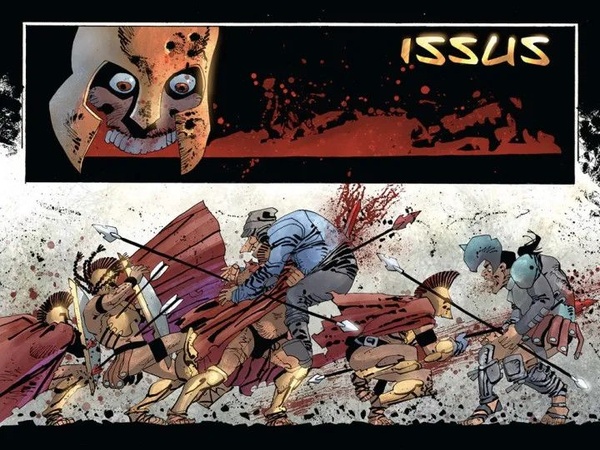
Yet the first chapter contains a dense narrative, in which the Battle of Marathon serves Miller to introduce a handful of characters, also subjected to a process of stylization in which history and myth merge. The most eccentric idea is the depiction of Aeschylus, the Greek tragedian who recounted the wars between Greeks and Persians in his works after having fought in them firsthand: in Miller's hands, he becomes a lethal assassin, with an elastic mind and capable of wielding weapons of exotic origin, from every corner of the globe, like rudimentary nunchaku. Miltiades, the Athenian general to whom we owe the idea of abandoning the phalanx to channel the Persians between two wings of Greek fighters, is branded upon his first appearance as a dandy: for Miller, it is the first manifestation in the West of Persian softness, whose rise and fall he will outline in subsequent chapters.
The one who addresses his general with a term probably unknown to the Greeks of the time is Themistocles, the acclaimed leader who would defeat the Persians by deception ten years later, dissuading them from besieging Athens after the defeat against the Spartans at Thermopylae: the only ornament Miller grants him is a battle helmet, which he tends not to wear, because he is annoyed. The fleeting sketch of this lack of characters already fades halfway through the second chapter, when the focus shifts towards the Persian dynasty, once again to celebrate their defeat achieved by deception: Athens is almost devoid of warriors, but brings the entire population to the shores, adorned for war, to appear as a multitude.
Two decades in two chapters and over a second condensed into the next three: Miller's pace accelerates, the temporal scanning fades, and the narrative slides from events to suggestions. Gigantic figures in human history, at the head of boundless empires, rise and crumble within a few pages, a kaleidoscope of triumphs and defeats, hate, love, and suffering, all soaked in blood, with the final part of the graphic novel perhaps an anticipation of where Miller's comic production would have gone if other muses had not called him elsewhere.
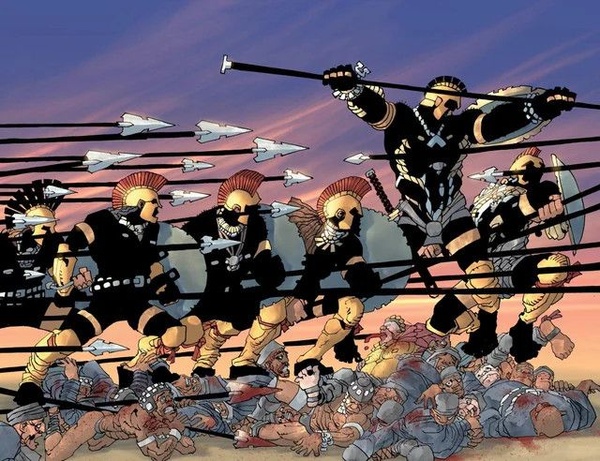
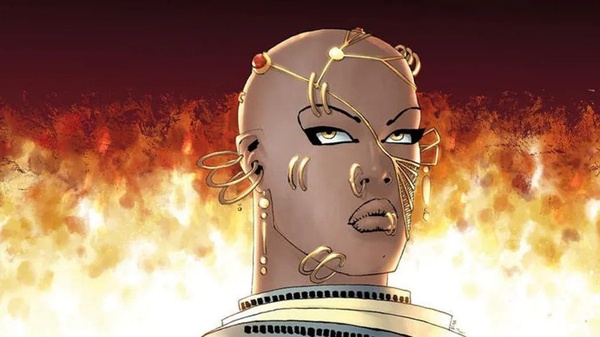
While plot and History fray their ties, martial impetus and wit are replaced by the burning of emotion, an eternal hunger for revenge fueled by an unreachable ambition for greatness. Miller's archaic prose then expands and gives way to the graphic sign in which a simplification of figures is opposed by the density of details, such as the gold with which Darius (III, even Miller loses track of the successions to the throne) is adorned. But the recursiveness of forms is the characterizing sign: traversed by suggestions ranging from the most elegant European comics to the decorative motifs of 5th century B.C. ceramics, Miller's pencils and inks seem to want to apply to comics the modus operandi of the oral tradition of the era, where the use of epithets and other repetition techniques allowed long epics to be remembered.
Supporting Miller on the page are the colors of Alex Sinclair, whose chromatic choices echo those traced by Lynn Varley (Miller's ex-wife) on 300, but without always managing to grasp their effectiveness. Sinclair's work is more technical (whereas Varley's was more artistic), but in some sequences, the excessive adherence to comic book canons does not fully blend with the cave painting-like ferocity of Miller's stroke.
Trying to sum up, Xerxes - The Fall of the House of Darius and the Rise of Alexander is a difficult work to categorize, which chapter by chapter increasingly distances itself from sequential narration, in favor of an “expressionistic” narration, made of flashes and suggestions, with much less clear ideas about where it's going compared to other recent Miller comics. Yet precisely this indeterminacy is extremely fascinating, a transitional work, in which Miller's inspirations and directions coexist and clash, just like the two figures in the title, led in a very long trail of war by forgotten recriminations until they recognize each other, on a deathbed, as two sides of the same coin.
Similar articles