If You Haven't Seen A Knight of the Seven Kingdoms Yet, You Missed the First Must-Watch Series of 2026
A Knight of the Seven Kingdoms is a TV story we'd like to tell more often: a franchise that gets lost and then finds itself again, listening to fans and finding the right solutions to expand.


Now that the final episode of A Knight of the Seven Kingdoms has arrived on HBO Max and the spoiler restraints are less stringent, we can finally analyze in detail why this Game of Thrones spin-off worked so well, giving viewers (fans and non-fans of George R.R. Martin's original saga and the first “historic” series) a true gem. A Knight of the Seven Kingdoms is a production story that gives hope in an entertainment world, as we know well, which even due to our laziness as viewers ends up being trapped in the logic of franchises. We see few original products, we tend to look for stories and characters with whom we have a certain familiarity: hence the need for those who hold the rights to great successful sagas to expand them far beyond their initial boundaries, giving us content to consume, new and at the same time already familiar.
A Knight of the Seven Kingdoms works much better than House of the Dragon
The literary world of Westeros, in this sense, lends itself much better than others to this operation, being able to span entire continents, nations, genealogies and already hinting in the main saga at millennia of previous history (and potentially subsequent). Yet House of the Dragon, the first offshoot of Game of Thrones, proceeds with some difficulty and has encountered several problems in calibrating its rhythm and in winning over viewers outside the pool of enthusiasts of Targaryen dragon matters.
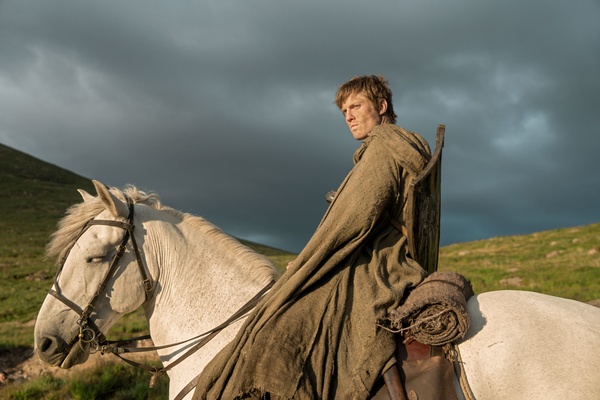
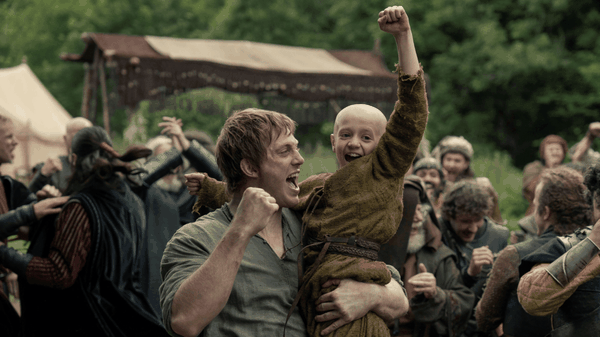
A Knight of the Seven Kingdoms, on the other hand, moved in the opposite direction, making choices so radically different in tone, approach, and production that it seems barely related to the two series already set in Westeros. Indeed, the real winning move of A Knight of the Seven Kingdoms is that it functions as a standalone series, completely original, in which high-sounding surnames and families echo, but is completely enjoyable for those who have never seen Game of Thrones. It pains me now to cause pain to fans of the latter by reminding them that eleven years have already passed since the first episode of the first season aired and we all have a decade more on our shoulders. So much so that little Dexter Sol Ansell, the breakout star of the new series in the role of Egg, has not seen a single episode of that series due to age limits, having been born after its airing.
A Knight of the Seven Kingdoms is a careful operation, aiming to expand the Westeros audience, to draw in new generations, ensuring its television longevity. However, it is not a cold and detached operation; on the contrary, it starts precisely by listening to the core group of fans, without, however, assuming a position of subservience to them. In fact, Ira Parker, a great reader and admirer of George R.R. Martin's books, is the showrunner of A Knight of the Seven Kingdoms and the second hero of this television success, which in the last episodes reached the audience peaks of its network companion The Pitt, a true phenomenon series of the last two years. Parker was called upon to expand the trio of late '90s novellas on which the series is based, working closely with Martin. This time, however, HBO allowed the original material to be brought to the small screen while maintaining its spirit, irony, earthly and jovial dimension that alternates in the author's books with the dramatic nature of events.
Small in scale, but produced with great care
A Knight of the Seven Kingdoms is, in short, the first series in which one feels the breath of Martin's prose, his attention equally divided between great power games and small squabbles of the common people, whose psychological and character complexity is never less than that of those who command and often oppress them. There are intrigues between princes and matters of honor between knights, but it's all local, provincial, far from the epic clashes between dragons and historical events that weigh down the costs and pace of House of the Dragon. Free from expensive special effects and the need to recreate large-scale scenes, A Knight of the Seven Kingdoms focused entirely on a handful of scenes: the medieval jousts and the cruel duels of the Trial of Seven, which reach their dramatic climax in the final two episodes.
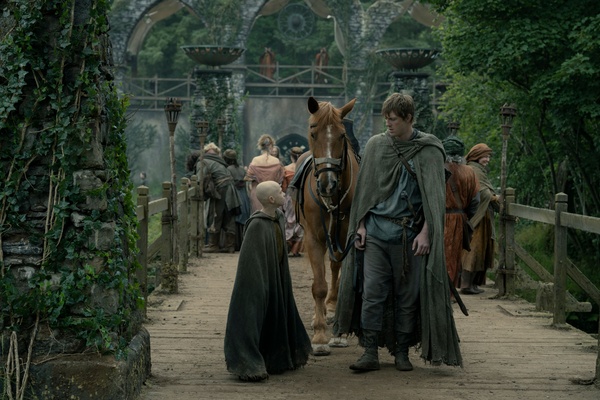
The series, therefore, is contained, local, but not poor for this reason; on the contrary: the production is impressive in scale and quality, with an entire tent encampment recreated with material and tangible sets, rich costumes (between armor and court clothes, there is truly much to delight fans of the genre) and very realistic wigs. All departments in which House of the Dragon is very lacking. The direction of the action scenes and the duels on horseback and with swords is adrenaline-pumping, engaging, with a minimal use of visual effects in favor of stuntmen and old-school cinema tricks. A splendid metaphor for the series is provided by the caravan of wandering artists who stage the stories of the Targaryen kings for the local population, in a riot of costumes and moving puppets. While AI undermines the realism of cinematic productions, A Knight of the Seven Kingdoms focuses on extreme materiality, on doing things well and for real.
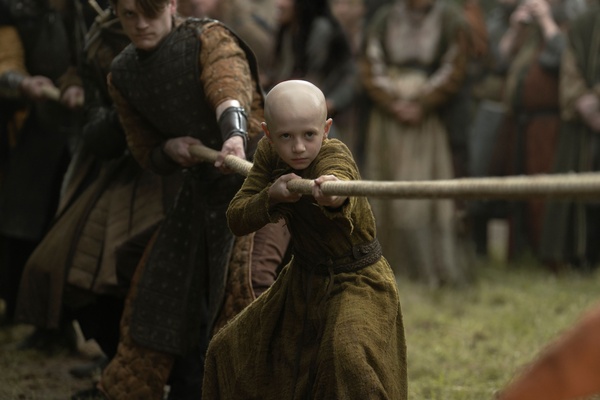
If the packaging is therefore carefully wrapped, it is obviously the content that makes the difference, and once again A Knight of the Seven Kingdoms intercepts the needs and spirit of the moment. The series revives from the past a more measured pace of an old-fashioned series, with great economy of runtime: the episodes are always under fifty minutes, for a total of just six episodes. Just enough to tell its story well, without overdoing it or unnecessarily dragging it out. The necessary time, however, to make us fond of Ser Duncan The Tall, Egg, and a host of minor Targaryens and Baratheons who, once again, are played by a large group of excellent Anglo-Saxon character actors. The fact that no cast member is particularly famous, but all have a lot of experience in film, television, and theater further increases the quality of the exchanges. Also because, unlike Game of Thrones, with the exception of Egg, the component of young actors here is reduced to a minimum and, for once, they chose not the pretty faces, but the right ones and the most capable actors. A small group of veterans capable of giving depth to characters who are barely mentioned in the original literary source and who here, even with little space, strike the viewer's imagination, see the excellent work of supporting actors Daniel Ings, Bertie Carvel, and Sam Spruell.
Score
Editorial team
If You Haven't Seen A Knight of the Seven Kingdoms Yet, You Missed the First Must-Watch Series of 2026
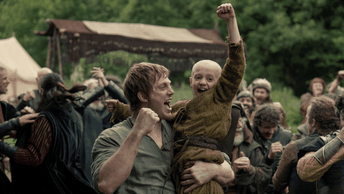
Well-written and directed, even better produced, A Knight of the Seven Kingdoms finds a way to give new life to Game of Thrones on the small screen, with a more contained story but no less epic than its sister House of the Dragon. The first season, engaging and impeccable, makes no missteps. So much so that its only flaw is that it ends too soon. Absolutely catch up on it.
Similar articles