The Weight, the best film seen so far in Berlin, is the directorial debut of an Irish editor
Surprisingly, the best film seen so far at the Berlinale is a debut presented out of competition, starring an unsparing Ethan Hawke.
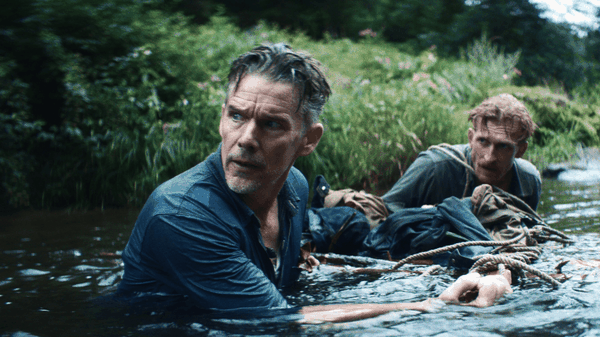


His name is Padraic McKinley, he's Irish, and until today he's edited commercial films that weren't particularly memorable: a practically unknown name that, after watching The Weight, his dazzling directorial debut, will be worth remembering, because he is the first and probably only revelation of this 76th Berlin Film Festival. A festival so short-sighted that it either didn't want or didn't know how to include The Weight in competition, even though it easily overshadows most of the films vying for the Golden Bear. It's worth clearing up any doubts, because whatever serendipity brought forth this gem, it deserves to find its audience, potentially a vast one, because we're talking about an old-school film, excellently crafted, reminiscent of William Friedkin's Sorcerer. The Weight blends thriller and Western influences, with a dirty half-dozen characters engaged in a particularly risky and uncertain mission, yet it features one of the simplest and most immediate single narrative units: a parent willing to do anything to embrace his daughter again.
That dirty half-dozen in the Oregon forests
It's Oregon, 1933, with the Great Depression firmly underway, and Murphy (Ethan Hawke), a man with capable hands and a sharp mind, ends up in prison due to a series of more than unfortunate circumstances. A widower with no connections, he finds himself behind bars, anxious about his daughter's fate, destined for correctional homes and then the foster care system, even though her dad has solemnly promised her he'll come get her as soon as he's out of prison. When Warden Clancy (Russell Crowe) of the labor camp where he's serving part of his sentence makes him an offer, Murphy knows it's something illegal and dangerous, but also the only possible and available shortcut to find his daughter. So he puts together a team with his fellow inmates and forced laborers for an assignment he still knows nothing about.
The "job" that could get him out of prison involves illegally transporting a quantity of gold bars out of the mine where they are stored before it's assaulted by panicked and hungry crowds, just days after the announcement (evidently not so secret) of Roosevelt's intention to take possession of all deposits to revive the country's economy. Two trusted guards will accompany four men on a journey on foot through the Oregon forest to a rendezvous point where they will deliver the gold and, in return, gain their freedom and a wage.
With backpacks laden with "the weight," the group begins its slow, dangerous crossing, joined by an indigenous woman (Julia Jones) who has figured out what's happening: she claims to have no designs on the gold, but simply wants to leave the mine. The film retraces, in a slow countdown to delivery, the six-day journey through a forest where one always has the feeling of not being alone, perhaps not entirely without reason. In addition to poachers and vagrants, the group must also guard against internal betrayals: if even a single gold bar is missing upon delivery, the entire agreement falls apart. Murphy, however, is desperate enough to lead the group through the forest, finding solutions to impossible problems. There's even a scene where he has the gold bars thrown to him one by one while he balances on a rotten rope bridge over a chasm, because crossing with the backpack would cause it to collapse. Thus, with bated breath, we follow the throwing of the gold bars, in a diabolical version of the baseball that Clancy loves so much.
The Weight is an original film inspired by the great scams of the Great Depression
The Weight is a very simple film in its premise, but intriguing in its historical setting: it was written by a trio of screenwriters, Leo Scherman, Shelby Gaines (who also composed the soundtrack with the Latham brothers), but especially Matthew Booi. The latter conceived the story while researching the Great Depression era and how the economic crisis and rising gold prices generated an endless series of scams and thefts related to mined gold. It is an original story, capable from the very first moments of generating tension in the viewer, who is constantly kept on edge by the (correct) impression that no one is truly safe.
Maintaining the tension is precisely Padraic McKinley's excellent direction, who certainly has an extremely effective script in his hands, simple yet carefully written and without weaknesses, and he translates it perfectly into a feature film that looks to the classics of Westerns, heist movies, and thrillers to manage the escalating tension of the film. The imagery and approach are those of cinema from another era, which, despite realism, prefers a construction between cinema, illustration, and comic book: there's a truly memorable scene where a murder occurs under heavy nocturnal rain, which we glimpse whenever lightning illuminates the scene for a few seconds, barely allowing us to distinguish the figures in the torrential rain and leaving us and the protagonist in doubt as to what actually happened. Padraic McKinley also handles the editing, choosing a dry style that further highlights the excellent craftsmanship of his film, immersed in the forest, tactile, truly "earthy" and wild. He allows himself just a couple of poetic licenses, such as a transition where the figures of the next scene emerge from the full moon in the sky; he also indulges in that circular construction (with the closing scene recalling and enriching the opening), but everything works so well that one leaves exhilarated.
Ethan Hawke knows how to choose his projects very well
What also makes a difference is Ethan Hawke, the absolute protagonist of the film, who delivers a significant acting performance, given that his character is a trope, a Western archetype of the good man forced into a risky gamble. However, not only does it work, but he is also engaged in moments of great physicality that prove his capabilities as an action hero. Not to mention his intuition: in recent years, he has managed to take on significant challenges that have almost always turned out to be winning bets (see the cult First Reformed, Linklater's Blue Moon seen at the last Berlinale, and the horror Black Phone). Hawke has exquisite taste and the ability to discover small films like this with great potential and elevate them. Moreover, he is surrounded by a cast of not-so-known character actors who are truly effective, with that tough and gritty vibe just right for a film that looks so much to the Western genre despite not being strictly set in the West, in which everyone gives their best. So much so that even Russell Crowe (the only other familiar face in the operation) delivers his best performance in many years.
Score
Editorial team
The Weight, the best film seen so far in Berlin, is the directorial debut of an Irish editor
Between souped-up cars, baseball, risky bets, and "dirty" gold bars, The Weight is already poised to become a small cult classic in a genre less explored in cinema than it once was, and rarely, in recent years, with such effectiveness. Perhaps one could argue it has an overly classic approach, were it not for the unusual setting, amidst coniferous forests, which creates an energetic contrast in a very masculine film that features only two female characters, yet they possess incredible character, including the protagonist's tender and irresistible daughter. In short, there are every reason to be excited, because The Weight is a great film in and of itself, even more impressive considering it's a directorial debut.
Similar articles