My Brother is a Viking: Whether crazy, on the spectrum, or sporting a terrible haircut, Mads Mikkelsen never misses
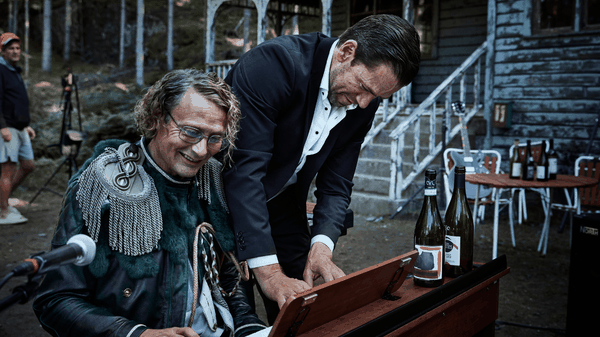


It's not hard to understand Northern European filmmakers' obsession with Mads Mikkelsen (here you can find our interview with the Danish actor): who wouldn't want an actor who is talented, handsome, intense, and so internationally known and loved that his mere presence increases the media exposure of their film and the chances of global distribution? Vinterberg and Refn, who have repeatedly wanted him by their side in the past, know this well. However, no one comes close to the degree of obsession of Anders Thomas Jensen, who with My Brother is a Viking returns to work with Mikkelsen, his fetish actor, for the sixth time. A brotherhood reciprocated by Mikkelsen, who has repeatedly said that he is only willing to tackle certain characters and situations if Jensen is behind the camera, whom he considers a unique director even in the landscape of Danish cinema.
Mads Mikkelsen Returns to the Spectrum
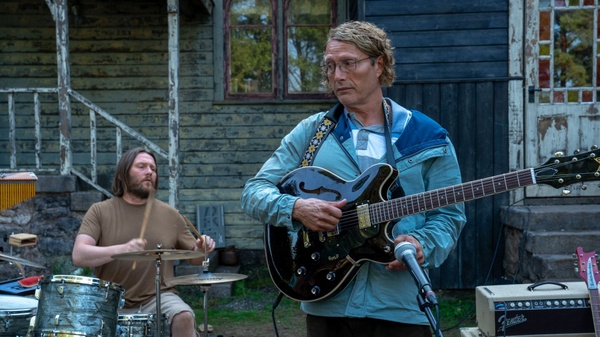
This statement probably also refers to Manfred, the bizarre protagonist of this black comedy with truly Northern European humor (meaning it often leaves you bewildered or perplexed). Mikkelsen here plays an adult man whose personality is clearly within the autism spectrum, although the film conveniently (?) decides not to specify exactly where. Methodical, at times obsessive, impulsive, and very stubborn, Manfred often displays the narcissism and obstinacy of a child, with behaviors that make things difficult for those around him. Among his obsessions, for example, is stealing other people's dogs, pretending they belong to him.
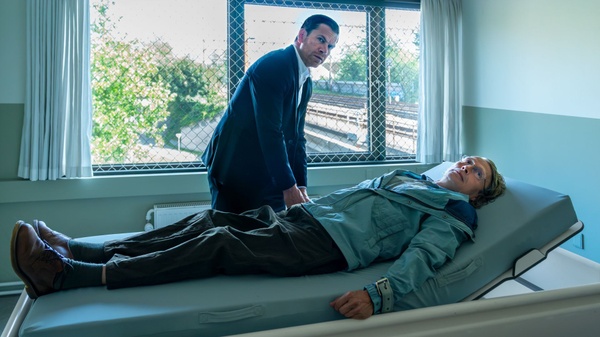
His brother Anker (Nikolaj Lie Kaas), decidedly more conventional, proves to be no less problematic at the beginning of the film. He barely has time to give his brother instructions on how and where to hide the loot from a robbery he pulled off before the police surround the apartment building he lives in and arrest him. Upon his release from prison, Anker is convinced he can finally recover the money and enjoy the fruits of his criminal labor. However, he hasn't reckoned with Manfred, who is very fond of him, and who, during his long imprisonment, has developed a new, worrying obsession: he is firmly convinced he is John Lennon of the Beatles, so much so that if someone addresses him as Manfred, he doesn't hesitate to jump out of a moving car or the nearest available window rather than confront reality.
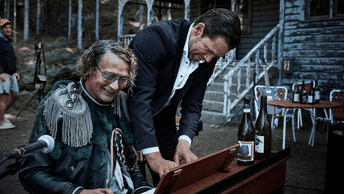
Anker thus finds himself having to humor his brother while trying to get help recovering the money, dodging a former accomplice who has already spent his share of the loot and now wants his colleague's untouched portion, threatening violent action if it's not handed over. Always at ease in the territory of the paradoxical, from this post-incarceration family reunion, Jensen weaves a kind of road movie of clear comedic stamp in which, to humor his brother, the protagonist agrees to his psychiatrist's funny request to reunite the Beatles, forming a band of people convinced they are one or more members of the Liverpool quartet. What do the Vikings in the title have to do with it? The viewer will only find out at the end of the film, after an animated introduction that tells a macabre but not humorless story of brotherly love like that between Anker and Manfred.
It's a bit of a hit-or-miss with films like My Brother is a Viking. This is because the film relies heavily on a comedy so rooted in the language and sense of humor of its country of origin (Denmark) that it can happen to be left hanging in front of scenes, situations, and exchanges where the viewer perceives that the film expects to make them laugh, but it's not a given that it will. Also because the director loves to juxtapose surreal situations not without violence and funny twists, with unpredictable effects. Violence is then portrayed in a somewhat realistic way, a detail that makes it even more complicated to laugh at what is happening on the big screen.
My Brother is a Viking wants to talk about identity, but seems to lack a well-defined one
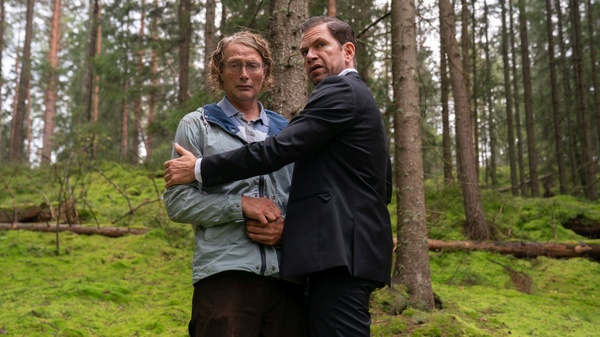
In fact, My Brother is a Viking wants to be a film about male identity seen from the two opposite poles of its construction, attempting to find a balance to truly and sincerely communicate. On one side there's Manfred, who, despite his obsessive disorders, lives his identity exactly as he wants it to be. On the other side there's Anker, the “normal” character who struggles to accept his brother's whims. Yet the film immediately highlights how even his identity, though socially more acceptable, is the result of a construction of what is considered right and proper for a man, a criminal, a person who struggles to contain anger and often transforms it into violent outbursts, while often being subservient to the will of others.
One should not expect great realism in a film with such paradoxical situations. However, partly due to the untranslatability of certain gags, and partly because the screenplay is dotted with many over-the-top and excessive but not always successful figures, the film at times is tedious, at other times distressing. What saves it, not surprisingly, is Mikkelsen, who skillfully manages the most extreme and less thought-out excesses of his character, putting heart into a film that often, for the sake of absurdity and exaggeration, even comes across as detached.
Score
Editorial team
My Brother is a Viking: Whether crazy, on the spectrum, or sporting a terrible haircut, Mads Mikkelsen never misses
My Brother is a Viking is a film whose appeal is highly subjective and largely depends on how closely the viewer's humor aligns with the rhythms and approach of Northern European comedic cinema. However, the fact remains that its quirky and over-the-top characters are often quite unpleasant, so much so that the director's attempt to find redeemable humanity within them even seems a bit forced. Fortunately, he has the usual, magnetic Mads Mikkelsen at his disposal, who injects pathos and emotion even where the film appears very cold, detached, and tedious.
Similar articles