The Outer Worlds 2: An Otherworldly Review!
Obsidian takes us to space with the new chapter in its RPG saga!


The Outer Worlds 2: The Return of Obsidian!
Do you love RPGs? Are you a Sci-fi graduate and for every choice in your life, you can't help but decide by rolling a die? Above all, are you desperately searching for a video game capable of satisfying your craving for Western role-playing games? All you have to do is board this spaceship, buckle up, and read our review of The Outer Worlds 2! After the first episode, well-made but certainly not perfect, Obsidian returns to the forefront and brings us back to this dystopian future where space is controlled by totalitarian states, religious corporations, companies with immense power, and organizations far outside the law. The controlled and safe zones are far fewer than those where violence decides who is right or wrong. I'll answer a question right away: The Outer Worlds 2 is not a direct sequel to the first installment, and you can play it even if you're new to the brand. Of course, it's generally recommended not to miss the previous The Outer Worlds, partly because it remains a great game, and partly because you can get a taste of this particular retro-futuristic universe that owes so much to Fallout, but has proven capable of standing on its own two feet. You don't need to be a video game expert to understand how strong the link is between Bethesda's saga and Obsidian's; after all, Obsidian itself created Fallout New Vegas, a chapter that was supposed to be a “simple” spin-off and turned out to be one of the most beloved installments in the series, but we must never forget that, regardless of the brand, Obsidian has given us many high-quality titles.

The Plot of The Outer Worlds 2
Let's get straight back to talking about The Outer Worlds 2 and discover its plot: we are no longer in Halcyon, but in the Arcadia colonial system, on a mission for the Earth Directorate. The situation is not the best given the continuous conflict between corporations and organizations and the increasing frequency of space-time rifts, with the result that both the system and communications with Earth are at risk. The suspicion that there is a connection between the rifts and the struggles between corporate organizations is strong, and it will be up to us to discover the truth. The main forces at play are three: the Order of the Ascendant, a sect dedicated to the ascension of humanity; the Sub Rosa, dedicated to smuggling and other illegal activities; and the inevitable Auntie Cleo's Solutions, a mega economic corporation where consumerism seems to be the only recognized value. All three with their own way of seeing the world, all three with not always noble interests, all three immersed in a relentless struggle. The protagonist is brand new, and we can create them as we wish thanks to a very versatile editor, not only from an aesthetic point of view. We will be an esteemed ship captain, but we will have to choose our origins, which will shape our personality and allow us to have unique options in certain situations and dialogues. For example, I started by impersonating a former laborer, and this allowed me to choose some direct approaches when talking to other characters, but I could have chosen other social backgrounds, and these would have led to further possibilities: if I had been a former science professor, how many times would my knowledge have been useful?
The Outer Worlds 2: Role-Playing Power!
The possibilities are truly many, and to these are added the abilities we can choose at the beginning of the game and improve as our experience grows. Using the most disparate weapons, knowing how to convince anyone thanks to eloquence, being a capable engineer, and so on, with a range of options and situations that opens up more and more. Among other things, we can acquire new behavioral traits based on what we do in-game: for example, after a long period spent crouching, the system proposed that I unlock a new profile: enjoying an increase in movement speed while crouched, but having such creaky knees that they would make noise, so much so that enemies would have an easier time hearing me, limiting my effectiveness in stealth. It's impossible to list all the possibilities, because there are so many, and they evolve with increasing experience levels, with the result that we will have a superb role-playing system at our disposal. Naturally, our choices will lead to real action-and-reaction mechanisms on multiple levels. Actions or decisions can change how a character or faction views us, and some choices will significantly impact the balance of the entire Arcadia system, so much so that these situations can be noticed around the various visitable planets through various elements, such as radio transmissions and the like. If it wasn't clear, we are facing what we can define, without mincing words, as a role-playing system of great depth, which will surely delight all fans of the genre.

The narration is of the highest level, but to get the most out of The Outer Worlds 2's lore, you need to accept that the many available texts (all in Italian) must be read to get a comprehensive idea of the world around us. It must be said that even the most avid role-players might find the sheer volume of lines present in dialogues, journals, and digital documents we find to be excessive, but all of these contribute to recreating a truly credible and detailed universe. A special mention goes to the companions who will help us in our mission, each with their own well-defined personality and stories to tell, so much so that it's very easy to become attached to those who will take up arms alongside us. Without wanting to spoil anything, I'll just say that some might have more than two arms to offer for the cause, but all of them have well-written backstories that will make them companions who will enter our hearts, for better or worse. Together with them, via our spaceship (and operational base), we will move through the Arcadia system, navigating between the main mission and a large number of secondary quests, for a total playtime that the most completionist gamers can easily push to almost eighty hours. You could also rush through, following only the main plot, but you would miss the best parts of The Outer Worlds 2. Furthermore, unless you play at the lowest difficulty level among the four available, successfully completing some missions without leveling up or utilizing the help we could get from secondary quests will be quite complicated.
The Outer Worlds 2: The Technical Side Doesn't Disappoint Either
There are multiple ways to complete a task, including sabotage, eloquence, stealth approach, rushing into enemy territory with guns blazing, and so on. As much as I can only rely on my own experience and not on dozens of runs, even the quietest infiltrator or the most experienced diplomat will sooner or later have to resort to weapons, a situation in which a fairly simple but solid gunplay is utilized. In addition to shooting, hitting with a secondary weapon, or throwing grenades, we can use inhalers that will have various more or less curative functions, but if we want to use items in our inventory, we must remember to do so only when we are away from the fight. Furthermore, we will have access to certain mechanisms that can be used for a limited time with a rechargeable bar, whose usefulness could save our lives: launching acid, slowing down time to improve aim, raising shields, and so on. We can also bring two companions with us at a time, and each of them will have abilities that we can use. Even when the situation gets "hotter" and combat is necessary, the most satisfying factor is that we will have the opportunity to take the path best suited to our abilities, without forgetting that we might find some paths blocked, perhaps linked to specific knowledge: for example, if we are not good enough as lockpickers, we simply won't be able to open certain doors. As you will have understood, the gameplay of The Outer Worlds 2 is also extremely enjoyable, this time supported by three different camera views: first-person and two third-person, one further away and one closer to the protagonist. While first-person remains the best way to experience this adventure, the other two allow even those who absolutely must see their protagonist on screen to approach Obsidian's title. Personally, I am a huge fan of third-person, while first-person has often given me many problems related to motion sickness, but for some reason, the subjective view in The Outer Worlds 2 did not cause me any problems at all, showing the quality of the Obsidian team's work also from a technical point of view.
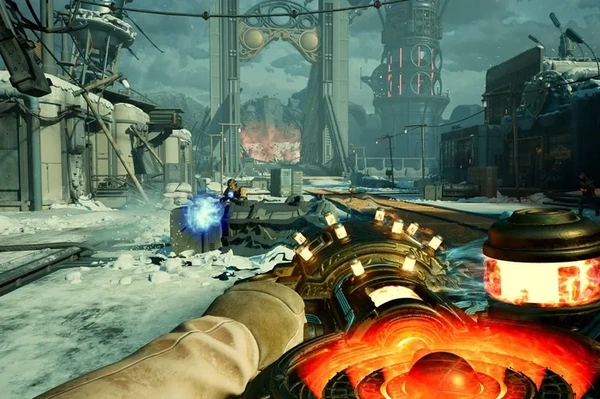
On the other hand, the visual impact of The Outer Worlds 2 is excellent, also in relation to the breadth of the environments, where we will visit several very different planets in a semi-open world mode. On one side, we have a respectable artistic direction that contributes to recreating the setting of a future so dystopian that it seems dramatically caricatural to us, as a clear satire of our present, between pressing advertisements for products born of rampant consumerism or ultra-nationalist propaganda that aims to transform every person into the model citizen. On the other, everything runs smoothly without particular hitches, although some visual bugs did appear, but it would have been difficult to expect everything to be perfect at the launch of such a vast title. I want to say that, however, I did not witness any errors that undermined the quality of my games or forced me to redo any sections. Obsidian has shown enormous attention in providing gamers with various game options, and in the Xbox edition that I was able to test on Series X, a mode dedicated to graphic quality, one to performance, and a balanced one are available, but in none of these does it ever drop below 30 FPS. A big round of applause to the development team for including several options to make The Outer Worlds 2 accessible to more people: I gladly spend a few words on the possibility of varying the field of view on screen, a choice that makes the game usable even for those who suffer from particular visual impairments, a possibility that it would be nice to have on every video game.
Naturally, the audio also does not disappoint, and between excellent English voice acting and a good soundtrack (even if the themes are not that memorable) it pleasantly accompanies us to the end of the game, which will obviously be affected by the choices made during the adventure, with the result that the replayability rate is very high. Obsidian must be applauded, because The Outer Worlds 2 manages not to betray expectations and presents itself as a pure role-playing game in a market that has fewer and fewer quality exponents of this genre. If you love RPGs, don't be scared by a few scattered bugs and the amount of text to read: conquering the universe of The Outer Worlds 2 is an endeavor you must not miss!
Score
Editorial team
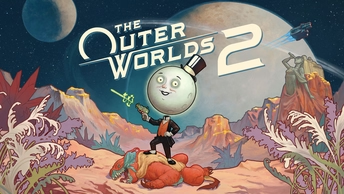
The Outer Worlds 2: An Otherworldly Review!
The Outer Worlds 2 is exactly everything we could have hoped for in the sequel to the title that captured our hearts back in 2019. Technically almost flawless, with gameplay improved from every point of view, and with a world that is increasingly realistic in its satire of our reality, The Outer Worlds 2 is a pure RPG, capable of offering practically everything that can excite a role-playing game purist. What's astonishing is the depth of choices our character can make and how so many elements can change based on them. Personal relationships, power struggles between factions, and even the future of the Arcadia star system: everything could be impacted by what we do. Add to all this a meticulous script down to the smallest detail and an artistic direction of rare beauty, and the game is made. A few bugs cannot scare a true space captain, nor can the enormous amount of text to read (all in Italian) to fully understand the game's lore. To summarize everything in one sentence, The Outer Worlds 2 is a true RPG, the likes of which are rarely found anymore.
Similar articles