Esoteric Ebb: A Review of a Quirky Discolike
A surreal fantasy universe that knows how to entertain its guests.
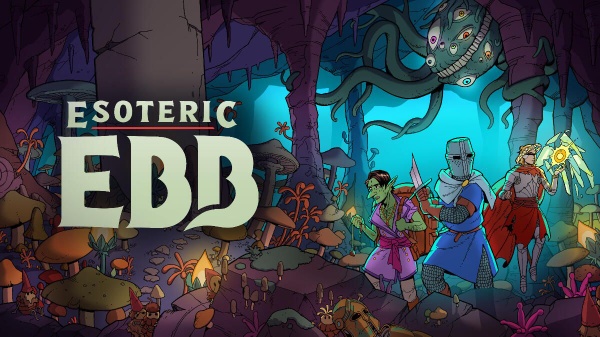


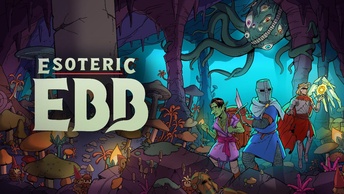
Disco Elysium can well be considered one of the most influential RPGs of recent years: ZA/UM's work, with its concept of role-playing based on narrative and great freedom in defining one's character, has inspired a series of titles with similar characteristics, which have been labeled as "discolike." Most of them will be released in the coming years, but there's one recently released that deserves your attention: Esoteric Ebb.
Esoteric Ebb doesn't shy away from the discolike label; in fact, it flaunts it with a certain pride, and it couldn't be otherwise: the similarities with Disco Elysium are so many and so obvious that it would be pointless to deny them. Esoteric Ebb faithfully retraces the steps of ZA/UM's title right from its basic structure, which is that of an isometric CRPG, with the connotations of an investigative adventure focused on narrative.
The Strange World of Esoteric Ebb
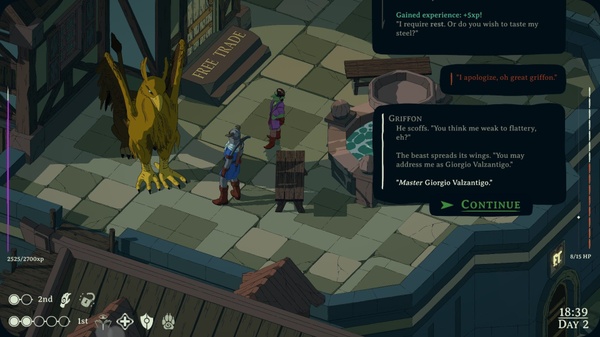
Esoteric Ebb takes place in the town of Norvik: at first glance, this setting echoes the classic medieval fantasy iconography already encountered in countless other games. Soon, however, one realizes that the fantasy canons have been subservient to an atypical representation, where bizarre, seemingly out-of-place elements are not lacking: for example, you might come across a row of bicycles parked by the roadside, or a jukebox inside a tavern.
The population of Norvik is made up of the usual mix of humans and assorted fantasy races: NPCs thus have a familiar appearance, behind which, however, often lies a complex personality, waiting to be discovered, with some eccentric touches. In its details, Esoteric Ebb proves it wants to be much more than it appears on the surface: it is made clear that Norvik itself is nothing more than a small center within a world with a past, traditions, and mythology that extend beyond the town's borders.
Here too, an analogy with Disco Elysium recurs, whose location, Martinaise, is in turn presented as a fragment of something much larger. The painful difference between the two works is that the universe of Esoteric Ebb will probably be expanded in the future with one or more sequels, while that of Disco Elysium is suspended in the limbo of a lawsuit between its authors and the franchise owners... but that's another story.
Esoteric Ebb tends to push far beyond the canonical horizons of fantasy video games also regarding the themes it touches upon. Suffice it to say that Norvik is approaching its first elections, in which parties advocating rather clear ideologies will participate, and the player is warmly invited to delve into the discussion and take a stance on the matter. Needless to say, this development of a social dimension closely resembles that of Disco Elysium.
The Writing of Esoteric Ebb
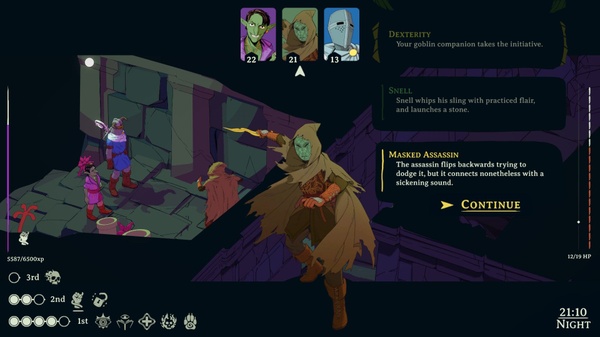
In Esoteric Ebb, we are called to step into the shoes of the Cleric, a religious figure with an innate talent for magic, who is tasked with investigating a shop explosion that seriously threatens to undermine the serenity of the elections. Accompanied by the goblin Snell (whose race is oppressed by humans), the Cleric will cross paths with many people and follow various leads before embarking on the path that will lead him to shed light on the matter.
Obviously, this setting is a pretext to tell us about an entire world and its inhabitants, a pretext to write that river of text that represents the soul of Esoteric Ebb: the game's author, the Swede Christoffer Bodegard, has never made a secret of being interested in what he calls "interactive storytelling." Ultimately, the quality of a discolike is largely measured by the quality of its writing, and a comparison is inevitable.
Disco Elysium owes its brilliant dialogues to a chaotic creative process, where multiple hands wrote and rewrote various parts before arriving at the final draft. This was an inefficient modus operandi that caused production delays, but from which a very high-quality result emerged. Esoteric Ebb, on the other hand, is the fruit of a single person, so the register tends to be more monotonous, and the words cannot aspire to the profound, vivid heterogeneity found in Disco Elysium.
Despite this, Bodegard surprisingly succeeds in telling us about his complex universe, ranging with ease from the most majestic concepts to the lightest: one moment you reflect on the deities that make up the pantheon of Esoteric Ebb, the next you realize you can no longer open your bike's padlock. Conversations are rarely boring, thanks also to a marked underlying irony.
The Role, Outer and Inner
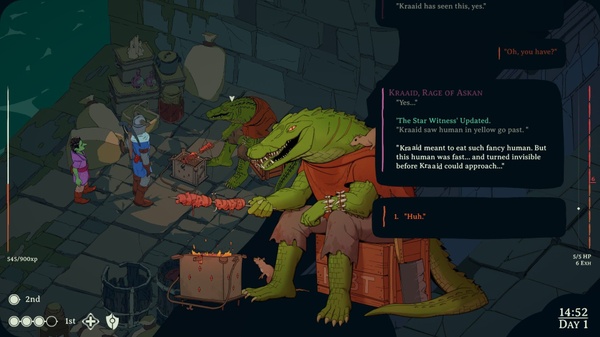
In Esoteric Ebb, you spend time reading (the text is in English only, you've been warned) and making decisions that will influence various aspects of the events. The first choice to make concerns the protagonist: the player will have to decide what kind of Cleric to be, interpreting a character faithful to the role or deviating greatly from it, perhaps becoming a wizard or a rogue.
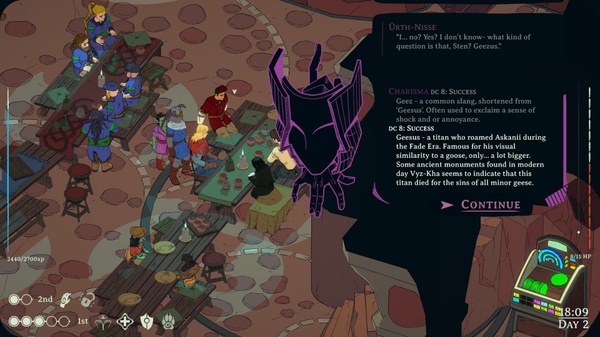
The Cleric will be confronted with a myriad of topics to comment on, and the player can adopt various opinions on them: we mentioned politics above, but there are also philosophical, religious, social, etc., questions awaiting an answer. For example, you can show empathy, contempt, or something in between for the condition of goblins in Norvik and observe Snell's reactions.
One of Disco Elysium's most successful insights (yes, we always end up there) was to transform the impulses of the human psyche into skills/NPCs, with whom to engage in illuminating inner dialogues. Esoteric Ebb also adopts this formula, with two fundamental differences: here the skills/NPCs are only six and all participate constantly in dialogues, while in Disco Elysium there are many more, and their talkativeness depends on the build used.
Unfortunately, this design choice is open to criticism: Esoteric Ebb's "inner NPCs" are indeed well-characterized and give rise to fascinating conversations, but they lack the elegance of the reference model. In this respect, the copy Esoteric Ebb is quite distant from the glories of the original Disco Elysium, but it is understandable, given that this is perhaps the most difficult merit to reproduce among all those inherent in ZA/UM's title.
Gameplay Depends on a Dice Roll
Each of the six abilities has a score, which depends on the points allocated by the player and other factors (e.g., equipment). This score is constantly checked during inner dialogues: if it reaches the established threshold, then the ability/NPC will make a witty comment or otherwise be useful in some way; otherwise, the inner interlocutor's remark will sound duller.
To succeed in his actions, the Cleric will often have to pass a check with a roll of a 20-sided die. More arduous tasks will require rolling a higher number, and you can help yourself by increasing the score of the ability in question to get a small bonus. In case of failure, the outcome could be disastrous; however, some checks can be repeated multiple times.
Among the many peculiarities that Esoteric Ebb has drawn from Disco Elysium, we also find the combat system, but here the discussion becomes curious. ZA/UM's work had to forgo a proper combat system because it was too expensive and demanding to implement: as a fallback, there is a kind of textual combat, essentially composed of choices, which is moreover used very little.
Esoteric Ebb has appropriated this system, elevating it from a fallback to a "feature," if you'll pardon the expression. Battles thus unfold by deciding which move to make among those described on screen and reading their consequences, obviously with dice rolls determining our fates. There is little tactics and a lot of RNG in this setup, and you risk dying frequently, but despite everything, the combat works because it's quite original, because it's in line with the rest of the game, and especially because it doesn't happen often.
Exploring Norvik is a Pleasure
Disco Elysium boasts brilliant ideas and first-rate writing, but it is certainly not without flaws. From a purely gameplay perspective, ZA/UM's work tends to be less refined than its narrative, an imperfection that emerges especially during the second half. Well, at least in this area, Esoteric Ebb surpasses its reference model, proving to be in many stretches more fun to "play" in the strict sense.
The city of Norvik has a rather contained extension, but in addition to a colorful cast of inhabitants, it can also count on a long series of secrets to discover. In the underground, a dungeon unfolds with secret passages and dangers galore: there is an exploration factor that improves the overall gaming experience, regardless of Esoteric Ebb's textual component. A good part of the credit also goes to the spells.
As warned above, the Cleric possesses a natural talent for magic: over the course of his adventure, he will learn many, which will lend themselves to different uses. A good part of them will allow for increased interaction with the surrounding environment, for example by highlighting new elements of interest in the scenery, or allowing communication with inanimate objects. As the cleric acquires new powers, new possibilities will open up.
This setup thus allows Esoteric Ebb's gameplay to progressively expand: the further you go, the more thoroughly exploration can be carried out, and the more tools the Cleric will have at his disposal to pursue his goals, which conveys a strong sense of growth. Compared to Disco Elysium, which is at its best in the early hours, it can be said that Esoteric Ebb, on the other hand, builds towards the ending.
How Long Does a Stay in Norvik Last?
20 hours are enough to comfortably explore all the nooks and crannies of Norvik and complete most of the forty or so quests (both main and secondary: the boundaries between the two categories can be blurred) that constitute Esoteric Ebb. A single run has a rather contained duration by RPG standards, but the true strength of Christoffer Bodegard's work lies in its replayability.
Once the experience is concluded, one wonders how it would have gone if different choices had been made, what would have changed if the Cleric's personality had been shaped differently: the best way to find out is to do another run and see what turn events take. It should be added that the quests present multiple resolution possibilities, so they can be tackled in different ways.
The Graphics and Sound of Esoteric Ebb
The graphics of Esoteric Ebb are characterized by the use of vibrant colors: this title has no interest in being seen as a dark fantasy work and makes that immediately clear. The scenarios are light-years away from the wonderful ones painted by Alexander Rostov for Disco Elysium, but all in all, the scene is pleasant to look at, even with a deliberately ugly character design.
Animations are reduced to the essential, a convenient choice that is partly justified by the constant textual description of what happens: Esoteric Ebb moves little and poorly, but it's not the important aspect of the production. Much more relevant is the audio, with a sample of music that constantly changes to follow the Cleric's vicissitudes and demonstrates a well-defined sound identity. A great pity is the absence of voice acting, which would have greatly increased immersion.
Conclusions on Esoteric Ebb
Esoteric Ebb offers a high-level narrative adventure in a surreal context, an experience that encourages the user to experiment, perhaps even to try silly things, to see what outcomes they lead to. Behind the textual framework lies a remarkable work of world-building: one perceives an entire world that extends far beyond the borders of Norvik. The investigative part itself may not be memorable, but it fulfills its function as the engine of events well.
Repeatedly mentioning Disco Elysium in this review was a necessary step; it must be acknowledged that Esoteric Ebb lives a bit in its reflected light, but beyond ZA/UM's work, other sources of inspiration are found: Dungeons & Dragons, Planescape Torment, and The Secret of Monkey Island are mentioned. From the very first moments of the game, enthusiasts will notice more than one reference.
A conclusive comparison with Disco Elysium also seems necessary. Esoteric Ebb does not possess its genius, nor the quality of its writing or its artistic dimension. However, Bodegard's title does not pale in comparison; in fact, in some respects, one might venture to say that the student has surpassed the master, and, depending on taste, some might even prefer Esoteric Ebb between the two.
Score
Editorial team
Esoteric Ebb: A Review of a Quirky Discolike
An interactive narrative enthusiast, evidently captivated by Disco Elysium, decides to create a similar video game, but opts for a fantasy setting. The result is a game that in many respects closely resembles ZA/UM's title, but to reduce it to a simple variation on the theme would be unfair: Esoteric Ebb is a work capable of immersing the player in a complex universe, granting appreciable role-playing freedom, and embedding the narrative in a gameplay context that is in some ways superior to that of Disco Elysium itself. If long on-screen readings don't scare you and you love RPGs, give Esoteric Ebb a chance; you won't be disappointed.
Similar articles