Stonemachia, a review of a chess match to the last parry
We step into the shoes of the pawn Zephyr and prepare to face the "Plague of Angels" after a war in the Heavens divided Paradise


There are gaming scars that, once etched onto the controller, forever redefine our judgment. Having traversed the desolation of Lordran, the infected streets of Yharnam, or the immense expanses of the Lands Between inevitably forges the spirit of those who chew on soulslikes for pleasure and vocation, but it's undeniable that for me there's a point of no return, a peak of technical perfection that bears only one name: Sekiro: Shadows Die Twice. FromSoftware's epic stripped combat of its role-playing trappings to reduce it to a lethal dance of steel against steel, where timely deflection is not merely a defensive measure, but a true act of rhythmic domination over the opponent.
To seek that same, surgical finesse in every contemporary production would be an exercise in vain frustration, as Sekiro represents the exception, the singularity, not the golden rule. Yet, whenever a development studio shows a desire to pick up that gauntlet, attention is captured almost by unconditional reflex. This is exactly what happens with Stonemachia, the ambitious effort by Crossfall Games.
Largely freed from the cumbersome burden of genre dogmas, the studio aimed straight for the jugular of action, developing its gameplay around a combat system that elevates parrying to a very satisfying main mechanic. The invitation to dance on the edge of the blade is extended to us by stepping into the shoes of Zephyr, a simple pawn on a chessboard of a much higher caliber, forced to make his way through the oppressive and lethal "Plague of Angels".
Having thoroughly explored every hidden corner of it, I can affirm that Crossfall Games' game does not merely ape its illustrious predecessors. It is, rather, a descent into the abyss that rewards dedication and timing with fierce satisfaction, one perfect deflection at a time. In this review, we will dissect Zephyr's odyssey without mercy, to discover if and how Stonemachia has managed to carve out a place of honor in the pantheon of melee combat systems, or if its ambition has shattered against the wall of poorly calibrated difficulty.
Stonemachia between ruins and folklore: the Plague of Angels
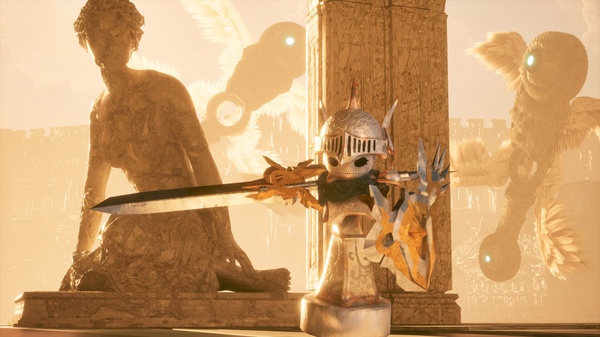
The narrative framework of Stonemachia rests on a premise with a strong Dantesque flavor. We are cast as Zephyr, a humble chess pawn trapped in a desperate journey of revenge and redemption through the gloomy architectures of Medhelan, a forgotten land devastated by the so-called "Plague of Angels". This unknown blight has corrupted the celestial hosts, transmuting angels into grotesque stone aberrations, molded in the image and likeness of Renaissance statuary and art. Zephyr's ultimate goal is as simple as it is titanic: to fight his way through these divine legions, purge the corruption, strike down celestial tyrants like Zerafim, and reclaim the path back to Paradise.
Yet, the way Crossfall Games chooses to tell this odyssey is situated at a peculiar point of balance. On one hand, Stonemachia fully breathes the air of the most cryptic soulslike, pushing the player to meticulous attention to connect the dots of fragmented lore. On the other hand, it chooses to abruptly deprive itself of one of the genre's most overused narrative tools: stripped of any real role-playing drift beyond canonical leveling up, the inventory completely disappears, and consequently, the narrative conveyed by item descriptions.
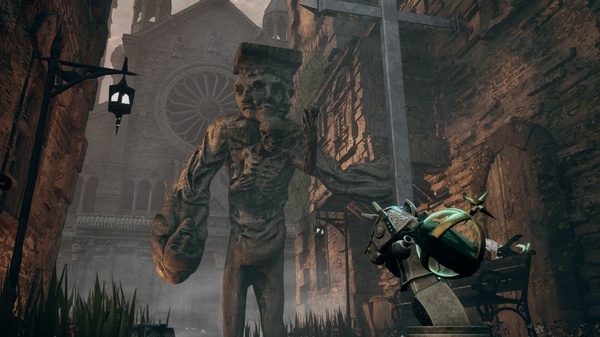
Everything, therefore, passes through the cutscenes and dialogue lines of the NPCs we encounter on our journey, the most relevant of which are surprisingly (and pleasantly) voiced in Italian. It is by listening to these isolated voices that one understands the true nature of the Plague and the fallen Angels. Despite its fragmented nature, the plot still maintains a comforting underlying linearity, resulting in a clear overall picture provided one explores and dialogues with everyone. Two specific breaking points — one of which coincides with the epilogue — shake the player's certainties, acting as effective plot twists capable of completely overturning our perspective on Zephyr's journey and the world around him.
The absence of textual descriptions does not translate into a total lack of collectibles, although these have strictly secondary functions. Scattered across the map we find vinyl records, very useful for overwriting the soundtrack of a given area if we desire a different accompaniment, and cards depicting enemies. The latter, although embellished with evocative Latin phrases, have a purely aesthetic value and do not hide secrets about the game world as was the case in FromSoftware titles.
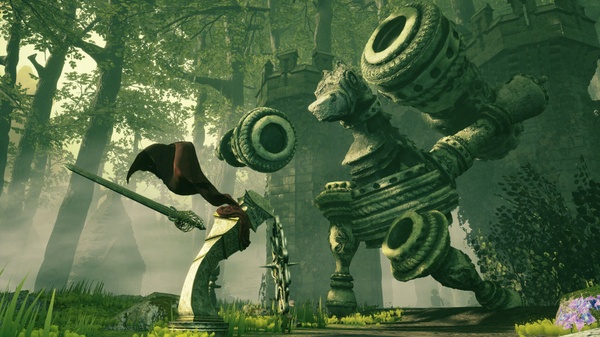
In this context, a reflection that becomes increasingly pressing arises. A similar setup would greatly benefit from a travel journal: not a mere objective indicator, but a true narrative log that keeps track of events and details gathered so far. Without it, the concrete risk is that of remaining "stuck" playing only this title continuously, because abandoning Stonemachia for a few weeks inevitably means forgetting the context and losing the thread of the story. I don't directly blame Crossfall Games' work for this — it certainly wasn't their job to pioneer this paradigm shift — but it's another piece of a puzzle that makes me feel a strong need for this addition in today's soulslike landscape.
To compensate for the unspoken words, the construction of the game world intervenes, as is tradition. Much of the story is whispered by the visual imagery and environments which, along with the design of some enemies, openly celebrate Italy and its rich folklore. Traversing the levels of Medhelan means immersing oneself in a dark fantasy with a exquisitely local flavor, where the decadent architectures, sculptures, and aberrations that block the path seem to draw heavily from popular legends, giving the title a strong and proudly distinctive artistic identity.
Anatomy of a perfect parry
If there's one element on which Stonemachia stakes its entire credibility, it's undoubtedly the combat system. I anticipated it at the beginning: Crossfall Games looked to Sekiro, studied its rhythm, and attempted to replicate its lethal harmony. With controller in hand, the result is the closest thing to FromSoftware's epic seen in recent years, albeit expressed through entirely personal rules of engagement.
The beating heart of Zephyr's experience lies in the angelic shield, a tool dedicated to parrying but, above all, to perfect deflection. Visually, the parry does not translate into a mere physical impact between metals, but rather into the generation of a fleeting circle of light on the ground — an aesthetic and mechanical solution that strongly recalls the Golden Parry of Elden Ring. The precision required of the player is very high, although the game rarely grants a microscopic permissiveness; however, the brilliance of this system lies in its absolute readability. Unlike the cumbersome and often unnatural anticipation required by old Dark Souls, everything here is based on the immediate reading of enemy movements (the legendary Tommaso is a striking example, but I won't add anything else). The feedback, especially visual but also auditory, is viscerally satisfying: you physically "feel" the deflected blow, regardless of whether it's a melee strike or a spell cast from afar.
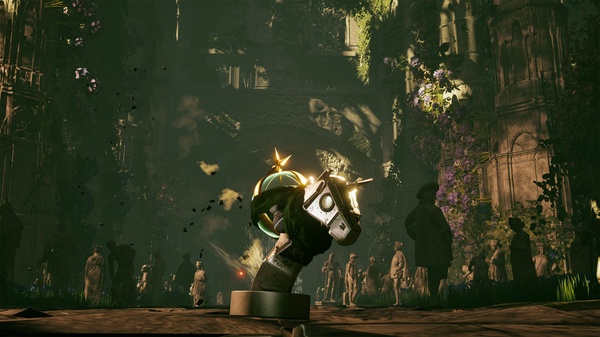
What's surprising, however, is a specific absence: Stonemachia has no enemy posture or stagger indicator. This might seem like a step backward, an emptying of the very meaning of parrying, but this is where a game design choice intervenes that I would describe as both sadistic and extremely challenging. When fighting, timely deflection is, along with killing opponents, the only method to recharge the healing flask that floats next to Zephyr. This flask is literally a bullet in the chamber: there's only one, and once consumed, it empties completely. This mechanic raises the stakes dramatically, forcing the player to maintain a spasmodic level of attention, transforming the perfect parry not into a flourish to shorten fights, but into the only real lifeline available. Completing the defensive package is the dodge which, if executed with the right timing, triggers specific counterattacks linked to the class in use, in an ecosystem where, moreover, there are no technically "unblockable" enemy attacks.
Pawns, Bishops, and Queens: the metamorphosis of offense
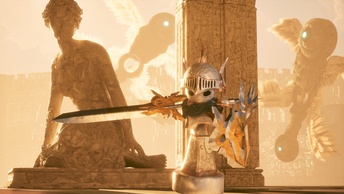
Zephyr is introduced as a Pawn, but his nature is profoundly mutable. During the descent through Medhelan, our alter ego unlocks the ability to instantly change form, embracing three additional classes: Bishop, Knight, and Rook. Each completely overhauls the moveset, equipped weapon, and engagement dynamics, with the absolute advantage that the transition itself from one class to another, if executed at the moment of enemy impact, counts as a perfect deflection.
The Pawn represents the golden standard: balanced speed and power, with the addition of a hidden "Queen" form, which temporarily triggers by chaining deflections and allows for releasing a devastating energy beam. Its heavy attack summons a clone for a circular slash, inaugurating a "friendly fire" mechanic (the blow can injure Zephyr himself if poorly positioned) which we will also find in the Bishop. The latter is the quintessence of mobility: it partly sacrifices power to literally dance upside down, using the shield as a pivot to spin a spear at very high speed, and hurls magical circles like boomerangs that the player himself must be ready to deflect if they are in the trajectory when they return.
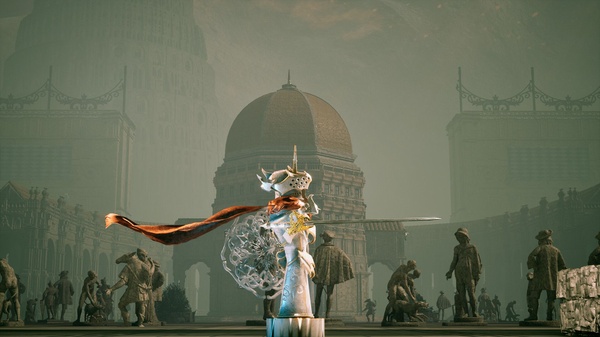
The remaining two classes are of a completely different ilk. The Knight breaks away from the role of pure combatant to embrace the unexpected vocation of healer: fragile on the offensive front, it compensates with lightning-fast dashes and the ability to generate healing pools with every successful parry. It's even possible to "draw" larger healing circles on the ground by chaining the crosses generated by its heavy attack, making it an simply invaluable support tool. I've lost count of how many times, caught off guard by an attack that almost killed me, I repositioned myself to observe the enemy and risked everything with a parry, immediately changing class to return to a more restricted offense (I stayed in the small healing circle and held my ground there) but supported by constant healing until it ran out. The healing speed, it should be noted, is still not enough to allow us to drop our guard and get hit randomly, which only adds to the adrenaline of the moment.
The Rook, at the opposite end, is the absolute tank: very slow movement but catastrophic damage. Its peculiar mechanic allows it, after an initial deflection, to keep its shield up and absorb subsequent blows (physiologically sacrificing some health) before exploding in an explosion proportional to the damage absorbed. The addition of a charged attack capable of raising miniature city sculptures from the ground, which, once destroyed, spawn supporting Rooks, closes the circle of a varied and exquisitely bizarre arsenal.
Synergies and feathers: a layered evolution
Freed from cumbersome role-playing menus, leveling up follows the most classic genre tropes. You cut down aberrations, accumulate feathers, and spend them at the bonfires (chessboards) to automatically increase the stats associated with each class. Yet, the apparent flatness of evolution shatters when the skill tree is unlocked. Requiring specific items offered to a dedicated creature, this system hides a level of complexity that relies entirely on the concept of "inter-class synergy".
Each form has three abilities, whose activation demands a perfect dance between Zephyr's different identities. The most striking example is the interaction between Bishop and Rook: by casting the magic circle with the former and rapidly transforming into the latter to deflect the returning projectile, a defensive wall is raised that significantly increases the Rook's speed and attack. Mentally (and physically on the controller) chaining these synergies in the midst of a frantic melee is an exercise that requires dedication, sometimes leading to a difficult-to-manage frenzy, but, if successful, yielding an invaluable sense of omnipotence.
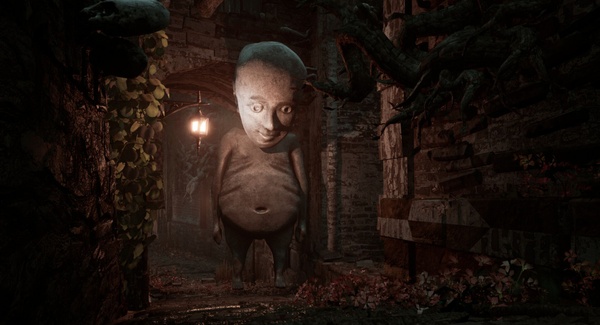
Speaking of the game world of Stonemachia, categorizing it is simple: Crossfall Games borrowed the philosophy of Dark Souls, but applied it to a compartmentalized system. Forget the gigantic, uninterrupted web of Lordran; Medhelan is divided into distinct macro-areas, connected by precise junctions — which can sometimes be multiple, allowing access to the next area from different points, each with its own challenges. However, within each individual level, the interconnection is brilliant, rich in clever shortcuts, and with checkpoints always distributed logically.
While the level design shines, it violently clashes with a structural choice that is as anachronistic as it is incomprehensible: the complete absence of a fast travel system. While the narrative and gameplay logic of pushing the player forward in self-contained levels is understandable, the inability to conveniently teleport translates into a nightmare for the completionist soul. Wanting to retrieve a secret or a collectible in an early area means having to retrace very long sections, an artificial annoyance that was truly unnecessary. Not to mention that in some areas, it's not possible to return after a certain point in the game.
Angels, fishing, and the abyss of the endgame
Facing the bearers of the Plague is a totalizing visual and gameplay experience. The boss design is perhaps one of the production's highest points: a triumph of Renaissance sculpture fused with biblically accurate angelic iconography, perhaps the most accurate (artistic liberties aside) after El Shaddai or Bayonetta. On the balance front, the difficulty curve remains fair and solid from beginning to end. There are no punishing imbalances or artificial spikes of frustration: every pattern is readable, every strike is telegraphed enough to be deflected. Having consumed Sekiro so thoroughly that I could play smoothly even without a HUD, the challenge seemed like a pleasant average interlude, only spiking in the very last moments; for parry novices, however, it will represent a somewhat tough but incredibly instructive wall.
Total completion of the game requires at least a couple of runs, precisely because of the absence of fast travel. The game leads to a New Game + not only for the physiological hunt for miscellaneous trophies that may have been missed in the first playthrough, but to give full meaning to one of the most peculiar accessory mechanics: fishing. Casting the hook does not lead to tedious mini-games, but to real martial challenges. The speed and amplitude of the on-screen indicator immediately reveal the caliber of the prey: fluid movements indicate trivial skirmishes, while microscopic and schizophrenic indicators announce full-blown boss fights. If these evocations are limited in the first playthrough, in NG+ the encounters are populated by advanced bosses, becoming the primary tool to accelerate feather farming and definitively dominate the chessboard.
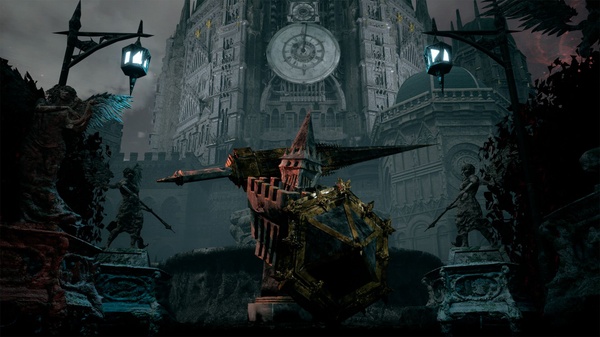
Summing up this gameplay structure, it is undeniable that Stonemachia emerges victorious precisely thanks to a skillful and courageous act of subtraction. By foregoing the ballast of statistical role-playing and the compulsive accumulation of equipment, Crossfall Games was able to concentrate every effort on a surgical, at times punishing but exhilarating, combat system. The lethal dance of deflections, combined with the metamorphic fluidity of the classes and an exquisitely crafted internal level design, delivers a rock-solid and viscerally satisfying experience with the controller. Despite the anachronistic stumble of denied fast travel and the risk of a physiological mental overload in managing synergies during the most chaotic encounters, Zephyr's descent through Medhelan confirms itself as an exercise in brutal and rhythmic beauty.
The technical and artistic sector
If there's one word that constantly echoes as we wander through Medhelan, it's undoubtedly "unsettling." The artistic framework of Stonemachia strongly presses the pedal on discomfort, delivering a vision of dark fantasy that shuns Nordic or Gothic clichés to embrace a viscerally Italian nightmare. The "Plague of Angels" corrupts Renaissance art and classical statuary, fusing their purity with often grotesque and disturbing forms of body horror. The decadent alleys of Medhelan, its architectural glimpses, and the design of the aberrations that populate it do not merely pay homage to our folklore, but distort it, creating a constantly oppressive and sickly atmosphere.
Cementing this feeling of constant unease is a soundtrack that does an excellent job. The musical accompaniment embraces dissonant scores, distorted liturgical choirs, and ambient laments that perfectly match the angelic corruption displayed on screen. It's an agonizing soundscape, interrupted only in moments of respite when we decide to play one of the rare collected vinyl records, or violently torn by the metallic clang of parries. The sound effects, in this sense, deserve a special mention: the sound of a perfect deflection is a vital metronome that powerfully cuts through the audio mix, serving as a fundamental auditory compass in the most chaotic encounters, all accompanied by unexpectedly well-crafted and impactful Italian voice acting.
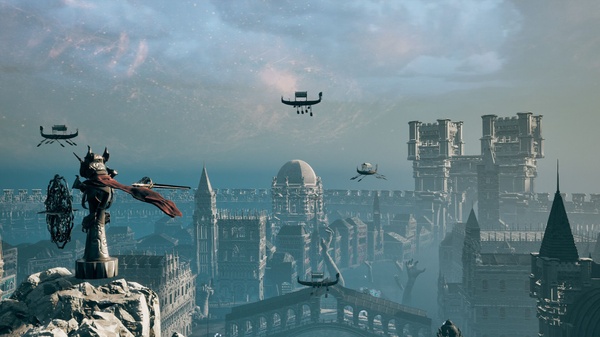
On the technical front, the game by Crossfall Games proves to be up to its very strict gameplay demands. As a title where parrying requires surgical precision, fluidity is not a luxury, but a non-negotiable survival requirement. Fortunately, the game is anchored to a stable 60fps framerate, ensuring the responsiveness needed to read and deflect every single blow without suffering lethal micro-stutters. The stability of the graphics engine is impeccable, although it does lend itself to some occasional camera whims when surrounded in the tightest corners of the map: a venial but historical sin of the genre, and one that in this case I found much more refined than even the genre's cornerstones.
Score
Editorial team
Stonemachia, a review of a chess match to the last parry
In a video game landscape often saturated with productions that merely ape soulslikes by superficially replicating their difficulty, Stonemachia emerges as a work of rare clarity and courage. Crossfall Games has assimilated Sekiro's ruthless rhythm and grafted it onto an original ecosystem of mutable classes and complex synergies, stripping everything of statistical ballast to give us the purest essence of combat.
Of course, there are flaws. The complete absence of a fast travel system is a choice that borders on therapeutic obstinacy, especially for endgame completionists, and the cryptic approach, devoid of any narrative log, risks alienating those who cannot delve into the game in close sessions. But when you pick up the controller and resonate with the lethal dance of perfect deflections, defending the only available healing flask amidst a flurry of angelic shields and lightning-fast transformations, the structural flaws quickly fade into the background.
Stonemachia is a demanding, unsettling, and visceral title. It's a punishing journey that makes no concessions, but repays dedication with a sense of martial omnipotence that very few other games can match. A one-way ticket to the hell of Medhelan that every orphan of the perfect deflection should rush to buy.
Similar articles