Portrait of a Classic: Why Shrek Changed Animation and Rewrote Fairy Tales | 25th Anniversary
Fifteen years after its release, an analysis of how DreamWorks' green ogre overturned classic fairy tales and left a lasting imprint on pop culture.
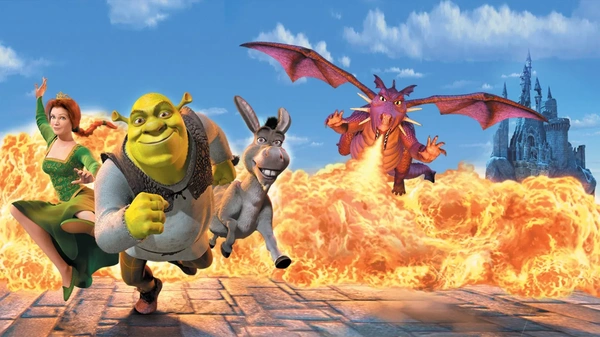


When it was released in 2001, Shrek didn't seem destined to become a manifesto. It was an animated film, based on an illustrated book, with a deliberately clumsy protagonist and an imagination that enjoyed deconstructing traditional fairy tales. Yet, within a few years, it transformed into something more than just a commercial success: a cultural rupture.
Twenty-five years later, it's worth asking why, among the many digital productions of the early 2000s, it was this film that changed the tone of mainstream animation.
The answer lies not only in its humor or technological progress. It's primarily in how it challenged the rules of animated storytelling, implicitly rewriting its codes and expectations.
- The End of the Fairy Tale as We Knew It
- Irony as a Generational Language
- An Imperfect Protagonist in a Changing Era
- The Legacy in Industry and Pop Culture
- A Soundtrack That Redefined the Tone of Animation
- Why Does It Still Work Today?
The End of the Fairy Tale as We Knew It with Shrek
Before Shrek, Hollywood animation tied to fairy tale imagery followed a well-defined model, strongly influenced by the Disney tradition: impeccable princesses, idealized heroes, clearly recognizable antagonists, and morally pure figures. With Shrek, DreamWorks challenged that structure. And perhaps “challenged” is even an understatement: the film dismantled it, piece by piece, analyzed its characteristics, and reassembled a new one.
The reversal starts from the point of view. The ogre is not the monster to be eliminated, but a vulnerable protagonist. The prince charming does not embody the savior, but a caricature. The princess stops being a mere “narrative prize” and acquires an autonomous complexity. It is a redefinition of the hierarchies of storytelling, a key step for any work that aims to truly change the rules of the game.
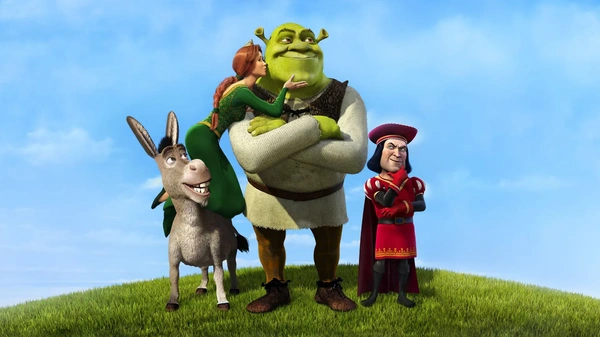
Shrek also tapped into a changed audience. Children continued to love fairy tales, but adults who grew up with the classics had begun to view them with more detachment, aware of the distance between those ideals and reality. The film works on this dual perception. It operates on two levels, without ever adopting the tones of a self-satisfied operation. The result is animation capable of openly dialoguing with the adult viewer, without losing immediacy and accessibility.
Irony as a Generational Language
Shrek's hallmark is a continuous and layered irony, never incidental. The pop culture references, allusions to the entertainment world, jokes playing with narrative stereotypes, even the seemingly out-of-context soundtrack, don't just elicit a laugh. They contribute to building a shared, generational language.
It is in this transition that the film transforms into a cultural phenomenon. Many expressions and dynamics have become firmly embedded in the collective imagination. Not because of a supposed technical revolution, but because they tapped into a different way of understanding animated comedy: less reverential, more self-aware, more inclined to deconstruct its own mechanisms in front of the viewer.
DreamWorks, in this way, defined an identity distinct from its competitors. After Shrek, the studio's animation decisively shifted towards a more irreverent and metanarrative tone. It's no coincidence that numerous subsequent productions, even outside of DreamWorks itself, progressively adopted a more explicit humor tied to contemporary culture.
Shrek, an Imperfect Protagonist in a Changing Era
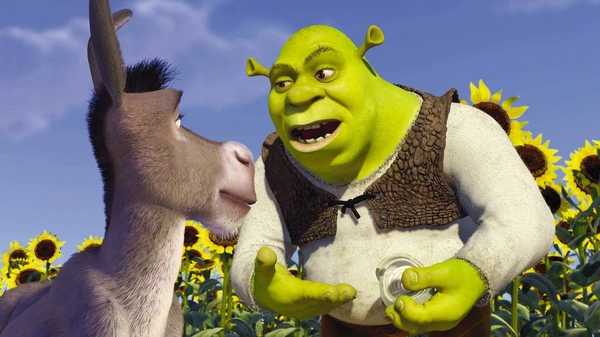
Shrek arrived at a time when live-action cinema was also re-evaluating the figure of the hero. The idea of an imperfect protagonist, sometimes even hostile to the surrounding world, resonated with an audience increasingly unwilling to accept the rhetoric of the irreproachable hero.
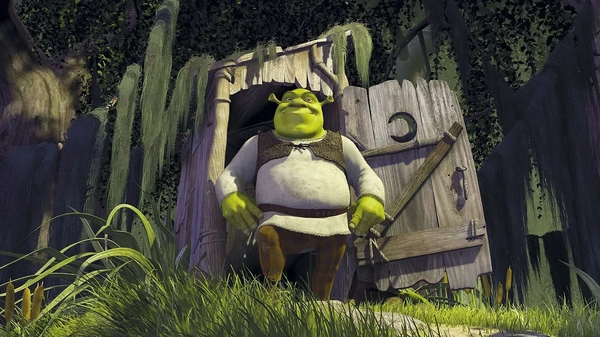
The green ogre is not charming, not elegant, and does not seek approval. Precisely for this reason, he ends up winning over the viewer: his distance from the traditional model becomes his strength. With apparent lightness, the film suggests that identity is not something to hide or to mold to fit a predetermined fairy tale scheme.
This subtext, embedded in a declaratively comedic structure, contributes to redefining the very idea of an animated protagonist. After Shrek, the central character can afford to be clumsy, ambiguous, sometimes even unpleasant, as long as they come across as authentic. It's a shift that paved the way for less rigid, more nuanced narratives, capable of embracing contradictions and fragilities without turning them into flaws to be corrected.
Shrek's Legacy in Industry and Pop Culture
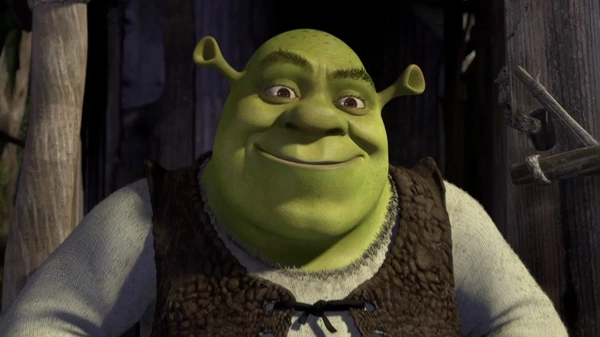
To talk about Shrek inevitably means thinking in terms of before and after for digital animation. It wasn't the first CGI film, but it was among the first to clearly show that audiences were ready for a work capable not of replicating classics, but of questioning them.
Its influence is evident in the proliferation of films that rework the fairy tale genre, in the centrality of increasingly explicit metatextual humor, and in the construction of narrative universes willing to ironize their own mechanisms. From that moment on, animation seemed more aware of its cultural weight and less afraid to expose itself.
Then there's a pop dimension that defies any purely theoretical reading. Shrek became meme material even before the term entered everyday use. Its images continued to circulate and transform. It's rare for an animated film to retain such vitality outside the cinema and, especially, for such an extended period.
A Soundtrack That Redefined the Tone of Animation
Shrek's strength also comes through its music. The opening with All Star is already a declaration of intent. The film doesn't introduce itself with an orchestral fairy-tale theme, but with an immediately recognizable, almost provocative pop hit. The soundtrack alternates contemporary tracks with traditional moments, creating a contrast that solidifies the work's irreverent identity.
This casual use of pop music helps legitimize a less solemn approach to animation. The songs accompany the scenes, comment on the story, emphasize its irony, and shorten the distance with the adult audience. In this respect too, Shrek broke a consolidated habit and demonstrated that animation can openly dialogue with the musical culture of its time without losing narrative coherence.
Why Does Shrek Still Work Today?
Revisiting Shrek years later means confronting a work that doesn't seem confined to its own time. Some jokes inevitably betray the cultural context in which they were born, but the backbone of the story, the reversal of roles, the questioning of the conventional happy ending, and the definition of an imperfect protagonist remain surprisingly relevant.
Its enduring appeal stems from a rare balance. It's not a cynical demolition of the fairy tale universe, nor a parody for its own sake. It's a story that uses irony to suggest an alternative, without sacrificing the pleasure of classic narration and its emotional power.
Fifteen years after its release, Shrek confirms itself as a classic because it demonstrated that animation could dare to do more. It cracked a structure that seemed immutable and opened up a creative space that others have since occupied, each in their own way.
If today mainstream animation can afford to play with its own myths and question its own conventions (like Rick and Morty), it's also because a green ogre, lacking good manners but rich in self-irony, showed that fairy tales are not untouchable. They are living narrative material and, as such, can be rewritten.
Similar articles