Deadpool Kills the Marvel Universe One Last Time - Will This Be the End?
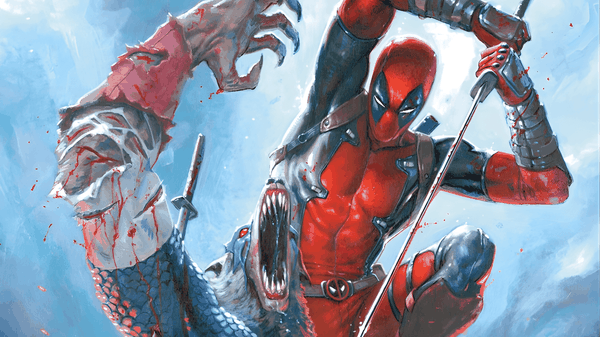


In the 90s, the grammar of horror underwent a genetic mutation driven by Wes Craven's double move: on one hand, the breaking of the fourth wall with reality in New Nightmare, on the other, the meta-narrative surgery of Scream.
It is in this precise vein that Deadpool Kills the Marvel Universe One Last Time is situated, a work that ceases to be a simple sequel to transform into a debug interface for a Multiverse that has stopped generating meaning. After exterminating his own reality in 2012 and attempting to eradicate inspiration itself in classical literature, this Wade Wilson finds himself in a limbo reminiscent of the nihilistic atmospheres of X-Files in its darkest episodes, where the monster is no longer an external threat but a biological inevitability. The return of the original creative team, composed of Cullen Bunn and Dalibor Talaji, is not a nostalgia operation for die-hard collectors, but a structural necessity: who better than those who opened the wound can decide when and how to stitch it up? Can we still consider Deadpool's violence as a playful element, or are we facing the plastic representation of the wear and tear of a franchise?
Is the return of the "voices" in Wade's head a return to form or a symptom of a system that cannot stop reiterating its own traumas? The real systemic friction lies in the paradox of a character who, to save continuity, must act as its most lethal virus.
Legacy vs. Innovation: The Return of the Founding Fathers
The transition from Deadpool Kills the Marvel Universe Again to this latest iteration marks a paradigm shift in aesthetics and tone that is not just a visual choice, but functional to the narrative: the "grime" of Talaji's style acts as a contrast filter that removes Deadpool from the glamour of modern marketing, bringing him back to his original nature as a system error born of 90s sensibility.
This change cannot be ignored, as it acts as a declaration of intent against the aseptic aesthetic of contemporary serialized comics. In 2012, the massacre was a shocking novelty, a what if amplified by an iconoclastic fury that relied on surprise. In 2025, the audience is addicted to blood, consumed by years of exposure to hyper-realistic violence and meta-commentary, and Bunn knows this well. For this reason, the choice to bring back Dalibor Talaji is strategic: his style, here dirtier, more sketched, and deeply melancholic, deliberately moves away from the vectorial cleanliness of mainstream comics to embrace a visual grittiness reminiscent of late 80s indie productions or his visceral work on Empire of the Dead.
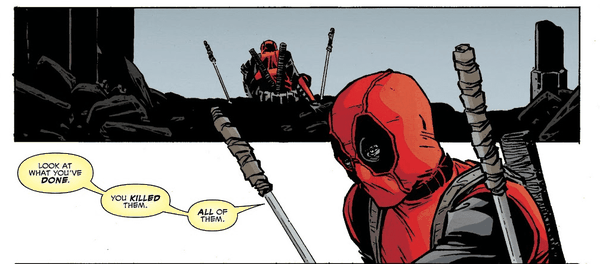
This Deadpool is not a clown: he is an emptied man, a biological shell wearing a mask devoid of the iconic white lenses, allowing us to see eyes laden with a sadness and existential weariness that classic design usually denies the viewer. Seeing Wade's iris through the red fabric radically changes the emotional contract with the reader: we are no longer watching a violent cartoon, but a reluctant executioner.
The innovation lies not only in the quantity of excellent corpses — which are abundant, from the dismembered remains of an arrogant Superior Spider-Man to the spare parts of a grotesque Frankencastle — but in the direction of the narrative vector. It is no longer Wade against the world for personal revenge or psychotic delusion: here Wade acts as the hitman for a cosmic entity, Alphea, who uses him as a tool for surgical pruning to eliminate the dry and dangerous branches of the Multiverse. It is a pure and ruthless system logic: identify and eliminate corrupted files (the evil or deviant versions of classic heroes) to preserve the integrity of the kernel, i.e., Earth-616. The implication is unsettling: the stability of the main canon is guaranteed through the systematic extermination of multiversal anomalies, transforming Deadpool into the ultimate anti-signal.
Mechanics of Massacre: The Gameplay of Narrative
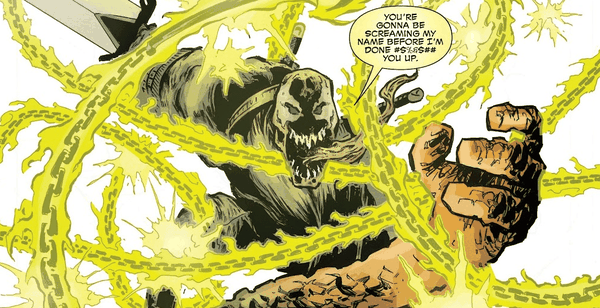
The pace of the album is deliberately asymmetrical. If the first clash with John Doe (an archaeological recovery by Bunn that cites the forgotten Nth Man: The Ultimate Ninja) serves to set the power parameters, it is in the montage of the central issues that the narrative accelerates to become frantic. The killings of variants like Zombie Punisher or Daredevil possessed by the Beast of the Hand are treated almost like bureaucratic to-do list tasks. Bunn uses this speed to communicate Deadpool's alienation: for him, killing these legends is no longer an event, it's a job.
However, the gears jam when Wade suffers a head trauma during the clash with Superior Spider-Man. It is here that Deadpool's operating system undergoes a forced reboot, bringing back the infamous yellow and white "boxes." This return to the past is not a lazy comedic device, but a defense reaction of the psyche: Wade needs the noise of his voices to avoid succumbing to the silence of a universe he himself helped to empty. Bunn here draws on his horror experience on titles like Harrow County, injecting a dose of psychological unease that was missing in previous iterations, where blood obscured the mind.
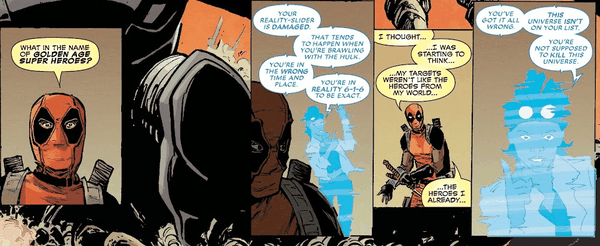
The real short circuit occurs when Deadpool, due to a malfunction of his dimensional jumping device, lands in the middle of the events of Avengers #1 by Jed MacKay. Seeing Bunn's nihilistic Deadpool observe the heroic hope of the main Avengers creates a contrast that defines the entire operation. Here Bunn's thesis becomes clear: the destruction of "bad" variants is not an end in itself, but a purification ritual. The reader is forced to wonder if the survival of the "normal" universe is worth the price of a multiversal genocide committed by an individual who has lost all moral compass.
It is a ruthless analysis of the editorial management of major publishers: how many titles must be closed (or universes destroyed) to allow the flagship series to continue to shine? It is a brutal parallel with the original Killogy: if there Wade wanted to free the heroes from the prison of narrative, here he acts as their invisible jailer.
An End That Never Comes: One Day Deadpool Will Kill Us All!
Deadpool Kills the Marvel Universe One Last Time is a work that requires a solid knowledge of previous narrative loops, but it rewards the reader's dedication with a conceptual stratification that the graphic violence, however hyperbolic, initially tends to hide behind a curtain of blood. It is not an issue aimed at those looking for the "cuddly" and chatty Deadpool of the movies, cheap pop meta-references, or celebratory cameos inserted for pure fan service: every excellent execution serves as a piece in a ruthless treatise on the end of stories and the inevitable weariness of serial myths that have stopped evolving. If you are readers who detest narratives that require compulsive consultation of the Marvel Database or who cannot stand cynical violence devoid of immediate catharsis, this mission is not for you. On the contrary, the issue is a categorical imperative for those who loved the original Killogy and wish to see the definitive closing of the systemic circle, for those who appreciate a raw aesthetic, and for lovers of meta-narrative who are not afraid to see their idols reduced to faulty gears.
Bunn and Talaji have built a funerary monument to their own success, a kind of creative scorched-earth operation where the return of the original team does not serve to celebrate the past, but to dismantle it with surgical precision. They thus demonstrate that even within the most abused and saturated genre on the market, there is still room for a technical, almost engineering, reflection on the architecture of storytelling and the need to close life cycles before the entire system definitively collapses under the weight of its own redundancy. In summary: this is an issue for those who need to see the ultimate anti-signal at work, far from the aestheticizing canons of the modern MCU.
Similar articles