Digital Dragons 2026 - Square Enix and Global Investors Reflect on the State of the European Industry
From Krakow, three video game finance heavyweights — Erebor Capital, Gamesmiths, and Square Enix — discuss how the market has changed after the pandemic bubble


If the ID@Xbox panel showed us the perspective of those who push games onto platforms, there's another side of the coin at Digital Dragons that cannot be ignored: that of those who, simply put, decide whether to fund games. After the golden years of 2020-2021, fueled by a seemingly endless pandemic bubble, the video game sector in Europe is facing its biggest cleanup and recalibration operation.
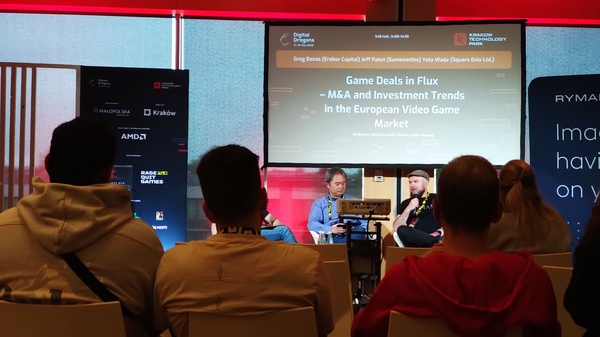
To understand how the rules of engagement between developers and finance are changing, we went up to the second floor of the Polish event to follow an exceptional panel. Seated at the speakers' table were three heavyweights who eat investments for breakfast: Greg Banas (Managing Partner at Erebor Capital), Jeff Pabst (Founder of Gamesmiths), and Yota Wada (Manager of Investment & Business Development at Square Enix).
The summary of their meeting? Simple: "You see a lot less useless stuff around". An investor's words.
The Great "Adjustment": Farewell to Open Covid Taps
No point beating around the bush: mass layoffs and the advent of generative AI have cast a strong shadow of uncertainty over the industry. But where many see the apocalypse, those who move capital simply see history repeating itself. "The industry has matured over the last thirty years; these are just new changes, and we will emerge better", Wada began, drawing on the experience of a giant like Square Enix.
The market is self-regulating. During the pandemic, budgets had skyrocketed, money was virtually thrown at anyone with an idea, causing development costs and teams to explode unsustainably. Today, that's no longer the case. Money has become an expensive and limited resource. As Jeff Pabst very transparently admitted: "Today, the focus is on lowering costs and completing projects quickly and economically. No one wants to invest in a team of 100 people for 5 years anymore; investors want 2 years of development with half the people".
In this scenario, the psychological ceiling for an indie project has settled around 2-3 million dollars. Asking for more, today, almost always means being told "no".
Europe as a Hunting Ground (and the Collapse of VR and Mobile)
In this phase of strong selection and risk recalibration, Europe is carving out a surprisingly strategic role compared to the US and Japanese markets. The reason? A potent mix of cultural diversification, a propensity for remote work, and, above all, significantly lower production costs.
But where do investors' dreams go to die? When asked which platform is least attractive, the jury's answer was unanimous and ruthless.
- VR is officially dead (or almost): For Greg Banas, the virtual reality market is in a terminal phase. Jeff Pabst joked: "The trends for the next 24 months? VR! No, just kidding".
- Mobile is a meat grinder: Generating stable revenue in the mobile market has become an unsustainable lottery.
- PC (and secondarily consoles) is the Eldorado: Steam remains the "go-to platform". PC offers diversity, real monetization opportunities, and, paradoxically, allows for commercial success even while remaining within the average quality of the catalog.
Anatomy of a "Groundbreaking" Studio: What Funds Are Looking For?
If you are an independent team looking for funding, you must pass the reality test. Pabst highlighted a typical developer short circuit: "When I ask 'what is the game and who are you making it for?', everyone can answer the first question, almost no one the second".
Today, the average investor isn't just looking for art or "magic" (although inexplicable miracles like Goat Simulator or bizarre city builders with beavers like Timberborn continue to exist), but rather a macroeconomic vision. The three pillars for capturing the attention of funds today are:
1. Strong and Clean Intellectual Property (IP)
IP is the undisputed queen of negotiations. Investors want to create long-term franchises. One of the biggest red flags for funds is chaotic rights management: Banas emphasized how too often teams present fantastic prototypes, but with reckless copyright management. If people change within the team and someone "takes away" a piece of code or an asset without clear contracts, investor confidence plummets to zero. The same goes for a lack of clear organizational charts: "If we don't know who is in charge of what, we don't invest".
2. "Green" Development and Community Testing
The market is saturated. To stand out, you need a strong visual identity or radically innovative gameplay, but you also need to demonstrate the ability to do marketing and development testing from day one. Building an active community before launch has become a financial asset in its own right. Furthermore, the numbers must add up before production begins: if financial projections are not "in the green", the wallet won't even open.
3. The Policy of Small Steps (Minority Stake)
Forget total "devouring" style acquisitions. Today, the trend favors minority stakes (around 20%). Funds like Erebor Capital or Gamesmiths prefer to join the board to guide the company without taking total control, helping the studio grow, structure an "investment story", and, in the case of the Polish market, aim for a stock market listing.
The "Marriage" and Transparency
One point Yota Wada particularly insisted on was the human aspect of the deal. "An investment is like a marriage: you have to trust each other. Due Diligence must be bidirectional: the developer must ask themselves if they really want to work with that fund, and vice versa".
Game development is an inherently complicated obstacle course. That's why transparency on milestones, budget, and timelines is the only glue that prevents the project from collapsing. If you try to sweep problems under the rug, the whole thing falls apart.
AI is Just the New Unreal Engine (but Watch Out for "100% Human")
Finally, the inevitable chapter on Artificial Intelligence. If you expected investors ready to replace programmers en masse with algorithms, you're mistaken. For the panel, AI is a tool, not the end goal.
Wada drew an illuminating historical parallel: "Once upon a time, we didn't have commercial game engines; we had to write the graphics engine from scratch for every game. Then Unreal and Unity arrived, and everything changed. AI is exactly the same thing: a tool". AI will speed up the tedious phases of production — prototyping, rapid concept creation — allowing even micro-teams of one or two people (striking examples like Balatro or the management of Silksong) to perform miracles in reduced time.
The real AI bubble, upon closer inspection, is not so much in video games themselves, but in the capital pouring into companies that create AI-based development tools. And while the industry ponders this technological revolution, Greg Banas launched a provocation that we at Gamesurf will monitor very closely in the coming months: "There's an emerging counter-trend, that of games branded '100% Human Power'. A fascinating trend that we will keep a close eye on".
It remains to be seen how many, in the ultra-selective market of the next 24 months, will be able to afford the luxury of being exclusively human
Similar articles
Digital Dragons 2026 - ES Digital and the search for talent around the world

Digital Dragons 2026 - Huqiao Games tells us how the Chinese industry is changing
Digital Dragons 2026 - CD Projekt Red Explains the Importance of Game Documentation