Twilight Saga – The Unexpected 4K Limited Edition Box Set
Here's why the images are upscaled despite native 35mm negative footage
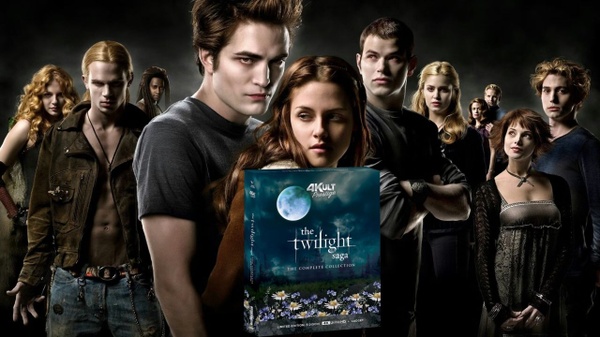


Twilight Saga 4K (2008) – Birth of the Teenage Myth
Directed by Catherine Hardwicke, the first Twilight is perhaps the most “pure” and recognizable chapter of the entire saga. It tells of Bella Swan's arrival in rainy Forks and her encounter with Edward Cullen, a seventeen-year-old vampire frozen in time since 1918. The narrative structure is simple, almost minimalist, but it is precisely this essentiality that allows the film to build an atmosphere suspended between melancholy, gothic romance, and adolescent unease.
The mise-en-scène, often criticized for its rigidity, instead plays a precise role: to slow down time, create distance, and accentuate the characters' strangeness. The Cullens appear as out-of-place figures, pale and still, almost abstract, while the cold and unbalanced cinematography helps define Forks as an emotional space even before a geographical one. The vampire is no longer just a predator but an ethical creature, forced to repress its instincts.
The film truly takes off when it introduces the conflict: the uncontrollable desire Bella arouses and the threat posed by James. Here, Twilight shows its limits in terms of action, often clumsy or rushed, but also its strengths, namely an absolute, naive, and declared romanticism. It is a work that does not fear emotional excess and precisely for this reason manages to speak to a vast audience. Its global success stems from this: the ability to transform an impossible love story into an identity-forming experience.
Twilight Saga 4K: New Moon (2009) – Pain as the Center of the Narrative
The second chapter changes tone sharply. New Moon partly abandons the charm of discovery to focus on loss. Edward leaves to protect Bella, and the film transforms into a story about emptiness, adolescent depression, and identity built through suffering.
The direction insists on the passage of time, the repetition of days, the protagonist's dull gaze. It is a risky but coherent choice, which makes New Moon probably the most melancholic film in the saga. Bella is no longer just the object of desire, but a character defined by absence, unable to exist without the other.
The central entry of Jacob Black introduces a new imaginary: that of werewolves and Native American culture, treated in a simplified but symbolically relevant way. The conflict between vampires and wolves is not only supernatural but also cultural and territorial. The double American identity — white and indigenous — becomes a metaphor for a fragile coexistence, regulated by pacts and borders.
Darker, more static, and less spectacular, New Moon divided audiences but managed to consolidate the emotional heart of the saga. It is the film that takes adolescent sentimental suffering seriously, without irony or distance.
Twilight Saga 4K: Eclipse (2010) – Adult Evolution
With Eclipse, the saga attempts a synthesis: more action, humor, and awareness of its own mechanisms. The plot revolves around a series of murders that reveal the presence of an army of newborn vampires, forcing Cullen and werewolves into a forced alliance. In parallel, Bella must face the definitive choice between Edward and Jacob.
The film explicitly speaks of growth and responsibility. Choosing means hurting someone, giving up alternative possibilities and accepting the consequences. In this sense, Eclipse is the most “adult” chapter in its themes, even if not always in its staging. The action sequences often appear mechanical, choreographed with an almost television-like rigidity, and the epic moments struggle to find true tension.
However, the ironic subtext works, sometimes unintentional, sometimes conscious. The love triangle takes on almost muscular romantic comedy traits, with Jacob displaying physicality and confidence in contrast to Edward's icy fragility. Some lines become emblematic of this late self-irony, which makes the film lighter and, paradoxically, more enjoyable.
Eclipse remains a transitional chapter, imperfect but significant, in which the saga becomes aware of its status and plays, at least in part, with its clichés.
Twilight Saga 4K: Breaking Dawn – Part 1 (2011) – Melodramatic Excess
Divided into 2 parts, the fourth chapter begins with the long-awaited wedding between Bella and Edward. The first half hour is a concentrate of insistent, ceremonial, and decorative romanticism that summarizes the saga's aesthetic in its most explicit form. Immediately after, the film changes register, introducing Bella's impossible pregnancy.
Here the story moves to a darker ground: the protagonist's body becomes a battlefield, a place of pain and transformation. The idea is potentially powerful, but the treatment remains schematic, dominated by a Manichaeism that reduces the conflict to a clear opposition between good and evil. Despite everything, the stakes are finally concrete: Bella's very life.
The film at least manages to maintain a certain narrative tension, because for the first time the question is not related to Bella's loves but to her survival. The emotionality, however, remains forced, oscillating between sentimentality and visual shock. The choice to break the story into two parts appears evident and artificial, conceived more for production reasons than narrative ones.
Twilight Saga 4K: Breaking Dawn – Part 2 (2012) – Epilogue and Weariness
The last chapter opens with Bella's transformation into a vampire, an event awaited since the first film. This turning point is paradoxically quickly dismissed: superhuman control, thirst, adaptation to the new nature are barely hinted at, as if they didn't deserve further exploration.
The narrative proceeds by accumulating only touched-upon subplots: the relationship with Charlie, Jacob's imprinting on Renesmee, the Cullen family dynamics. Everything remains on the surface. The characters appear as figures now crystallized, devoid of real evolution, immersed in an artificial and immobile well-being.
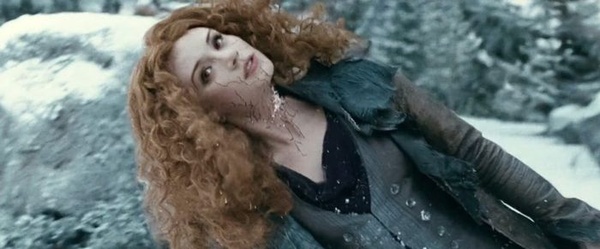
The heart of the film is the final clash with the Volturi, built as a long wait and resolved in a spectacular battle set in a snowy, barren landscape. It is the only true moment of tension, where, however, the feeling of forced dilation emerges, of a prolonged spectacle to justify the dilution into two parts.
Twilight Saga - Today
The Twilight film saga is a cultural phenomenon rather than a simple series of films. Imperfect, naive, often excessive, it has nevertheless managed to tap into deep emotional needs: the desire for the absolute, the fear of loneliness, the search for identity, romanticism taken to the extreme. Its limitations are evident — simplistic writing, uneven staging, moral Manichaeism — but equally evident is its ability to build a recognizable and lasting imaginary.
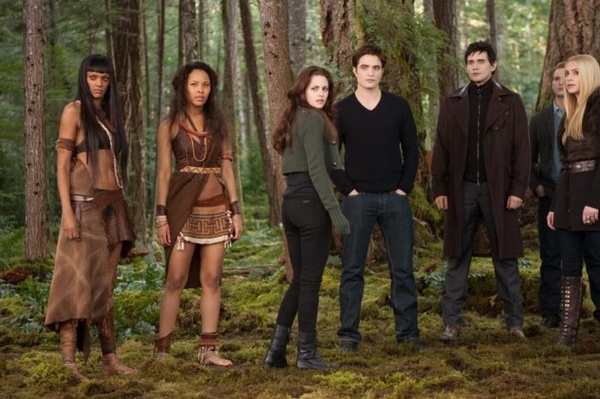
Film after film, Twilight loses freshness but gains awareness of its own myth, eventually transforming into a long sentimental parable that speaks more of emotions than of vampires. And it is perhaps precisely this, for better or worse, the reason why it continues to be loved.
Twilight Saga 4K - How it looks
Available for the first time in Italy in a 4K collector's box set (without accompanying 2K discs), numbered to a limited edition of 1,000 copies, the Twilight saga in UHD requires accepting the artistic-visual choices more than ever. All films have an image format of 2.40:1 (3840 x 2160/23.97p), HEVC encoding on a BD-66 dual layer except for the first BD-100 triple layer. Although shot on 35mm negative (Arriflex 435, Panavision Panaflex Millennium XL and Panaflex Platinum at unspecified ASA sensitivity), compromises had to be made regarding the maximum achievable video resolution due to the insertion of CGI.
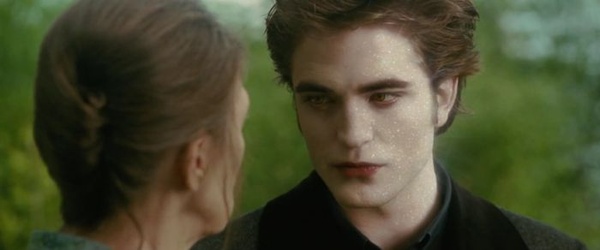
The post-production of all films was carried out at 2048 x 1080 pixels, using state-of-the-art professional visual effects suites at the time (Autodesk Inferno VFX and Autodesk Maya VFX), editing everything via an AVID system and finalizing on a 2K master. In 2008, the rendering of computer-generated elements required a heavy toll in terms of processing time from graphic workstations, with even more exorbitant costs if a 4K production had been planned, assuming the hardware of the time allowed it. This is why, despite the analog footage, we are in the presence of 5 films and as many UHD upscales.
The first Twilight and the "Cyan Edition"
Technically, the most critical work remains the first, with "ice" elements brought to light by cinematographer Elliot Davis (Out of Sight, Man of Tai Chi among many), in agreement with director Catherine Hardwicke, with heavy color correction. In this sense, this first 4K version led to a new colorimetric intervention, leaving the feeling of having further weighed down the rendering. The result is what we could define as the “Cyan Edition” of the film, which for this reason might not appeal to fans. Recalling the theatrical screening already with cold colors, here one immediately encounters elements that are nothing short of glacial and a consequent erosion of primary and secondary colors, bordering on a sometimes monochromatic spectacle.
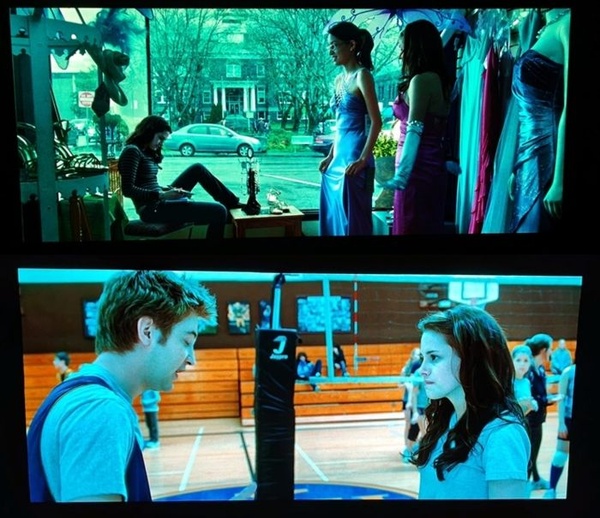
Of the 5 films in the saga, and compared to a US counterpart that is entirely similar in visual result, this is also the only one not to benefit from Dolby Vision but only HDR-10. Despite the inferior dynamism of the light points, it remains difficult to imagine concrete differences on images so heavily anchored to a cold chromatic spectrum. As for detail and prominence of background elements and in night transitions, we are a step above the 2K version. A virtuous digital chain starting from native 10-bit is necessary in this sense to fully exploit the video signal.
The remaining 4 films benefited from a more “indulgent” color correction and a more coherent chromatic aftertaste, perhaps to bring the narrative closer to the massive presence of werewolves-Native Americans, opening up a color scheme that also gave space to yellow & brown. As for overall rendering, wanting to draw up a technical ranking, we find Eclipse and the subsequent Breaking Dawn at the top, a step behind Twilight and New Moon, where on the second there remain reservations about chromatic transitions, especially on skin tones, despite a grain that appears balanced and coherent. All things considered, not such a marked generational leap from a visual point of view, but still interesting and capable of approaching the final result conceived for the cinema, with artistic-colorimetric choices no less questionable for the progenitor.
Twilight Saga 4K - How it sounds
The Italian localized production boasts a single Italian DTS-HD MA 5.1 (16 bit) track, with good overall rendering between dialogues, effects, musical accompaniment, and transitions where the subwoofer also makes its presence felt. The same format for English except for the first film, where there is a Dolby TrueHD 7.1 track with ATMOS objects (24 bit), which rarely deviates from the technical result mentioned above, as in the case of the entry of effects such as thunder and wind. For the latter, there remains the significant advantage related to the original voices of the characters and the consequent different narrative mood.
Twilight Saga 4K - The extras
The absence of 2K discs has limited the presence of supplementary material (all subtitled), divided as follows for the various discs.
Twilight
Twilight location tour 10 years later (10'); Conversation with Stephanie Meyer (24'); The music of Twilight (6'); Playing Edward (7'); Playing Bella (5'); Vampire bites (3'); Bella's Lullaby Mix music video; Edward plays the piano (3'); Interview Kristen Stewart and Robert Pattinson (7'); Interview Cam Gigandet (6'); Interview Edi Gathegi and Rachelle Lefevre (6'); Premiere Red Carpet (8'); Red Carpet Interviews (5'); Stephenie Meyer talks about the saga (35').
Twilight 2
Commentary by director Chris Weitz.
Twilight 3
First commentary with Kristen Stewart and Robert Pattinson
Second commentary track with Stephenie Meyer and Wyck Godfrey
Twilight 4.1
Film commentary by Bill Condon
Twilight 4.2
Film commentary by Bill Condon
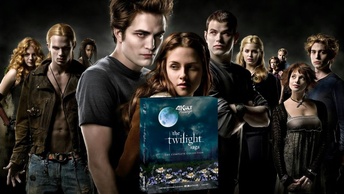
The numbered box set includes a cardboard case with collectibles: 5 commemorative postcards of the respective films, an Italian wedding invitation leaflet, a fold-out with ceremony shots and an English wedding invitation, the original poster of the first Twilight.
Score
Editorial team
Twilight Saga – The Unexpected 4K Limited Edition Box Set
A franchise whose unexpected box office success led to the creation of 5 films, which, despite their ups and downs, are still remembered today by the younger generations of that era. This box set sees the exclusion of the 2K counterparts and some of the extras present in past Italian editions. The viewing of the first Twilight is complicated to the point of visual discomfort, weighed down by a "glacial" color correction that erodes a large part of the primary and secondary colors, and is the only HDR-10 against the Dolby Vision of the remaining films.
Similar articles