The Ugly Stepsister confirms that today's best body horror is made by female directors
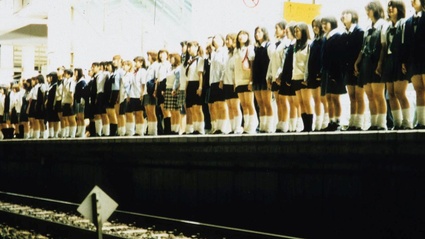
The Substance, Raw, Titane, and now The Ugly Stepsister: body horror is more alive than ever thanks to a plethora of female directors who intimately understand the horror of pursuing beauty at all costs.


The Ugly Stepsister is not a retelling (i.e., a rewriting of a known story like a myth, fairy tale, or literary classic from a different perspective or angle) of the Disney version of Cinderella, nor of Charles Perrault's French one. Instead, it draws from the particularly crude version, at least for contemporary sensibilities, by the Brothers Grimm. A vision that perfectly aligns with contemporary Norwegian horror and a certain vein of Nordic folklore that can even appear sadistic to those in Southern Europe accustomed to the much more accommodating Basile.

Nothing in this operation is truly surprising, because everything is extremely current, capable of keeping pace with the cinematic and social moment: The Ugly Stepsister is truly a product of its time, from the theme it addresses to how it does so. "Dark" fairy tale retellings in bookstores are a well-established phenomenon, and even in Hollywood, there was a period when, between Snow White and Cinderella, an attempt was made to update these "traditional" stories in a feminist and progressive key. Nor is using the framework of a traditional story to tell the eternal struggle of young women to adhere to an ideal of beauty so canonized that it almost requires them to border on incorporeality a novelty: it's no coincidence that many have cited The Substance in relation to this film, along with Julia Ducournau's Titane.
Elvira: More Naive Than Ugly
The point is that we are facing another female director - the Norwegian Emilie Kristine Blichfeldt - who chooses gore, disgust, and violence against the body to talk about women's eternal pursuit of an aesthetic ideal denied to them by genetic, natural, and social factors. In The Substance, it was the passage of time that confronted the protagonist with the impossible challenge of remaining the same as her younger self. The challenge Elvira faces in The Ugly Stepsister is, if possible, even more impossible: from the beginning of the film, when she lays eyes on her stepsister Agnes, she knows that if the kingdom's prince sees her, he will choose her as his bride. Very young and in the prime of her adolescent beauty, it's already a lost cause: too fat, too ugly, too clumsy, with a slightly imperfect nose.

The fact that protagonist Lea Myren (whose wide blue eyes, open in wonder, horror, or pain, do half the work) is none of these things only makes the film's vision even more grotesque. This reinterpretation of the Cinderella fairy tale is narrated from the perspective of a stepsister madly in love not with the prince, but with the image the nobleman projects through his pretentious, saccharine poems published throughout the kingdom. After becoming related to Agnes's family, she finds herself having to marry to help her mother and blood sister, but remains determined to win him over when the prince announces a ball to find his bride.
Elvira's true cardinal sin for which she is punished again and again in the film is not her supposed ugliness, the cruelty she sometimes expresses towards her stepsister, nor ambition, but rather her naivety. The protagonist maintains a certain maidenly purity, knowing nothing of the ways of the world, which Agnes/Cinderella (Thea Sofie Loch Næss) seems to know inside out: older, more conventionally beautiful, but above all more cynical, pragmatic, and disillusioned, she is ready to face the world in a way Elvira is not. It's no coincidence that only one of them already knows men biblically and knows precisely what to expect from them.
The Visual "Substance" Precedes Narrative Development for Emilie Kristine Blichfeldt Too
The Ugly Stepsister reworks the fairy tale's story by looking to Sofia Coppola's cult film Marie Antoinette, that is, with a playful touch of musical and historical anachronism, mixed with an abundant dose of horror towards a body always in excess. There's a cosmetic surgeon who is part mad scientist, part Elvira's "fairy godmother" attempting to give her a makeover, but there are also gruesome scenes that are nothing but the handiwork of the dear old Brothers Grimm, who reveled in body horror. Initially, Elvira is "only" a helpless victim of her mother's attempt to transform her into a valuable commodity for the kingdom's wealthy noblemen. For example, when she undergoes a very painful period rhinoplasty, she doesn't even choose the shape of her new nose; her mother does.
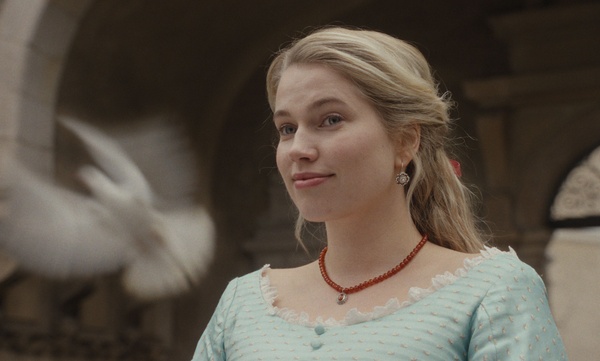
The only awareness she gains in the film is even more frightening: it's the ability to choose for herself how to mistreat her own body to become more beautiful, that is, thinner and more like a farcical version of Agnes, right up to the grand finale where she actively confronts the most grotesque and painful transformation of her body to adapt it to proportions that are not her own. Elvira's true tragedy and damnation is to clearly see her own limitations but not those of others. The generation this film seems to address would call her "delulu" for how she encounters the prince, who turns out to be a petty and despicable person, but this revelation doesn't change her goal one bit. Spoiled and sometimes cruel, but also lonely and exploited by those who should protect her, she is furthermore trapped in a relationship that is sometimes delightfully ambiguous, sometimes rather confused, with her sister Alma (Flo Fagerli) and with Agnes. The Ugly Stepsister confronts her with the cruelest outcome: getting what she wants and discovering that she was right all along: it still wasn't enough.
The film is full of striking stylistic insights that combine a delicate, costume-drama aesthetic with truly disgusting gore scenes worthy of the body horror designation. It also has some significant flashes, such as a certain voyeuristic streak that permeates both sisters, or the framing of Agnes as a person ultimately trapped by certain classist logics, so much so that she doesn't rebel against being relegated to servitude. After all, the film is entirely built on the virgin/whore, princess/servant dichotomy, giving the protagonists no way to conceive of themselves differently.
It's a shame, then, that certain ideas remain just that, and the final resolution of Elvira's story and those of the other young protagonists comes somewhat out of the blue: the film writes its protagonist well, but wastes the opportunity to have a memorable trio of female characters with Alma and Agnes, just as it leaves much unresolved regarding the generation of mothers and guardians who educate the girls to behave this way and who react poorly to their rebellion. Emilie Kristine Blichfeldt's priority and preference lies in the visual dimension (the same limitation found in The Substance). She willingly sacrifices the evolution of her protagonists to visually render, in a memorable scene, how horrifyingly difficult it is to eradicate from within oneself the urge to be different to please others. And that's fine for an indie film that, while doing everything that's trendy today in literature, cinema, and on social media, manages to entertain and scratch beneath the surface.
Score
Editorial team
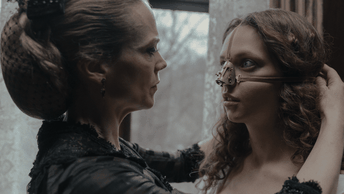
The Ugly Stepsister confirms that today's best body horror is made by female directors
The Ugly Stepsister is yet another excellent proof that female directors have colonized a genre that was once the preserve of their male counterparts, and are now building a body horror filmography that conveys, through gore and the grotesque, all the horror women are often forced into to feel beautiful, loved, and accepted. Part of its narrative potential remains unexpressed, but it is truly delightful and gruesome in the best visual way: a gore bonbon not to be missed for genre lovers.
Similar articles