The Blood Countess transforms vampirism into a bizarre tourist adventure in the heart of Vienna
Never taking its own story seriously, Ulrike Ottinger weaves an entertaining, sometimes silly film that has the merit of giving us Isabelle Huppert's first vampire role.



The fascination that French actress Isabelle Huppert exerts on filmmakers around the world (not just her compatriots) should be studied. A capacity to seduce them that has something vampiric about it, when you think about it. Perhaps then we should not be surprised that German director Ulrike Ottinger offered her the first vampire role of her very long career, but that no one had yet thought of how Huppert, one of the greatest and most audacious living actresses, is absolutely perfect for playing an immortal, bloodsucking noblewoman.
Her prolific career is quickly told: it's rare for an entire edition of a European festival (Cannes, Venice, and Berlin) to pass without at least one film featuring her in the cast, especially considering this actress's love for unique works and extreme, challenging roles. A corollary of this reality is that, by following her career from festival to festival, one stumbles upon a whole series of films that seem to have no reason to exist or to have been financed other than to allow Huppert to do something particularly bizarre on the big screen. Or at least that's how I categorize in my mind not-so-successful and very disconcerting films such as Elise Girard's Sidonie in Japan, Hong Sang-soo's Korean A Traveler's Needs, Michele Placido's Italian and terrible L'ombra di Caravaggio, and Anne Fontaine's Marvin, but the list could be much longer.
Isabelle the Vampire in Vienna
Unfortunately, The Blood Countess only adds to this list of another vacuous and at times very inconsistent film whose sole but not negligible reason for existing seems to be to see Huppert in the role of Countess Bathory, one of the most campy bloodsuckers seen in cinema in recent years. It's not entirely clear where the line between irony ends and the feeling of being amused while secretly doing something grand begins. The approach of The Blood Countess, in short, falls squarely within the very definition of camp.
Suffice it to say that the film opens with a long scene shot on Vienna's underground lake of Seegrotte Hinterbrühl, traversed by boats full of tourists and by an imposing ship completely enveloped in the vampire countess's red cloak. The boat enters the scene from the background, slowly approaching the camera, with Huppert hoisted at the bow like a blood-red siren. As it approaches the shore, we discover that the skirt of her dress is actually a velvet and metal hatch, and she opens it to detach herself from the boat and continue her nocturnal visit to the city. This will be followed by nips on the necks of sexy librarians, arguments with cloistered nuns, a panoramic ride in a restaurant that operates on a Ferris wheel serving only meat and blood dishes, and many, many other scenes that struggle to put together a real story. This is the level of camp in which The Blood Countess operates throughout the film, which doesn't even bother too much to build a story around its vampire and her powers.
The film opens with a prelude similar to that of classic Disney animations, with an enchanted book as the protagonist: a now unobtainable volume that encapsulates human experience in its purest form and would even have the power to transform an immortal back into a mere human, if they shed a tear on its pages. From fragments of information we gather here and there in the film, we understand that the countess cyclically returns to life (or to the city?) and commits a series of murders, without ever being discovered by the authorities. This time, however, her return coincides with a police investigation, a conference of eminent vampirists studying the language of bats to glean their secrets, and her timid nephew's desire to find the book and renounce mortality.
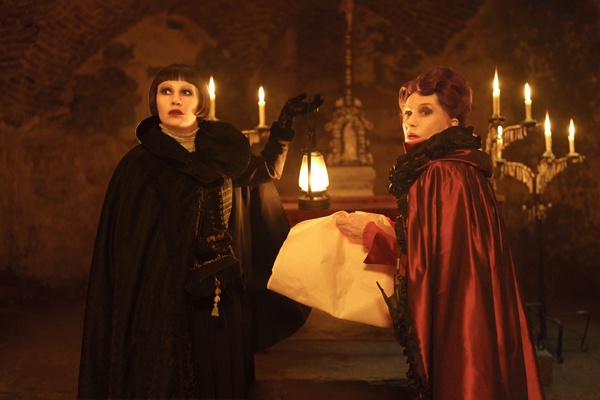
In a rustle of silks and velvets, with imposing outfits that aim for the most operatic and over-the-top theatricality (and with drag hints in the makeup and outfits), Huppert roams the city in her gothic carriage, interrupting the tourist guide who narrates the history of the Austrian capital. The impression for non-Austrians is that much of this fresco and its related irony is lost if one is not well aware of the city's spirit and toponymy. The main purpose of the film, which has nothing truly horrific and seems undecided about whether and how much it wants to be comedic, seems to be a nocturnal tour of the most touristy corners of the Central European city, reinterpreted in a curious or irreverent key.
Too camp to be a real film
It's a film so committed to capturing the Austrian essence that it doesn't forgo its most recent contemporary icon: the cast also surprisingly features Thomas Neuwirth, who even finds time to perform the hit "Rise like a Phoenix," with which he won Eurovision and became a kind of national ambassador in pop culture in the guise of Conchita Wurst. What, pray tell, is more camp than Eurovision? Little, very little. However, between exaggeratedly baroque costumes (the jewel-encrusted coffin-shaped pen holder purse, cloaks with train several meters long, velvet gloves with sharp fake nails applied to each finger à la Catwoman) and simply exaggerated situations (see Huppert's dialogues with her bat nicknamed Pipi, who acts as her messenger, it's unclear to whom or why, except to insert another over-the-top scene), Ulrike Ottinger seems to leave no stone unturned to discover and include it in the film. Forgetting, however, to give development and a sense of unity to the infinite scenes that make up The Blood Countess.
Even a decent knowledge of the German film scene makes the viewing decidedly more enjoyable or surreal, as when Birgit Minichmayr enters the scene dressed as a gothic maid who begins to act as a lady-in-waiting for the countess's reckless adventures, while Lars Eidinger acts as a psychoanalyst for the countess's poor nephew.
Score
Editorial team

The Blood Countess transforms vampirism into a bizarre tourist adventure in the heart of Vienna
Isabelle Huppert is so perfect for playing a vampire, so stylish and convinced in tackling even the most nonsensical and silly twists of this The Blood Countess that somehow one leaves perplexed, confused but still amused by the viewing. The fact remains that in her over-the-top genius, Ulrike Ottinger has given us infinitely better caprices in the past than this film, which still leaves a bit of a bitter taste: beyond the visual triumph offered by truly opulent costumes and sets, beyond the unique sightseeing tour of Vienna, much, much, much more could have been done to make Huppert's first time as a vampire decidedly more unforgettable.
Similar articles