No Longer Able to Romanticize Fashion, The Devil Wears Prada 2 Turns to Journalism
Twenty years after the first chapter, Miranda, Nigel, and Andy are no longer fighting for designer labels, but for dying journalism.



The Devil Wears Prada 2 has only one extraordinary insight: that of removing fashion from the center of its narrative, letting outfits and set designs achieve the glamour quota required for the sequel to the 2006 film. After all, the first film also took the fashion system and its media portrayal as a framework to then tell a story of a hyper-competitive work environment governed by its own incomprehensible hierarchies and logics from an external point of view, whose apparent arrogance simultaneously hid great professionalism on one hand and the worst that capitalism and misogyny can produce in their editorial liaisons on the other.
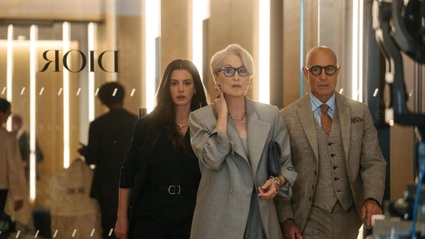
The true stroke of genius of the sequel, carefully concealed by a promotional campaign that revealed everything else, is that fashion stays in a corner. At the center of the scene is a theme very popular in auteur and mainstream cinema over the last twenty years: the death of "traditional" journalism and the ethics it theoretically entails. Print media becoming little more than toilet paper, a paper medium that has become a whim for figures like the rediscovered Miranda Priestly (Meryl Streep) and her loyal Nigel (Stanley Tucci). Somewhat faded and less charismatic relics of a bygone era who, as the world crumbles around them, find solace in stubbornly engaging in the futile exercise of choosing the perfect photo for the perfect cover of the glossy edition of the magazine they work for, archived with a couple of clicks on social media.
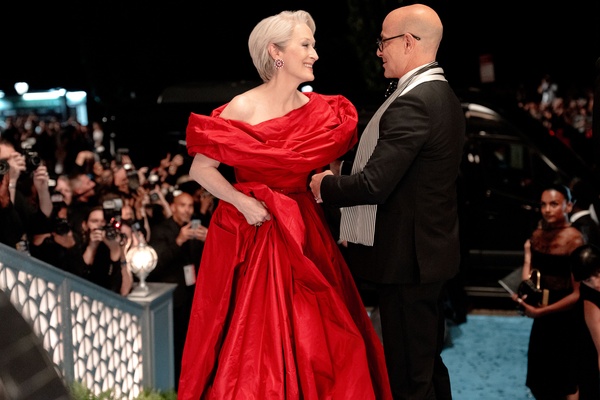
Journalism is Dying, but Still Glamorous, in The Devil Wears Prada 2
It's no surprise then that the press is moderately enthusiastic about a film that opens with an almost triggering experience for those who do this job: the sudden closure of their own publication, which for Andy (Anne Hathaway) comes hand in hand with a great career achievement. Told in its small cynicism, this sequel seems delightful in how it pushes Andy, once again out of necessity, to make a new pact with the devil, exchanging the weight of her respectability for a salary double what "serious" journalism, with which she built her authority, guaranteed her.
Not that Runway, the iconic magazine Miranda directs, is doing any better: slashed budgets, aggressive human resources, new recruits who don't know or understand what it once was. So much so that the director now has to hang her own jacket on the hanger in the office. Andy and Miranda thus find themselves working together, hoping to steer the magazine out of yet another editorial bankruptcy. In between there's a promotional event in Milan's fashion district, the co-dependent economic and reputational relationship between brands and publications (Dior is now captained by an Emily Blunt even more neurotic than before) and at least a couple of billionaire males whose worldview is so emotionally sparse and solely devoted to profit that it makes one miss that semblance of sentiment behind the old Miranda's worst outburst.
Miranda and Andy Are Worse Characters Than We Left Them
The new Miranda, however, is a poorly managed character, saved only by a Meryl Streep generous in giving herself to what the film asks of her, which is essentially everything and its opposite. Is she pretending or does she really not remember? Is it senile dementia or calculated coldness, alternated with out-of-place moments of kindness, discouragement, being passive, almost submissive? The film fails to give a precise direction to the character, called upon to put on a wicked show from time to time, but without any kind of involution, evolution, or even just personal stasis. The fundamental problem is that this film plays with cynicism as much as with quotationalism, but never manages to be truly incisive. Malice is replaced with a sometimes out-of-place romanticism regarding the media itself, embodied by Andy. Someone who has dedicated her life to journalism, but who the film suggests is where she is not exactly by her own merits. The world described by this film has a terrifyingly plausible reality at its margins, made up of people only willing to read nonsense, of ephemeral and unimportant content, of the continuous need to mediate artistic and informative impetus with the concessions necessary to survive.
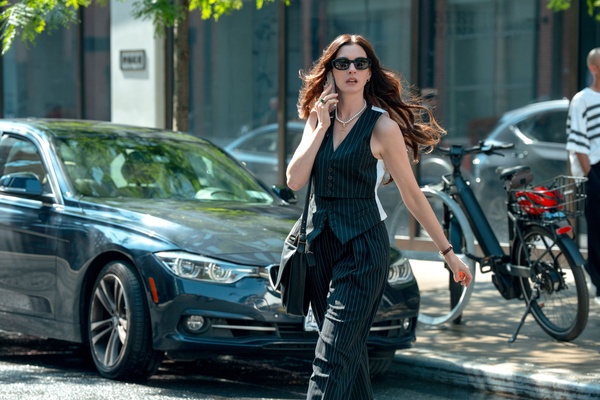
Yet Andy is somehow truly the moral compass of the film and at the same time a child protected and pampered by Nigel, by Miranda, and even by the film itself. A film that uses the ugliness and wickedness of our world as a pretext, but protects its protagonists from the repercussions. Andy can remain incorruptible because the film places next to her the only "ethical" real estate developer in all of New York, who buys buildings to renovate them, but to save them (sic). Someone with a theoretically morally ambiguous profession, but cleaned up just enough to allow her to find a home without becoming one of the privileged. We see her typing on her laptop late into the night, as an example of the hardness of the work. Yet this time no one scolds her when her arrogance leads her to write beautiful but little-read pieces. When the metrics don't favor her, she brings home the most desired interview in years with a couple of phone calls. If there's one thing The Devil Wears Prada 2 truly believes in, if nothing else, it's the miraculous power of a phone call.
But can all this interest an audience that, fortunately, has little or nothing to do with these editorial dramas made of engagement, content on the verge of continuous sponsorship, and newsrooms closing? Meryl Streep was already the editorial fairy godmother in The Post, then there was the Oscar darling Spotlight and the many monographs dedicated to war journalists, investigative journalists, and then unemployed journalists. Perhaps journalism truly died when it entered the ranks of professions – like the florist, the bookseller, the coffee shop clerk – romanticized by unrealistic romantic comedies, just like this film. Professions often in crisis, not felt to be needed but whose craftsmanship is "missing." We are impatient with journalism, criticism, yet at the same time that sense of authority, integrity is missing. And since the film is now on the side of fashion and cannot discuss the death of that craftsmanship, that know-how, the perceived, presumed, and authentic value behind a big brand placed on a small bag, it finds its soul within journalism, in a magazine that the Andy of twenty years ago despised precisely for its content, which, upon closer inspection, was never really discussed.
The Devil Wears Prada 2 is a Low-Quality Production
Instead, Runway's editorials are now the last bastion of journalism remaining. A bit like the film itself, which now that it would have the resources and means to aspire to a quality unapproachable by the original, is overshadowed by the comparison. Everything is done a bit worse in appearance and craftsmanship (starting with the terrible cinematography and imprecise editing). Everything is more fake, starting with the unnaturally smoothed faces of the protagonists: it's almost laughable how Emily insists on criticizing Andy's eyebrows "which have remained the same" when the rather immovable faces of both are profoundly different. The interactions are fake, the plot twists fake and predictable, the screenplay is poor, it has those two or three incisive ideas to make a great film but doesn't bother to do so because it doesn't need to. The sequel is already an event in itself, it sells itself, and no one seems to bother more than the bare minimum to make it special.
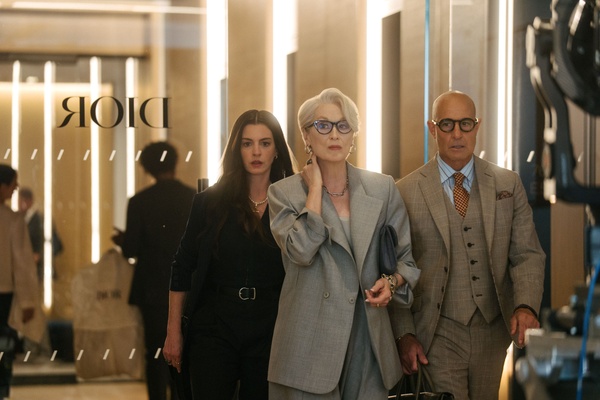
The only one who brings a dose of authenticity is Lady Gaga as herself, one of the many cameos that populate the film. And the only one to take on the burden of a role in opposition to Miranda, not asking to be praised but rather being in open conflict with the editor of Runway, yielding to her blackmail but referring to it with calm honesty. There is more truth in a Lady Gaga who admits to performing for free so as not to lose the possibility of appearing on future covers of the magazine than in everything the film says about the rest of the most glamorous editorial world.
Score
Editorial team

No Longer Able to Romanticize Fashion, The Devil Wears Prada 2 Turns to Journalism
Technically quite poorly made considering the possibilities of this production, The Devil Wears Prada 2 has neither the naivety, nor the enthusiasm, nor the freedom of the first chapter necessary to become a classic. However, it shares its ability to carve out genuinely cynical but brilliant moments that photograph the truth beyond the protagonist's perspective. Between one of these insights and the next, however, a real film is not built, but an infinite sequence of quotational, comforting, nostalgic moments, designed to titillate the viewer or the sponsor. Even Miranda appears confused, contradictory, like a film that tries to be cynical but without displeasing anyone, resorting to the easy scapegoat of tech billionaires. It's not even a real film: it's a series of checkboxes for the audience's and production collaborators' desires. A note of demerit to the Italian dubbing, which is really poorly done, so much so that at times it's difficult to follow the film's dialogues.
Similar articles