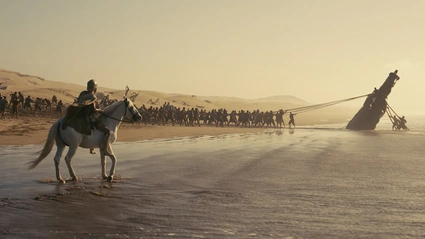
Christopher Nolan's Odyssey: We Expected a Lot, But Not Such a Gripping Blockbuster
Not since Inception has a Nolan film flowed so effortlessly as a blockbuster rich in ambition, certainly, but one to watch in a single breath, with an authentic taste for adventure and the unknown.


The nearly three-hour runtime is certainly epic, the ambition to bring one of the foundational myths of Mediterranean culture to the big screen is gigantic even for a director like Christopher Nolan. So much so that it was unclear what to expect from his Odyssey, after ambitious but complex films like Tenet and Interstellar. The real surprise, then, is finding yourself in front of a film that, while thematically it is the perfect heir to Oppenheimer, cinematographically it is a true blockbuster: pure entertainment in which the war effort, the exploration of the unknown, the gigantic star cast, and the gripping story offer a long but splendid cinematic experience.
Gallery
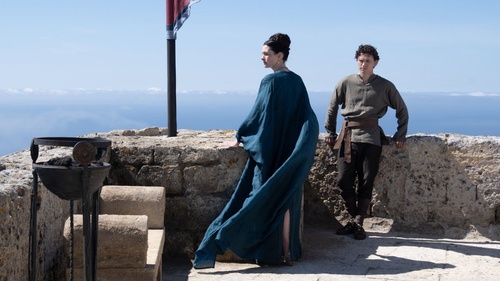
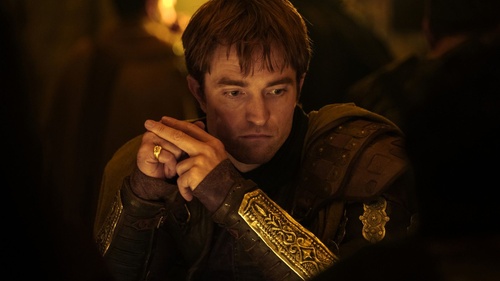
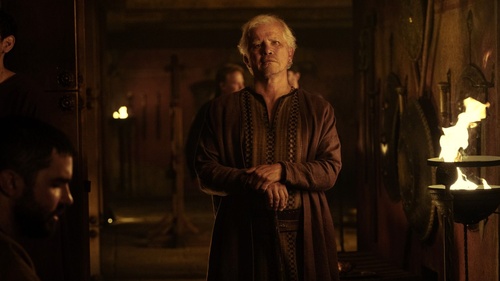
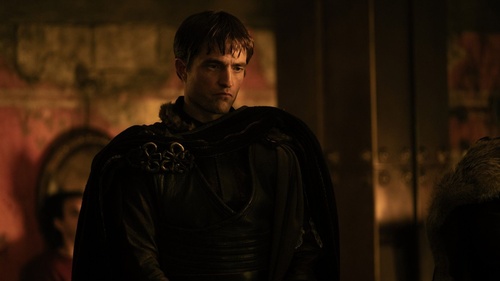

Nolan's Ulysses Looks to Our Present
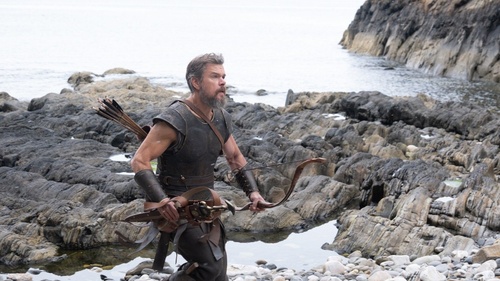
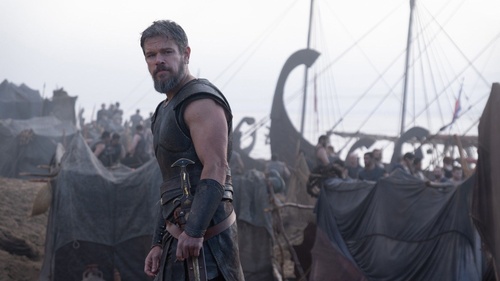
It's not that important ideas or profound reflections are missing from Odyssey; on the contrary: Matt Damon's Ulysses is deeply marked by his wartime experiences, making him one of the most restrained and sober versions of the arrogant, audacious, cunning king of Ithaca. Especially in the finale, Odyssey dialogues almost painfully with our difficult and painful historical present, questioning its audience on what humanity truly loses every time someone pushes a little further to gain an advantage over an enemy.
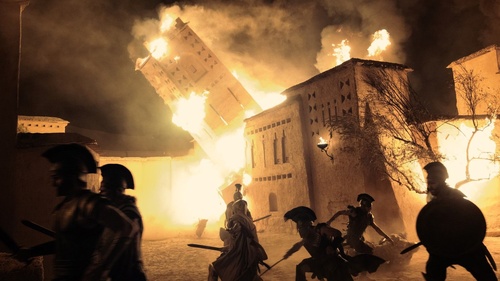
In an attempt to end an endless war, to subdue an invincible city, Ulysses becomes a destroyer: not only of a city, but above all of a pre-established order that ends up endangering his home, his family, and his loved ones. This is the interpretive key chosen by Nolan to recount his difficult return home.
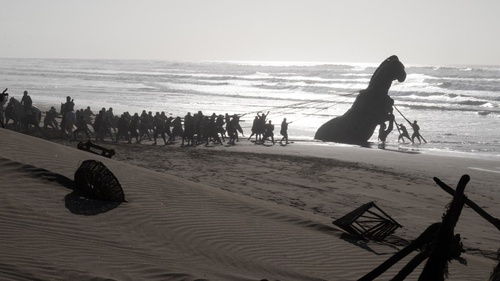
His journey is an awakening to his errors, interspersed with concepts from Greek myth that Nolan dusts off in the memory of those who studied the Odyssey in school. While certainly a personal and modern reinterpretation, the screenplay is guided by the concept of xenia, a concept that also forms the foundation of the Homeric poem. The hospitality sacred to Zeus becomes the discriminant that distinguishes good from evil: this second category includes both the barbaric and monstrous inhabitants of the world's fringes (like Polyphemus, Scylla, and Charybdis), but also those who, like Robert Pattinson's Antinous, bend the rules for their own gain, undermining Ulysses' throne.
In Nolan's Odyssey, There's Also Room for Emotion
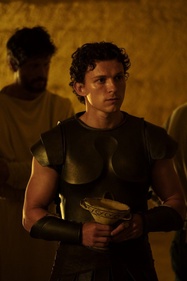
For a director always obsessed with absent fathers, the Telemachy (the introduction to the Odyssey where the hero's young son sets out in search of news of his father) could only be the starting point. Tom Holland's Telemachus carves out an important space in his search for a father he wants to find, yes, but even more so to know. Just as in Oppenheimer, marital and emotional relationships find much more space than in the past, with the tender but tense relationship of a wife awaiting her husband and a son trying to form an idea of a father he only knows through the songs of the bards.
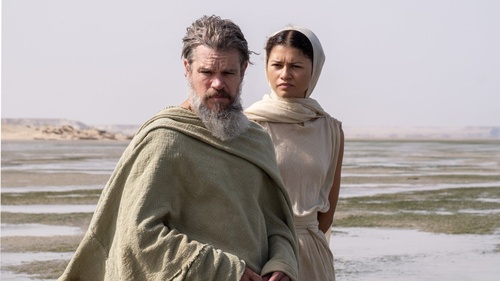
Nolan is not afraid to change, cut, innovate: with the exception of Zendaya's Athena, the gods are incorporeal, Nausicaa disappears, the tempting women who populate Matt Damon's journey become more mature and human figures, with a timid attempt by the director to tell the painful point of view of the female universe in a violent world populated by men. Penelope and Athena, however, are the heroines of the story as they defend that order and those rules that Nolan portrays as necessary and desirable. To lovers like Calypso, to bringers of chaos like Circe (among the most memorable figures in the film), and to avengers like Helen and Clytemnestra, Nolan, however, gives the benefit of the doubt and a good dose of understanding.
In terms of acting, it's difficult to isolate one performance as superior to the others, and not just because of the vastness of the cast. This time, no one excels because the narrative functions in an authentic choral dimension, where the great popularity of practically every star involved unifies the cast into a very well-blended ensemble, working to build a great cinematic story that functions like the peplums of old.
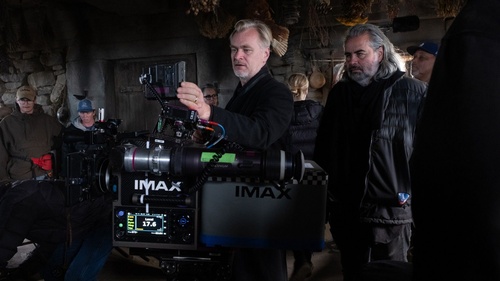
Those fortunate enough to see the film on a screen worthy of Nolan's technological challenge (who shoots the film entirely in IMAX, with a large format and, moreover, with an almost futuristic technological advancement in sound and image) will experience an almost total immersion in a story that, much like Batman, has the ambition, often successful, to make real, realistic, and palpable even what should be magical, fantastic, and realized with special effects.
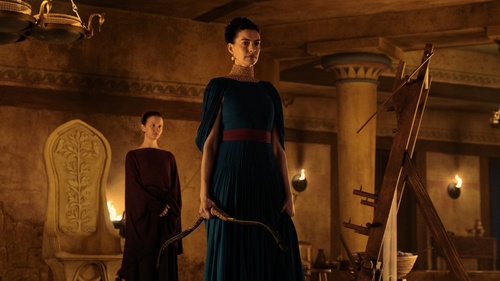
Compared to the past, moreover, also thanks to the touch of cinematographer Hoyte van Hoytema, Nolan's palette is enriched with warm tones, the warmth of fire, and vivid colors. The sea is not wine-dark but a brilliant blue, the garments mix intense reds and blues. Fire reflects sinister but warm shadows on faces.
Once Again, Nolan Blends Arthouse Cinema and Hollywood Blockbuster
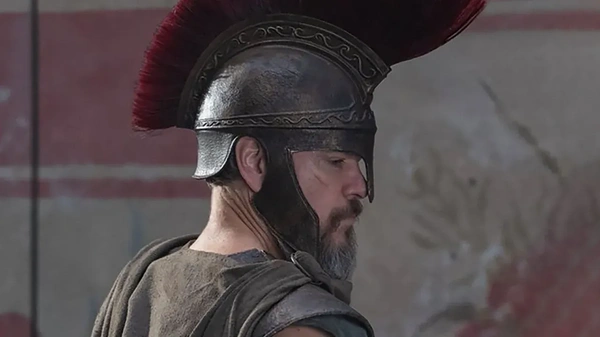
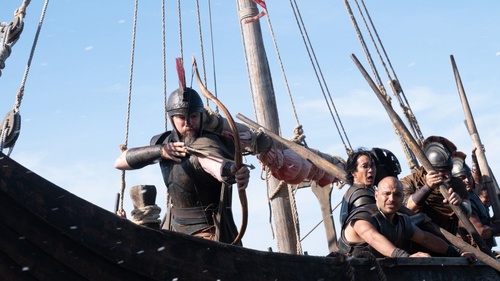
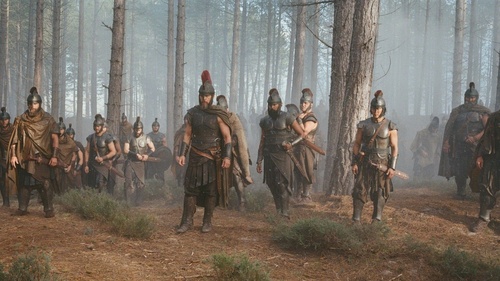
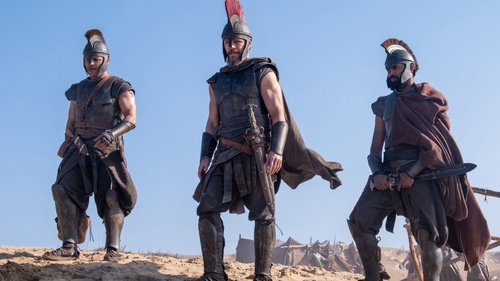
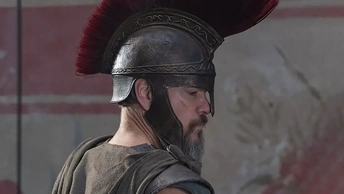
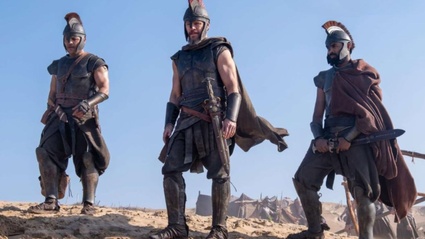
The real achievement, however, is how enveloping, ambitious, yet immediately accessible the narrative is. Nolan this time manages to effectively synthesize grand ideas into grand cinema that not only makes you think but also captivates. It's not his most ambitious film, but it's a title that makes you want to go to the cinema, to relive Ulysses' journey alongside him. Even its aesthetic, beyond preventive controversies, is an excellent compromise between what we imagine the appearance of armor, clothing, ships, and objects of the era to have been (which is not always so adherent to historical reality) and a Hollywood and cinematic functionality.
Are there some over-the-top touches? Certainly. However, Agamemnon's controversial black armor, within the incredible narrative Nolan weaves around him, makes absolute sense. When glimpsed beyond the finally opening gates of Troy, it becomes a powerful cinematic image.
It is difficult, therefore, to criticize this adaptation of the Odyssey. Not because it is perfect, not because it doesn't carry many of Nolan's limitations, obsessions, even recurring themes, a director who sometimes seems unable to fully embrace the Homeric tale. However, his betrayal has an interesting and strong idea behind it, which tells of the desire for an ordered world governed by rules that ensure the stability of human civilization. It is a somewhat conservative vision, contrasted with a tale of the horror of war that, seen in our historical moment, is truly chilling.
It won't please everyone, but a film with a strong point of view can only stimulate significant reactions, even opposing ones. What is appreciable about Nolan this time is how much he draws the viewer into the story, without overcomplicating it, telling a fascinating idea and a man who conceived and realized it, in his genius but also in his weakness. It is that kind of cinema, ambitious yet popular, auteur yet accessible, that made Hollywood great and that we often long for. Fortunately, there are still directors like Nolan up to the challenge.
Score
Editorial team
Christopher Nolan's Odyssey: We Expected a Lot, But Not Such a Gripping Blockbuster
Similar articles
Nolan's Odyssey: New Trailer Unveils an Epic Blockbuster
Nolan's Odyssey and Spider-Man: Brand New Day Brought Back the Magic of Cinema. And It's Not Just About FOMO
THRASH - Furia dall’Oceano: hurricane and sharks, but it's not Sharknado