DOOM: The Dark Ages – Revelations Changes the Pace of the Base Game - The Review
The Chain Lance brings back Eternal's mobility and blends it with The Dark Ages' "heaviness," but backtracking and crowded controls slow the expansion down.


Series that endure over time don't just survive by repeating what worked in the past. They must recognize which elements can be modified without losing their identity, even accepting the risk of dividing the audience. DOOM's recent history is built precisely on this principle: each chapter has preserved the series' speed and violence, but has organized them through different rules.
DOOM (2016) brought the shooter back to its foundations, eliminating cover and waiting to continuously push the player towards enemies. With DOOM Eternal, that same rush became more technical, involving double jumps, aerial dashes, resource management, and vertical movement. DOOM: The Dark Ages then chose another path, slowing the pace and building combat around the Slayer's "heaviness" and the Shield Saw (an immovable shield, as some would say). Revelations tries to bring these two directions together, seeking a balance between speed and solidity without sacrificing either.
However, the expansion arrives at a particularly difficult time for id Software. The Texas studio is part of the Xbox ecosystem after Microsoft's acquisition of ZeniMax Media, and the recent restructuring of the gaming division eliminated 136 positions directly linked to the team: 96 at the Richardson headquarters and another 40 among remote employees connected to the same office. After the cuts, id Software stated that it still has the necessary personnel to continue developing the games and technology it is known for, adding that the group's current size is comparable to that during the development of DOOM (2016).
The result is an expansion that doesn't just add new maps and new demons: but what happens when Revelations directly intervenes in The Dark Ages' combat system, correcting its rigidity without erasing its physical force? Is it truly an improvement capable of redefining the experience, or do some decisions related to exploration and control layout end up slowing its pace?
An Almost "Dantesque" Purgatory
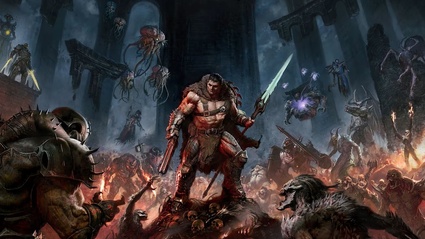
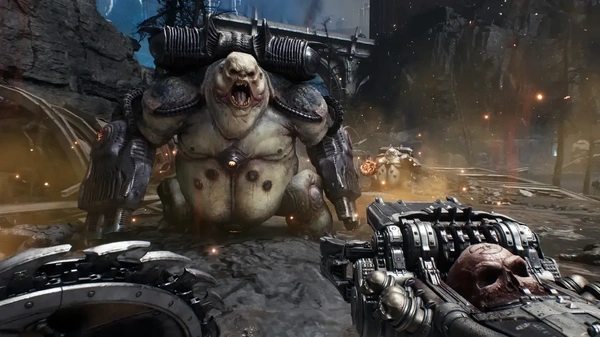
Revelations is an expansion of the DOOM: The Dark Ages campaign and therefore requires ownership of the base game. Its story begins immediately after the conclusion of the main adventure, taking place before the events narrated in DOOM (2016) and DOOM Eternal. The Slayer decides to directly attack the Infernal Council, the assembly of rulers who control a portion of the demonic forces, but the assault quickly turns into a trap. Betrayed and defeated, the protagonist is stripped of his armor and the Shield Saw, the defensive tool around which The Dark Ages' combat was built.
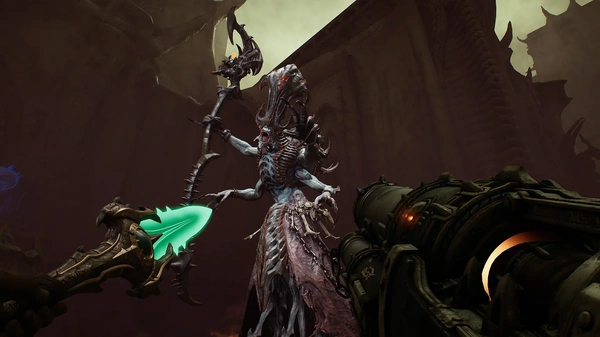
He is then cast into Purgatory, a suspended, frozen land where souls are forced to confront their sins. Here he meets the Architect, a demonic entity as ambiguous as it is terrified by his presence. The demon agrees to help him escape and gives him the Chain Lance, the new weapon that temporarily replaces the shield and becomes the focus of the entire expansion.
The choice to strip the Slayer of his equipment not only serves to justify new progression. id Software shows the protagonist in an unusual state of vulnerability, at least compared to the almost invincible figure built in recent chapters (we challenge you to think otherwise). The Slayer remains a force capable of tearing through entire armies, but he must regain his power starting from a defeat.
The tone recalls certain comic book archetypes, particularly approaching tormented figures like Spawn in Todd McFarlane's comics. Like the character created by the author, the Slayer moves in a space suspended between damnation and revenge, marked by a past that continues to influence his actions and a rage that stems not only from the violence of the present, but from what he has lost. Revelations doesn't transform DOOM into a psychological narrative, but uses Purgatory to allow more space for the protagonist's past and the reasons that fueled his rage.
I've Always Liked the Idea of a Central Hub
The campaign is developed around a large central hub located in Purgatory, from which six total levels are accessed. The areas are more open than many sections of The Dark Ages and contain hidden paths, collectibles, special encounters, and zones that can only be visited after obtaining certain tools.
This structure allows the narrative to deepen the relationship between the Slayer, the Sentinels, and the Maykr. Through inscriptions, diaries, and environmental fragments, Revelations shows more clearly how this dependence progressively destroyed the political and spiritual autonomy of the Sentinels. Purgatory becomes the material representation of that subjugation, a place where the consequences of the choices made by Argent D'Nur continue to survive even after death.
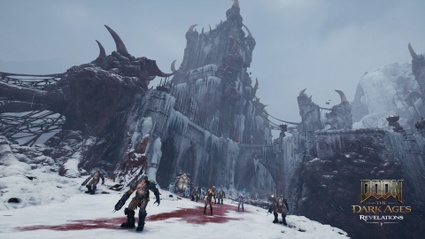
Sentinel technologies blend with snow-covered ruins, temples suspended in the void, and grand Gothic architecture. These are monumental, yet almost completely lifeless, scenarios built to accentuate the Slayer's solitude. The narrative material is interesting, although the cinematic sequences appear less developed than those in the base game. Some plot twists are resolved too quickly, and the Architect, who could have become a true counterpart to the Slayer, remains a less fleshed-out figure than necessary. His motivations are deliberately ambiguous, but the character primarily serves to show how much the Infernal Council can control and intimidate even its own subjects.
The most successful part of the narrative, however, comes through the playable sections. In some flashbacks, we control the protagonist when he was still a simple human soldier, engaged in a failed counter-insurgency operation before encountering demonic forces. These moments recall the industrial atmospheres of DOOM 4, the never-released project that was supposed to precede the 2016 reboot. The weapons are more conventional, the environments less fantastical, and the protagonist still appears to be involved in a human conflict.
Chain Lance: Is There Anything More Badass Than the Slayer's Weapons?
The Chain Lance is the central novelty of Revelations. It doesn't just expand the arsenal, but changes how the player traverses arenas, deals with projectiles, and decides which enemy to target first. To understand the change, one must recall how DOOM: The Dark Ages worked. In the base game, the Slayer was heavier and more stable than his previous incarnations. The Shield Saw allowed him to block attacks, repel projectiles, and advance head-on against demons. Combat was built around the feeling of controlling a war machine capable of absorbing pressure and returning it with greater force.
The Chain Lance follows a different philosophy. It doesn't offer passive protection and requires reacting at the correct moment. Parrying thus becomes an offensive gesture. It's not enough to raise a shield: you must read the trajectory, anticipate the attack, and respond. Errors directly expose you to damage and become particularly costly at higher difficulty levels, but every successful response delivers a very convincing physical impact.
The second function of the lance concerns movement. By impaling it into a demon's body, the Slayer can quickly drag himself towards the target, maintaining control of his trajectory during flight. He can also perform precision throws, traverse certain defenses, execute a ground slam, and modify movement mid-air (all of which translates into a majestic expression of movement).
The system reintroduces the principle of DOOM Eternal's Meat Hook, but makes it more flexible. Revelations recovers that aerial mobility without sacrificing the heaviness of The Dark Ages. The Chain Lance allows you to overcome obstacles, bypass vertical defenses, and use every demon as a grappling point to reach the next target. The quick dash also returns, absent in the base game. Its presence makes it easier to correct position, avoid lateral attacks, and move from one opponent to another without interrupting the flow of combat. It is in the union of weight and speed that the expansion finds its identity.
New Demons to Fight, New Ways to Fight Them
Progression revolves around Platinum and Blood Iron, resources that allow you to upgrade the Chain Lance and armor, expanding not only damage but especially the tactical options available. Some improvements introduce charged lunges capable of stunning more resilient enemies, while others transform the lance into a throwable weapon capable of bypassing specific defenses.
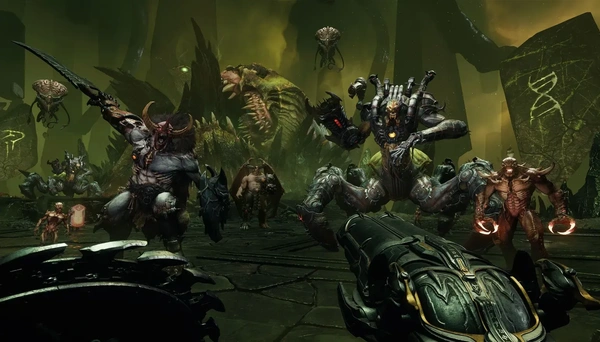
The bestiary also adapts to this increased mobility: the Archvile returns protected by energy shields, the Cosmic Elemental generates persistent minions, and invisible variants of Revenant and Whiplash force the use of area attacks. Added to these are new enemies like Warlock and Buzzsaw, designed to maintain high pressure during movement.
Mid-campaign, the return of the Shield Saw completes the system, allowing it to be alternated with the Chain Lance and achieve maximum depth. The shield offers control and frontal defense, while the lance prioritizes mobility and risk, creating a dynamic balance that forces continuous adaptation to arena composition. However, this richness also translates into some confusion in the controls, with different actions assigned to the same buttons and muscle memory that takes time to stabilize.
Despite these difficulties, the system clearly rewards aggression: perfect dodges charge the Power-Up and incentivize melee, while retreating often means losing opportunities. Increased mobility also enhances heavy weapons like the Accelerator, making the meta-game deeper without rendering obsolete solutions already present in the base game.
A Strange Way to Backtrack
The least convincing part of Revelations concerns the exploration structure, built around a formula we could call "Doomtroidvania," meaning a version of DOOM based on initially inaccessible zones that can only be opened after obtaining new tools.
During the first visit, some doors and paths remain closed, and to reach them, it's necessary to obtain the Mastery Key and later return to already completed levels, where advanced upgrades, resources, and collectibles essential for total completion are found. The principle isn't wrong, because the hub structure and larger maps lend themselves to progressive exploration, but the problem arises when many paths must be traversed again after the main combat encounters have already been completed: backtracking slows down a game that performs best when it doesn't interrupt combat, and returning to now-empty corridors to retrieve a Platinum fragment extends the duration without necessarily introducing a new challenge.
The absence of fast travel and immediate chapter selection during the first playthrough makes the system even more rigid, because if you pass a point of no return forgetting a resource, you cannot retrieve it immediately; instead, you must finish the campaign and return to the level later—a choice that seems designed to extend longevity, but ends up penalizing those who explore carefully, turning an oversight into a game-imposed wait rather than an error correctable with available tools.
However, completing the story does not represent the actual conclusion of Revelations, because after the epilogue, new zones are opened in already visited levels, it becomes possible to recover missing collectibles, and Master Arenas are unlocked—advanced challenges designed to test mastery of the Chain Lance and the full arsenal.
These arenas also lead to the expansion's most difficult encounter, deliberately left out of the main path, and it is precisely in the endgame that Revelations truly shows how deep the new system is, gradually ceasing to introduce tools and asking the player to use them without room for improvisation.
Completing the Master Arenas also unlocks Revelations content in Ripatorium 3.0, the base game mode that allows you to create and customize encounters within dedicated arenas, adding three maps — Infernal Core, Osseus, and Classic — along with the expansion's demons, including leader and champion variants, plus fully upgraded loadouts built around the Chain Lance and new armor improvements, Revelations music tracks in the jukebox, and six combat configurations prepared directly by id Software.
In this sense, the endgame manages to at least partially justify returning to already completed levels: it doesn't eliminate the backtracking problem during the first playthrough, but offers sufficiently challenging content to ensure that the added duration doesn't solely depend on searching for collectibles.
Beautiful to Look At, But There Are Limitations
We tested Revelations on a configuration equipped with an NVIDIA GeForce RTX 4060, SSD, and ultrawide monitor in 21:9 format, and from the very first minutes, it's clear that id Tech continues to be one of the most robust engines available. Even in a visually more ambitious context, it manages richly detailed environments without necessarily requiring high-end hardware, maintaining a convincing overall rendering.
The transition to Purgatory offers the art direction an opportunity to move away from the warm, familiar tones of Hell, building scenarios that focus on colder, more solemn contrasts. The snow-covered ruins, runic temples suspended in the void, and Gothic structures linked to Sentinel technology define a distinct visual identity that manages to refresh the aesthetic impact without betraying the coherence of the game's universe.
In this context, readability remains one of the most successful elements. Even in the most crowded encounters, the game maintains a visual clarity that proves fundamental: distinguishing a green projectile, identifying an invisible enemy, or recognizing a weak point is never left to chance, but becomes an integral part of the combat rhythm.
The 21:9 format contributes significantly to this clarity. The wider field of view allows for better control of the arena's sides, anticipating the movements of faster demons, and reacting to projectiles coming from the flanks. During movements with the Chain Lance, this increased visual openness reduces blind spots and makes choosing the next target more natural, improving overall space management. It is not merely an aesthetic advantage, but an element that directly impacts the reading of combat.
On the RTX 4060, however, some limitations related to the 8 GB of VRAM emerge. At the ultrawide monitor's native resolution and with the maximum graphics preset, video memory usage exceeds the card's manageable threshold, causing instances of micro-stuttering and frame rate drops, especially during the streaming of more complex scenarios. By adjusting the settings, the situation improves significantly: setting texture pool and shadow quality to High and keeping other parameters on Ultra, memory occupation stabilizes around 7.2 GB, providing smoother fluidity without obvious visual sacrifices.
A separate discussion concerns DLSS 3 with Frame Generation. When activated in our test, Revelations exceeded 90 frames per second, thanks to the generation of additional frames between those actually processed by the GPU. However, this increase in perceived fluidity is accompanied by an increase in system latency, which approaches 28 milliseconds.
On the audio front, Finishing Move Inc.'s work accompanies the change of setting with a soundtrack that partially deviates from that of The Dark Ages. Industrial components remain present, but are flanked by liturgical choirs, tribal percussion, and more solemn passages, contributing to building a more gothic atmosphere consistent with Purgatory. The result is an accompaniment that maintains the necessary energy during combat, but also manages to support slower moments dedicated to exploration. The audio mixing on PC also appears more refined than the base game version: explosions, metallic impacts, and parried blows remain always distinguishable, even in the most chaotic situations.
The spatiality of sound adds another layer of depth, allowing enemies suspended in the air to be located even before seeing them. In this way, audio ceases to be a mere spectacular element and becomes an integral part of the tactical reading of the arena.
Score
Editorial team
DOOM: The Dark Ages – Revelations Changes the Pace of the Base Game - The Review
DOOM: The Dark Ages – Revelations blends the aerial mobility of DOOM Eternal with the heaviness of the base game, building a deep and aggressive combat system around the Chain Lance. Crowded controls and backtracking slow the experience, but Master Arenas and Ripatorium 3.0 support a rich and challenging endgame.
Similar articles