Agata Christian is a great missed opportunity to make a good Italian giallo film again
Christian De Sica's lazy and brilliant detective, "namesake" of Agatha Christie, is more of a missed chance to bring back the Italian giallo genre.
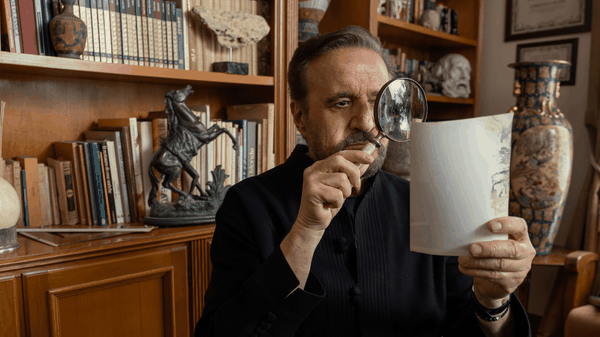


That Agata Christian is an almost blatant rip-off of Knives Out was more than evident to everyone, right from the very first promotional images of Eros Puglisi's return to directing, who also co-wrote the screenplay with three other colleagues. A small team of writers grappling with an attempt that is actually not unprecedented for the director. Those with a good memory and knowledge of Italian cinema will recall that Puglisi repeatedly tried to bring genre cinema back to theaters in past decades.
Copying Knives Out isn't a bad idea...
Between 1970s poliziotteschi and early 2000s thrillers, the genre of murders and investigators is extremely popular in Italy, not to mention the array of commissioners, priest-investigators, and prosecutors on the small screen. Italians, in short, like to investigate via screen, but for some reason, for years it has been very difficult to do so in cinema, unless turning to foreign offerings, which from France to the United States have always been very rich. Puglisi and his producers are therefore right, at least in their production assumptions: in Italy, there is space for a cinematic franchise with a detective investigating within the framework of a classic English giallo, with suspects trapped in a large mansion and united by ancient secrets and unspeakable truths.
One could even seize the opportunity of the deliberate absence of the model that Agata Christian so clearly "draws inspiration" from in theaters (given that Netflix specifically acquired the rights to future chapters of the Knives Out franchise to deprive exhibitors of a potentially fruitful and endless saga, considering the numbers the first chapter made in theaters), to create a long-term commercial success. However, this entire ideal scenario founders on the cliff of what Agata Christian unfortunately turns out to be: a rip-off with a handful of genuinely amusing insights, a pinch of inventiveness, but the fateful decision to draw on traditional, raunchy Italian comedy, and doing it badly, very badly.
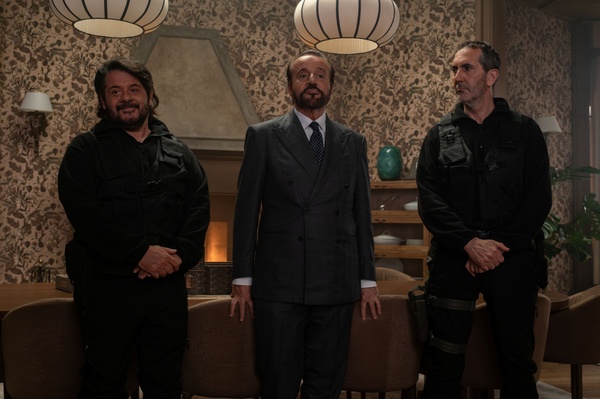
...but it needed to be copied better
So we follow Christian Agata (Christian De Sica), Italy's most famous criminologist, to the Aosta Valley manor of Carlo Gulmar (Giorgio Colangeli), patron of a famous toy company that achieved success thanks to a Cluedo-style board game called Crime Castle. In short, the screenwriters must have said to themselves: since we're copying, let's do it from the entire giallo genre, across the board. In reality, the board game setting, with pawns, a cardboard board, and dice rolls, is very intriguing: Christian Agata has been hired to be the star of a commercial for the new version of the game, but obviously while he is at the manor, after an evening of intertwined family threats, Carlo is found dead, his head submerged in a generous portion of Saint Honoré Cake. The criminologist must thus investigate to ensure his acting fee is paid.
From here, the predictable, well-worn script of the genre unfolds: mysteries and secret identities emerge, with the "support" of the clumsy brigadier and fan Gianni Cuozzo (Lillo Petrollo), leading to the finale where Agata gathers the suspects in a single room and reconstructs the killer's moves. Given that the case, however trivial, is still carefully constructed, there would be room for at least a decent film.
Of course, it almost makes you cry to think that from Rian Johnson's all-star cast, we get one where the superstars are Tony Effe (acting is not exactly his forte), Sara Croce (ditto), and Ilaria Spada (as above), but it's precisely the kind of film that, more than any other, forgives an ensemble as varied as it is inconsistent in acting quality. The problem is that, for some inexplicable reason, they wanted to combine this genre and this story with all the (retrograde) stereotypes of the worst raunchy and vulgar comedy.
Thus, in a context of millionaire entrepreneurial families and aristocratic detectives, there's a constant slide into Roman dialect to blurt out the most vulgar expressions possible in the hope of eliciting a laugh, with some timid peeks at the actresses' assets à la Bagaglino and an inexplicable animosity towards animals. Poor Petrollo, perhaps the only one here who truly tries, is forced to play this unfortunate brigadier constantly attacked by the most improbable and dangerous animals, some clearly out of place in the Aosta Valley, some even more out of place due to the horrendous quality of the visual effects with which they are created, for some reason, again. Vultures and venomous spiders in the Aosta Valley? More than for his genitals, bitten by a small dog for interminable minutes, it is painful for the viewer to witness this utterly embarrassing gag, in the silence of the room.
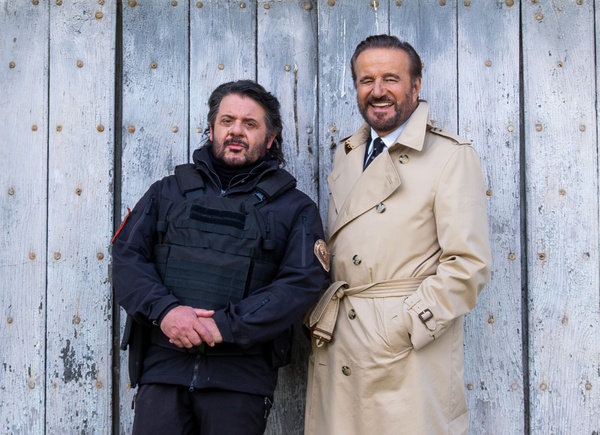
Agata Christian, in essence, is well summarized by its protagonist: a Christian De Sica who plays an equally scornful and bored investigator with great weariness, with trenchant remarks that are more annoying than audacious. A protagonist far removed from Daniel Craig's work, inconsistent and truly lazy in his "Italian-style" construction. He doesn't believe in it, and neither do those who thought it was enough to put Christian De Sica in the shoes of a caricature of himself to bring this film home, which also suffers from a truly poor production quality, despite Puglisi's attempts with his direction to give verve, brilliance, and liveliness to a story mortally sunk by moving in the exact opposite direction of Knives Out.
Indeed, where Johnson has made his giallo franchise popular, chapter after chapter, a continuous reflection on the distortions of American democracy, with a significant progressive bent, Agata Christian embodies all the annoyance, misogyny, and contempt of those who poorly experience the few changes in societal sentiment that separate us from the atmosphere and morality of the cinepanettoni. Which, without wanting to be sacrilegious, for many years did what Agata Christian attempts to do on the comedic front, eliciting some laughs but in a more refined, more convinced, more incisive way.
Score
Editorial team

Agata Christian is a great missed opportunity to make a good Italian giallo film again
Agata Christian is a great chance to take an excellent idea from others and bring a much-loved genre, long absent, back to Italian box offices: it's a shame that they decided to combine its detective story with another struggling genre of Italian cinema, that of vulgar comedies, which, box office data in hand, no one seems to miss. A last slice of panettone resurrected here at the cost of stifling an attempt that might not have been so original, perhaps not even so well made, but with its possibilities of success in creating an Italian giallo franchise. It's a pity for Puglisi, one of the very few not to give up on the death of genre cinema in Italy.
Similar articles

Minos Review: The Minotaur is a Great Strategist

The Long Walk is proof that making a good film adaptation of a Stephen King novel is possible
Bye Sweet Carole is the first Italian game to win a Webby Award