Vampire: The Masquerade – Bloodlines 2 Review - A fascinating gothic dream, but too fragile to become immortal.
A fascinating return to the World of Darkness: elegant, melancholic, and visually remarkable, but too fragile to bear the weight of its own name.



Twenty-one years after a chapter that changed the way narrative role-playing games are understood, Vampire: The Masquerade – Bloodlines 2 finds itself having to live with an inheritance that could be described as "cumbersome". The first Bloodlines, released in 2004 by Troika Games, was not a commercial success, but quickly became a cultural benchmark: a work capable of blending role-playing freedom, mature writing, and moral dilemmas into an experience that is still considered by many today as an example of narrative depth in Western video games. It was fragile, unstable, with some bugs, but also free, courageous, and perhaps even unpredictable.
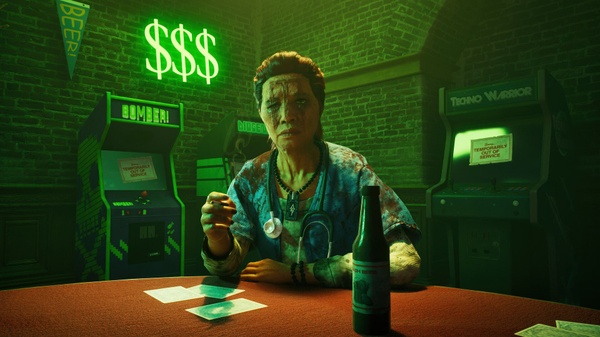
In taking on such a cumbersome legacy, The Chinese Room adopts a radically different approach, choosing to reinterpret the myth rather than imitate it. The new Bloodlines 2 foregoes some of the systemic freedom that characterized the original to embrace a more linear, more narrative, and more cinematic approach. The snow-covered Seattle in which the story unfolds presents itself as a scenario of extraordinary visual elegance: a city suspended between melancholy and immobility, where the beauty of the image is accompanied by a constant perception of emptiness. The atmosphere works, the direction suggests precise authorial intentions, but the feeling of freedom progressively vanishes, replaced by a direction that prefers to lead rather than allow action.
Within this aesthetic framework is the attempt to redefine the language of the vampire in contemporary video games. In this sense, Bloodlines 2 shares with Vampyr by Dontnod the ambition to explore hunger as a moral metaphor, transforming the act of feeding into a gesture laden with ethical and narrative consequences. However, if Vampyr based its effectiveness on the immediacy of choice and the direct impact of the player's actions, Bloodlines 2 prefers to maintain an interpretive distance.
It is in this distance, in the separation between experience and representation, that the deepest fracture between the myth and its heir is measured: a passing of the torch in which freedom gives way to contemplation, and the night becomes, more than lived, simply observed from afar and without passion.
The vampire's dual consciousness. What works in Bloodlines 2?
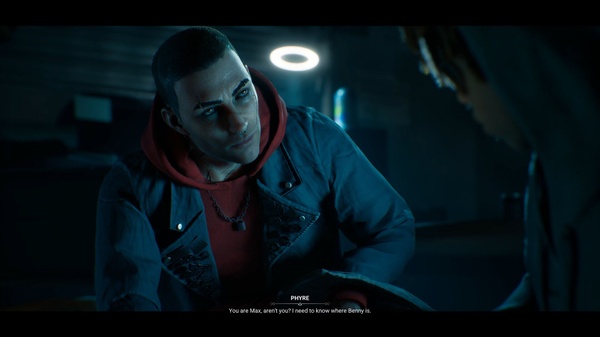
The narrative of Vampire: The Masquerade – Bloodlines 2 is, at the same time, its strength and its limit. The Chinese Room, true to its authorial style, builds a story centered more on characters and atmospheres than on player choices. The protagonist, Phyre, can be customized as either male or female, a decision that reflects the fluid nature of the vampire and the possibility of shaping one's identity even in the non-time of immortality. Their mind is inhabited by Fabien, a Malkavian detective with an analytical and tormented nature, whose presence generates a continuous dialogue between impulse and reason, power and conscience.
The initial plot is fascinating: Phyre awakens from a long torpor and is thrust into a nocturnal, snow-covered Seattle, where the Camarilla clans vie for control of the city. The early sections of the game effectively convey a sense of disorientation and curiosity, while the dual perspective between present and Fabien's investigative flashbacks builds constant and initially very interesting tension. However, as the story progresses, the narrative stops truly evolving: events unfold consistently, but rarely generate a sense of growth or tangible consequences. Dialogue choices, alliances, and moral conflicts initially seem to matter, but in practice, the game tends to always lead to similar trajectories.
Multiple endings exist and vary according to some key decisions, but this is not a true branching of possibilities, that "what if" aftertaste that we have now learned to love thanks to various entertainment mediums. Thematically, Bloodlines 2 questions – at least in intention – who vampires truly are.
Not simple predators, but creatures suspended between guilt and desire, condemned to a life of constant control to avoid succumbing to their inner Beast. It's a central theme of the World of Darkness, but the game treats it more as an aesthetic suggestion than a lived experience. Hunger, the Masquerade, and the loss of humanity remain evoked concepts, rarely translated into game mechanics. Nevertheless, when the writing touches on the fragility of the characters – the weight of power, the nostalgia for humanity – Bloodlines 2 finds its most sincere tone: that of a gothic drama trapped in an action body.
Overall, the main story offers approximately 25-30 hours of gameplay, enough time to appreciate the atmosphere but not to justify a second playthrough. It's a story that is followed with interest, but leaves the aftertaste of a novel experienced more as an observer than a participant.
Vampires are powerful but here they end up being a bit... repetitive!
The gameplay of Vampire: The Masquerade – Bloodlines 2 stems from an ambitious intention: to combine the slow, contemplative atmosphere typical of The Chinese Room with the physical and instinctive action of the vampiric world. The result is a compromise, at times interesting, but often uneven. The experience alternates moments of intensity with more rigid sections, where the combat system and environmental interactions show the limits of a project that seems not to have found a common language between story and game.
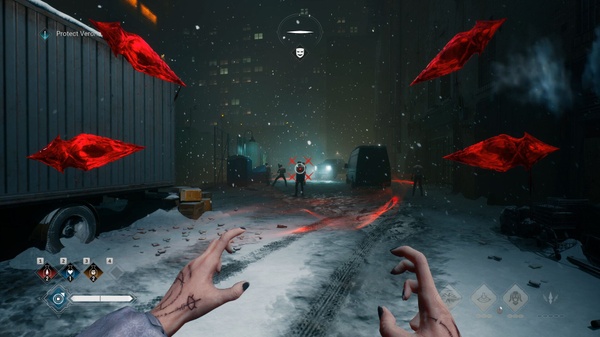
The action phases unfold in first-person view, and the initial feeling is that of a fluid system: Phyre – customizable in gender and clan – can rely on distinctive powers, called Disciplines, which include telekinetic abilities, enhanced strikes, and mental manipulations. However, the balance between spectacle and strategy doesn't always work. The powers are potent, but the elementary artificial intelligence and repetitive enemy patterns reduce the tactical impact of combat. After a few hours, one tends to fight by instinct rather than by choice, repeating the same attack and dodge combinations.
The absence of traditional weapons accentuates this effect of monotony. Phyre can wield weapons found in the environment, but only temporarily: progression is based almost exclusively on the use of Disciplines and Hunger, the act of feeding on victims' blood to recharge energy and powers. A narratively strong concept, but translated into mechanics without true tension. In the original tabletop and the first Bloodlines, hunger was a constant balance between survival and morality; here it becomes a functional routine, devoid of the symbolic weight that should accompany every bite.
The structure of the game world also affects the perception of gameplay. Seattle is divided into semi-open districts, explorable with some freedom but lacking significant interactions. Exploration is reduced to searching for collectibles or side missions, often of the "go-there-and-fight" type. Stealth, a theoretical alternative to the direct approach, suffers from simplistic management and becomes even boring in the long run: enemies react little to noise and quickly forget the player's presence, nullifying the tension that should characterize nocturnal hunting.
Despite everything, Bloodlines 2 manages to offer moments of pure engagement when narrative and mechanics meet, such as during clan clashes or sequences where powers are used to manipulate the environment. In those moments, the game reminds us why the vampire myth still works: not for strength, but for control, for the ability to dominate without being seen. Unfortunately, these are isolated moments in an experience that tends to repeat itself too soon, leaving the feeling of gameplay built around a strong idea but not fully realized.
Seattle is fascinating but lacks bite
Played on a PC equipped with an RTX 4060 Ti, Vampire: The Masquerade – Bloodlines 2 shows a visual compartment that lives on contrasts: a graphics engine capable of creating suggestive glimpses and decent quality textures, but also an overall realization that betrays development difficulties. Seattle, the silent protagonist of the game, is immersed in a cold, milky light, almost always enveloped in snow. The atmosphere works: the reflection of neon lights on puddles, the fog that distorts the streets, the metallic tones of the buildings convey a sense of immobility and decay. However, behind the first impression, evident limitations emerge.
Performance, even on a modern configuration, fluctuates irregularly. With "Ultra" graphics settings and DLSS active, the frame rate remains stable only in enclosed spaces; in wider districts or during clashes, sudden drops bring it below 60 fps, a sign of still immature optimization. Particle effects – particularly dynamic snow and fog – are suggestive, but heavily burden the GPU. Even ray tracing, though available, offers minimal benefits in terms of light rendering compared to the performance cost.
Artistically, The Chinese Room confirms its ability to compose images rather than worlds. Every environment is designed like a cinematic frame: sodium lights, dead signs, desaturated colors tell of a city dead inside, consistent with the theme of the vampires' immortal stasis. However, visual density is not accompanied by equal interactive vitality. NPCs are static, repetitive, often immobile in their routines. The city fascinates from a distance, but loses realism as soon as you traverse it.
Another critical issue concerns resolution management: tests did not reveal full support for ultrawide monitors. In-game videos and pre-rendered cutscenes feature black sidebars, interrupting immersion and indicating poorly managed aspect ratio. It's a technical detail, but one that matters in a title where the image is an integral part of the narrative language.
Ultimately, the PC version of Bloodlines 2 offers a fascinating, but fragile visual experience. It manages to evoke the melancholy and elegance of the vampiric world, but struggles to translate it into technical coherence. The eye is struck, but the frame rate and engine limitations constantly remind us that this night, however splendid, is not without cracks.
Score
Editorial team

Vampire: The Masquerade – Bloodlines 2 Review - A fascinating gothic dream, but too fragile to become immortal.
Playing Vampire: The Masquerade – Bloodlines 2 leaves a feeling that’s hard to shake off, that of a work that sincerely tried to be reborn, but couldn’t free itself from its past. It’s a title that carries an enormous weight: that of a name that evokes freedom, moral choices, seduction, and fear. All elements that exist here, but as distant echoes.
The Chinese Room has built a game with great visual personality and a melancholic tone, capable of evoking the charm of the World of Darkness with elegance and awareness. But beneath that cold and magnetic surface, the system falters. The mechanics don’t support the narrative ideas, choices have little impact, and the role-playing tension that defined the first Bloodlines is reduced to an illusion.
Similar articles
Mistfall Hunter review: the extraction RPG works, but plays it too safe to truly succeed

Vampire: The Masquerade - Eternal Whispers - Announcement Trailer
Gothic 1 Remake: The Review of a Great RPG's Return!