Ufophilia: Close Encounters of the Wrong Kind | Review
Hunting aliens amidst excellent ideas and too much frustration. K148 Game Studio tries to combine Phasmophobia and X-Files, but the result struggles to take off.
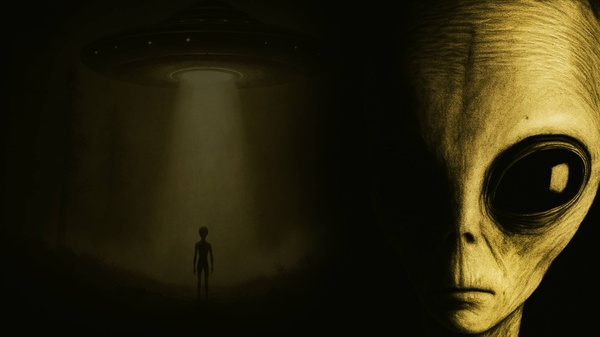


Returning to breathe the stale air of extraterrestrial mystery, in an era where sci-fi and horror imagery seems to have already said everything, is a two-sided experience. While the fascination with alien abductions and X-Files-style conspiracies never fades, on the other hand, Ufophilia, the new investigative title developed by K148 Game Studio and published by JanduSoft, arrives with a decidedly fluctuating balance of all its mechanics.
Credit must be given to the development team for attempting a fascinating path: adapting the highly successful Phasmophobia formula to an alien setting. The good intentions are primarily felt gamepad in hand, where the gameplay structure appears undeniably intriguing in the very first moments. However, this pursuit of an anxiety-inducing experience has brought with it an obvious side effect: a general cumbersomeness of mechanics that quickly removes the visceral thrill, transforming the work into an often frustrating puzzle game.
Added to this bittersweet picture is a technical sector that falters in terms of refinement and, above all, a structural absence that weighs heavily on the entire production. But is a single excellent core idea enough to compensate for the frustration and overly marked repetitiveness? To understand this, we must step into the shoes of a UFO hunter and delve into the unknown.
Ufophilia: Narrative Not Found
If there's one aspect where Ufophilia shows a clear shortcoming, it's in the management of the narrative component. To be clear: in a mission-based investigative title with procedural generation, an Oscar-winning plot is not necessarily expected, and often solid gameplay alone is enough to support the entire structure. However, in this specific case, adding even a minimal plot pretext would have made the experience decidedly more heartfelt and engaging.
The intro throws us into the shoes of an investigator obsessed with the UFO phenomenon, armed with a caravan full of state-of-the-art equipment and sent to remote locations to gather evidence. The core of the experience revolves around a promising concept: tracking down alien entities, deducing who you're dealing with, and managing to photograph them. The problem, however, is that the context literally ends with these two lines.
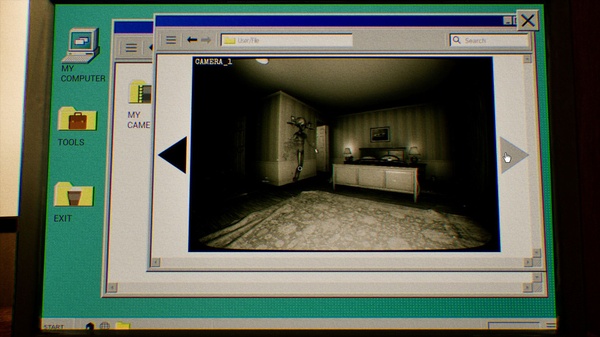
As the work is structured, progression is reduced to a sterile transition from one mission to the next, without a particular purpose beyond merely photographing extraterrestrials to collect in-game currency. There's no underlying motive, no mystery to unravel mission after mission, or even a minimal explanation of who is funding our sophisticated equipment. This total absence of a unifying element, even in the not-too-long run, inevitably makes the formula unstimulating: the sense of discovery quickly vanishes, transforming what should have been a compelling sci-fi nightmare into a cold and repetitive work routine.
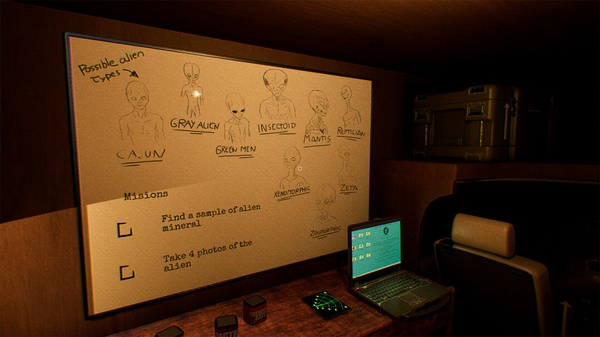
In fact, what little lore is present emerges exclusively through the descriptions of the nine types of aliens viewable from the laptop in our van, serving more as a medical encyclopedia than a true story. In a game that makes cosmic mystery its cornerstone, choosing to keep the player in this total void drastically reduces the scenic impact and the drive to continue.
Navigating a Looping World
Abandoning the idea of a linear campaign, Ufophilia welcomes us into a mission-based structure. The zones, ranging from modest homes to police stations and isolated campsites, become progressively accessible. The glue of this progression is Roswell Points, the in-game currency obtainable by successfully completing assignments, essential for unlocking not only new maps but also valuable upgrades for our equipment.
The idea of being able to invest compensation to purchase more sensitive EMF detectors, brighter flashlights, or more precise thermal cameras is, on paper, an excellent incentive. However, in the overall economy of the game, these upgrades end up having a surprisingly marginal impact: they undoubtedly speed up the very first stages of the investigation, but they are in no way able to mitigate the deep structural flaws that afflict the heart of the experience.
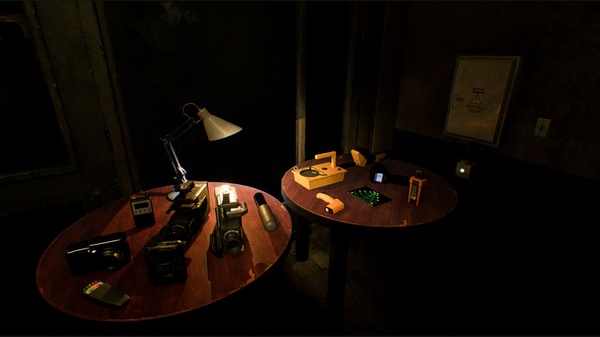
The entire architecture of each hunt is rigidly codified into four phases. Phase 1 requires us to scour the darkness to broadly identify the area where alien activity is concentrated. Once the anomaly is found, we move to Phase 2, dedicated to gathering evidence: wielding microwave meters, Geiger counters, or directional microphones, we must record the signals emitted by the entity. Phase 3 requires us to cross-reference the collected data on our laptop to accurately identify the creature (selecting it from the nine in the database) and locate its specific "Spawn Zone." Finally, there's Phase 4, the climax: the extraterrestrial physically manifests, and the ultimate goal becomes getting close enough to take a clear photo of it.
Synergizing devices to deduce the invader's identity is an undeniably stimulating process at first. However, the discussion becomes exhausting when analyzing the practical act. Due to the stringent limitation of transportable items (we can only hold two at a time), we constantly find ourselves shuttling between the infested building and the caravan. This rigidity forces inventory micro-management that completely breaks the rhythm, forcing the player into long and tedious walks solely to place one sensor and pick up another.
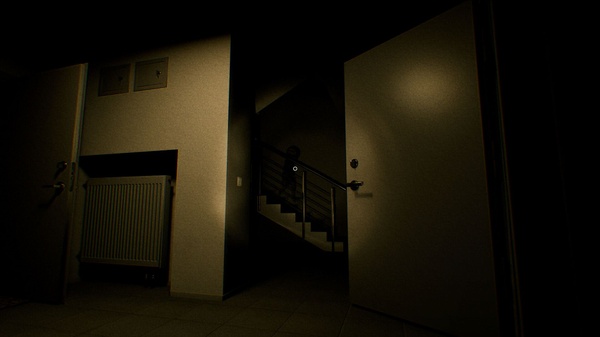
And it is precisely at the height of this tedious back-and-forth, in a fluid descent into nervousness, that the initial tension definitively gives way to frustration. The infamous Phase 4, in fact, turns out to be a real lottery. The risk of being instantly abducted by the alien – an event equivalent to an immediate Game Over with consequent loss of equipment and hard-earned Roswell Points – is very high.
Weighing heavily on this dynamic is the incomprehensible necessity of having to get too close to the creature to take a photograph considered valid by the game, even though the image is perfectly clear and distinguishable from much greater distances. This is a patently artificial obstacle, inserted solely to make the experience unnecessarily more complex. And when this forced limitation collides with elusive hitboxes and unbalanced AI reaction times, you find yourself being carried away without having made any real tactical error. If we add to this a tutorial that is, to say the least, sketchy, omitting to explain the exact rules of engagement with the various creatures, we fall prey to continuous trial and error. A punitive approach that transforms the close encounter into an unfair mechanic, capable of wiping out fifteen minutes of cautious and methodical camera and sensor placement in a second.
Anatomy of an Investigation
To convey the idea of this schizophrenic balance between thrill and annoyance, let's analyze the anatomy of a typical mission, precisely as the four phases just described unfold.
The first and second phases revolve around arrival and initial sampling. The mission begins in our caravan, parked outside the location – let's say, an isolated villa. We know there's something in there, but its identity is unknown to us. The transport limit forces me to choose wisely: I take an EMF detector and a microwave meter. The atmosphere inside is at its best: unsettling creaks, light footsteps, and a palpable sense of oppression. Suddenly, near the kitchen, the EMF detector emits a frantic buzz. We have a trace.
The third phase is an endless back-and-forth from the villa to the caravan to identify the extraterrestrial we will have to confront. To locate the "Spawn Zone" and cross-reference the data, the two instruments are not enough. I have to go back to the caravan. This is where the real loop begins: I walk slowly to the van, put down the EMF, pick up a heartbeat sensor and a thermal camera, and return to the villa. It's forced backtracking that, repeated multiple times, annihilates the suspense. After fifteen minutes of walking, the picture is clear: anomalous temperature, microwave peaks, and absence of heartbeat. The encyclopedia on the laptop declares: we are dealing with a Mantis.
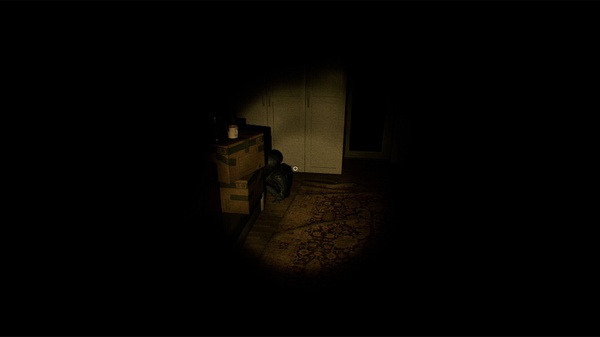
The fourth and final phase concerns the actual shots of the creature and a very probable game over. I return (once again) to the van and activate Phase 4. The alien now physically manifests. The laptop warns me: the Mantis is territorial. Don't run, don't point the flashlight, and only shoot when it's distracted. I re-enter the house with my heart pounding. I turn the corner and see it: a very tall silhouette, motionless in the dark. I walk crouched, flashlight off, looking for the perfect angle for the photo that's worth the entire mission.
I raise the camera from what seems to me a logical and safe distance, but it doesn't seem to be enough: I need to get closer. I take two steps forward, and just as I prepare to shoot, the alien turns towards me at an unnatural speed. Having crossed the invisible and tiny tolerance threshold of its AI, the game decides I have invaded its personal space. The screen distorts, a deafening sound explodes, and I am lifted off the ground. You have been abducted. Mission over. No photo, and no one will ever see me again. Of course, it can also end all rosy, with the necessary photos taken and life saved, but an AI that fluctuates in its reactions makes everything very complex, not to mention that if the creature detects us, the only solution, and the game also emphasizes this, is to run. Hiding is not an option.
The Elephant in the Room: Solitude
Perhaps the most disappointing aspect of Ufophilia, however, is the absolute lack of multiplayer. Given the titles it clearly draws inspiration from, Phasmophobia first and foremost, a cooperative component would certainly have benefited the entire production. Of course, a reflection is necessary: the game's structure, as presented to us, partly clashes with the idea of pure multiplayer. If we consider the concept of abduction – which acts as an instant Game Over – it is a mechanic explicitly designed to terrify a player facing the threat alone, and one that would hardly find a place in a team of multiple people without undergoing profound reworkings.
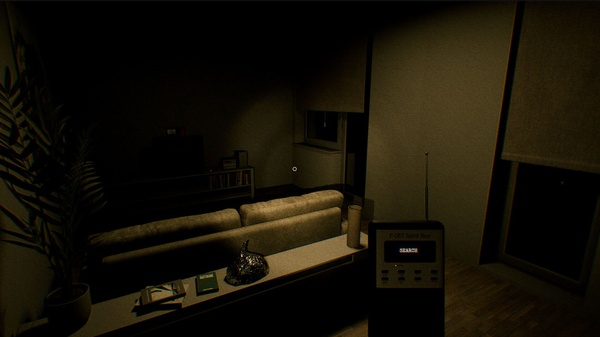
Despite this observation, however, solitary exploration remains irremediably burdened by questionable design choices. The constant shuttling back and forth to change tools, combined with the transport limit and the punitive trial and error of Phase 4, inevitably leads one to think that such an experience would have had much more value (and fun) if shared with others. Dividing tasks, placing cameras inside while a companion monitors graphs from the van, and shouting instructions via radio would have transformed the criticalities of backtracking into a true cooperative tactic. Instead, forced isolation in such a rigid loop ends up making the alien hunt not so much terrifying as irremediably tedious.
Between Sound Style and Technical Imperfections
Where Ufophilia manages to defend itself is in the sound department. The sound design is excellent and disturbing enough: distorted noises, creaking doors in the dark, and heavy breathing manage to evoke the right sense of desolation and anxiety. However, it is when delving into technical and visual details that the illusion cracks. The alien models are decent, but the overall graphical impact of the environments betrays a clear lack of refinement. The game visibly falters with unintuitive menus, annoying polygonal clipping, and a general lack of polish that would have greatly benefited the sense of immersion. Overall, Ufophilia presents itself as a raw product that would have needed further, abundant optimization.
Score
Editorial team

Ufophilia: Close Encounters of the Wrong Kind | Review
Ufophilia is, all things considered, a disappointing close encounter. By taking the successful formula of ghost hunting games and applying it to the fascinating world of ufology, K148 Game Studio had a concept with enormous potential in its hands. In the very first hours, the thrill of investigation and the excellent sound design even manage to trick the player into believing they are facing a small indie gem. However, scratching the surface reveals a fragile and poorly balanced gameplay structure. The absolute lack of a narrative context transforms the adventure into a cold routine, while the rough edges of the gameplay – divided between suffocating backtracking, a punitive and artificial difficulty, and the incomprehensible absence of a cooperative mode – quickly exhaust patience. The title barely scrapes by, saving itself only by virtue of an initially well-executed atmosphere, but remains a wasted opportunity. A work that struggles to take off, recommended exclusively to alien mystery fetishists armed with a titanic dose of tolerance for frustration.
Similar articles