Nintendo Switch Sports Resort: Review of the Competitive Return to Wuhu Island
Nintendo Switch Sports Resort features many classic disciplines and some new ones
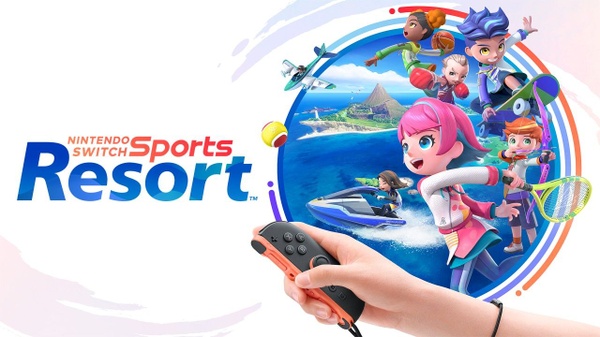


Nintendo Switch Sports Resort arrives on Switch 2 with a very clear objective: to recapture that combination of immediacy, movement, and shared fun that transformed Wii Sports, and especially Wii Sports Resort, into experiences capable of engaging practically anyone. The return to Wuhu Island is pure nostalgia, but the real goal is to see if there's still something to innovate from the first chapter, moving to the most recent one on Switch. The result is a collection built around twelve disciplines, some immediately recognizable and others designed specifically to add greater variety to the experience: boxing, table tennis, archery, tennis, volleyball, bowling, basketball, golf, and thumb wrestling constitute the competitive core, while skateboarding, jet skiing, and seaplane introduce activities more oriented towards leisure and exploration. The overall structure, however, remains that of a sports collection and does not transform into a true open world: the various activities are selected through dedicated menus, maintaining the immediacy that has always been one of the series' strengths.
New Controllers and More Fun
The control system is inevitably the core of the entire experience, and Nintendo leverages the Joy-Con 2 to maintain a very direct relationship between the player's movement and what is reproduced on screen. Virtual rackets, clubs, bows, and grips transform easily understandable gestures into in-game actions, making Nintendo Switch Sports Resort extremely accessible from the very first minutes. Accessibility, fortunately, does not necessarily mean superficiality. The most successful disciplines have a clearly perceptible learning curve, where improving doesn't just mean moving the controller faster, but learning to control strength, inclination, timing, and precision. It is precisely in these moments that Sports Resort shows its most convincing side, because it manages to create an immediately understandable language without taking away satisfaction from those who wish to master it.
Golf is probably one of the best examples of this philosophy. The swing must be carefully calibrated, the trajectory must be evaluated, and one must gradually learn to gauge the movement, while on the green, developing a certain sensitivity in more delicate shots becomes fundamental. It's not enough to just wave the Joy-Con 2 in front of the TV hoping for the best result: after a few games, you naturally start to correct your gesture and understand how small variations can produce different results. It is this natural progression that makes an apparently simple discipline satisfying. Something similar happens in table tennis, where timing, direction, and the ability to put spin on the ball transform more advanced rallies into surprisingly technical confrontations. The game naturally doesn't pretend to be a simulation, but it still manages to give the player the feeling (illusion?) that improving their movement leads to a genuine improvement in performance.
Archery, on the other hand, revives one of the great classics of the Resort philosophy and builds its effectiveness on the immediacy of aiming, adding the need to evaluate conditions before nocking the arrow. Bowling remains one of the most universal sports in the entire collection, immediately recognizable by anyone who has played one of the previous chapters, but it also features variants capable of making it less predictable, including special lanes characterized by obstacles and the inevitable hundred-pin mode. Basketball alternates traditional competition with challenges dedicated to long-range shots, while tennis seeks a balance between immediacy and shot control. Volleyball, meanwhile, continues to rely heavily on timing and the coordination of different actions, also offering specific challenges that break up the succession of traditional matches. Not all disciplines necessarily possess the same depth, and it's inevitable that rather marked personal preferences will emerge, but the overall variety works because each sport requires at least a change of mindset and gestures.
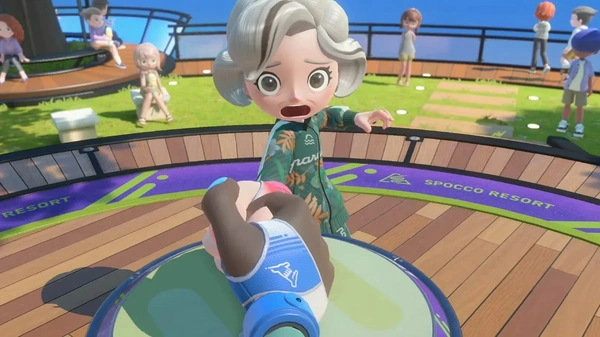
Thumb wrestling is probably the most curious discipline in the group. Its presence perfectly clarifies how Nintendo Switch Sports Resort doesn't want to be exclusively a collection of virtual representations of traditional sports. There's also room for deliberately light and almost absurd challenges, designed primarily to spark competition on the couch. This is a fundamental philosophy for understanding the game: Nintendo isn't trying to build an encyclopedia of sports, but a virtual place where extremely different activities can coexist while maintaining a single goal: to be understandable within moments.
However, it is in the three recreational activities that the concept of Resort finally takes on greater importance. Skateboarding, jet skiing, and seaplane allow players to experience Wuhu at different paces compared to traditional competitions. Skateboarding also utilizes the mouse-style controls of the Joy-Con 2 and allows players to traverse the island, tackle dedicated courses, or move with greater freedom; jet skiing brings exploration to the sea and also offers specific competitions, while the seaplane allows players to observe Wuhu from above and engage in both exploration and alternative activities. These are important additions because they break up the inevitably fragmented structure of a sports collection. Switching from a competitive match to an island tour completely changes the pace and restores at least some of that pleasant vacation atmosphere that made Wii Sports Resort memorable.
Alone or with Company?
Multiplayer remains the true soul of the experience. Playing together in front of the same TV continues to have a special charm because the simplicity of the rules allows people with completely different experience levels to get involved. The regular player can compete with someone who rarely uses a console without having to spend half an hour explaining button combinations or complex mechanics. Just pick up the Joy-Con 2, quickly observe the required movement, and start playing. This accessibility is a quality that few games can still offer with the same naturalness and is probably the main reason why the Sports formula continues to make sense many years after the explosion of motion gaming.
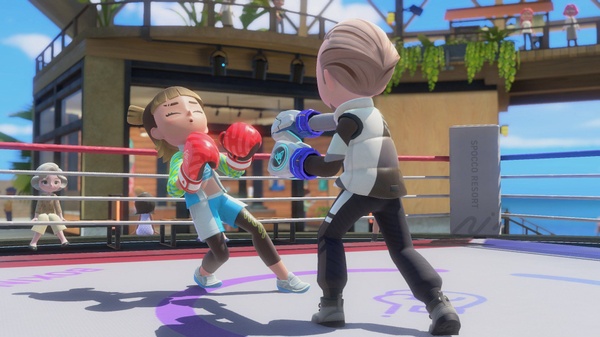
The online component naturally expands this concept by allowing players to face others when they don't have someone physically next to them. The different disciplines support different multiplayer configurations, and those most suited to large-scale competition manage to transform initial immediacy into something much more contested. The presence of the Pro League also adds a competitive dimension for those who don't want to limit themselves to occasional matches. It is online that the differences between simply knowing the rules and truly having learned a discipline become more evident: the system remains accessible, but having experience in controlling effects, managing timing, and precision of movements can make a huge difference.
Nintendo has also tried to give more attention to those who prefer to play alone. Island Crown represents one of the most interesting elements in this regard, proposing a single-player focused progression in which it is possible to face champions and particularly skilled opponents across nine disciplines, earning rewards and customization options during the climb. We are not looking at a story mode in the traditional sense, and Nintendo Switch Sports Resort does not suddenly try to become a narrative sports game, but having a more structured goal significantly improves the individual experience. This is especially important in the long run, when the simple selection of a sport and yet another match against computer-controlled opponents would inevitably risk showing a certain repetitiveness.
Customization also contributes to creating that small, continuous gratification necessary to sustain longevity. It is not, of course, the central element of the title, but it makes accumulating progress and gradually building one's own identity within the resort more enjoyable. The return of Miis, moreover, maintains that connection to the past that for many players will inevitably represent an important component of the experience. The presence of figures now associated with the very history of Wii Sports adds a nostalgic note without transforming the entire production into an exercise aimed solely at those who were there almost twenty years ago.
From a technical and artistic point of view, Nintendo continues to choose a clean, colorful, and extremely legible direction. Realism is not the goal and would even be counterproductive within a production of this kind. What matters is immediately distinguishing a ball, a trajectory, an obstacle, or the opponent's movement, and in this sense, the aesthetic of the series continues to work. Wuhu also possesses that particular ability to appear simultaneously artificial and welcoming: it does not want to imitate a real tourist resort, but to build an idealized version of a vacation in which sports fields, sea, paths, and recreational areas coexist without worrying excessively about plausibility.
But Does Everything Really Work?
Some inevitable qualitative discontinuity remains. A collection composed of twelve such different disciplines can hardly maintain the same level of depth in every element, and some activities can sustain dozens of matches much better than others. Golf and table tennis, for example, possess characteristics capable of rewarding learning more, while other disciplines focus more decisively on immediate gratification or the fun generated by the presence of other people. The three exploration activities, on the other hand, serve a different function and should not necessarily be evaluated using the same criteria as the competitive disciplines. It is this diversity, for better or worse, that defines the entire package.
In reality, the real flaw, if we must look for one, lies more in the lack of true innovation that makes itself felt. My girlfriend and I are "veterans" of golf in the Switch version, but it would have been nice to see totally new courses, not just some small technical innovation or perhaps the same ones and much more. Tennis now makes you miss by sending the ball out, but with a bit more grit, it could have been almost a standalone game, like Wave Race-style jet ski races. Archery is also terrifyingly beautiful, but super limited in possibilities, and I could go on with almost everything. Make no mistake, it's essential if you have Nintendo Switch 2 and like party games or even playing solo, but much more could have been done given that the foundation was already ready and particularly well-established. We hope for thematic DLCs and lots of extra content.
Score
Editorial team
Nintendo Switch Sports Resort: Review of the Competitive Return to Wuhu Island
There are so many games included, and among them, many new additions. The classics have been innovated, though not too much, but overall you'll have plenty to do for months and years to come, even more so if you play with company, and if not, you'll have an excuse to find new friends.
Similar articles