Philips Evnia 32M2N8900P – 4K OLED Review That Still Amazes
Prestigious hardware for a native 10-bit panel ready to impress in gaming and mixed use



The Philips Evnia 32M2N8900P belongs to a generation of monitors that has influenced the way we look at displays for gaming. The 31.5" QD-OLED panel offers 4K resolution, 10-bit color depth, a blazing fast refresh rate up to 240 Hz, and image quality that leaves a lasting impression. This screen is no longer an absolute market novelty, but precisely for this reason, it can represent an interesting alternative to more recent and expensive models. It boasts an excellent technological foundation with deep blacks, stunning contrast, and a much richer color rendition compared to traditional LCD monitors.
A merit of this ambitious monitor is its overall balance, with 3840 x 2160 pixels allowing for an extremely defined image on such a large diagonal, and it isn't afraid of being just a few centimeters from your eyes. Moreover, you don't always need to reach 240 frames per second to appreciate its advantages: even when the frame rate is lower, the panel's response provides a sense of immediacy, especially in very fast-paced games.
Gallery



When QD-OLED performs at its best
This is a typical monitor that requires some attention to the environment in which it is installed, starting with the glossy surface of the screen. In a dimly lit room, it helps to deliver very sharp images, with brilliant colors and a remarkable sense of three-dimensionality. The problem arises with the presence of ambient light.
The DisplayHDR True Black 400 certification not only concerns the brightness of the brightest points but also the ability to maintain deep blacks in the surrounding areas. In a night scene, for example, lights can stand out with greater intensity against a dark background, while explosions and light sources maintain a strong contrast with shadows. The OLED panel, by turning off individual pixels to reproduce black, offers theoretically infinite contrast. To best appreciate this result, it is preferable to avoid reflections and ambient light sources that can compromise the perception of darker areas.
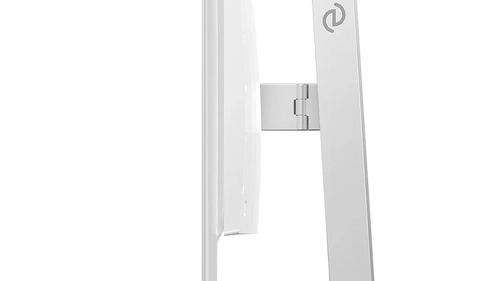
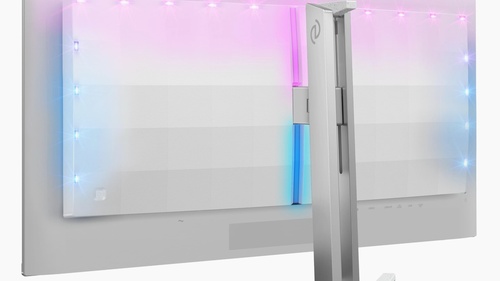
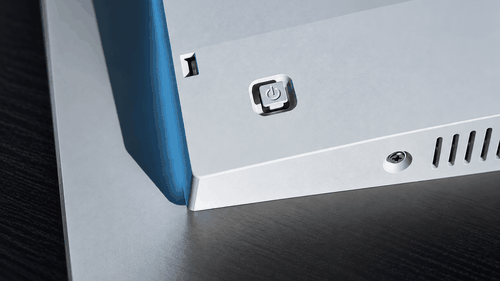
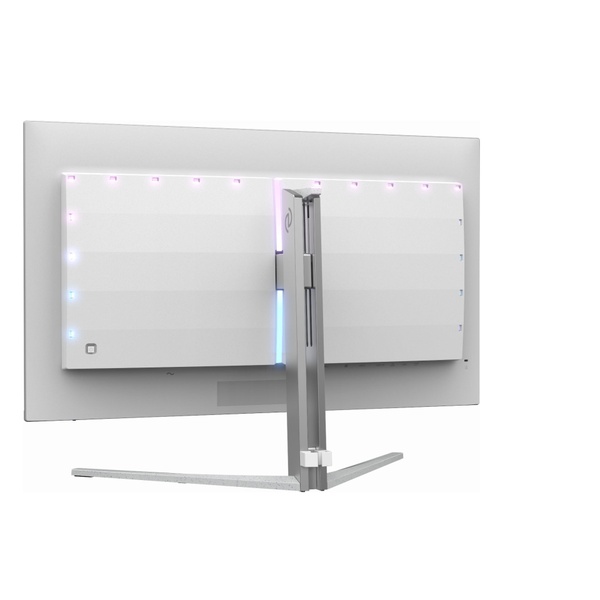
Philips has chosen an aesthetic for the Evnia line that is quite different from many competitors; this model also doesn't try to look like a war machine and doesn't rely on aggressive shapes or fill the chassis with unnecessarily flashy elements. The result is an elegant monitor, characterized by the silver lower bezel and the distinctive V-shaped stand, with remarkable design and robust materials, while also paying the price of a certain bulkiness to be totally stable. In the case of multiple physical connections, the rear organization remains at least partly chaotic. Dimensions with stand are 717 x 572 x 311 mm and weight is 9.65 Kg, with wall mounting capability.
Excellent technical specifications
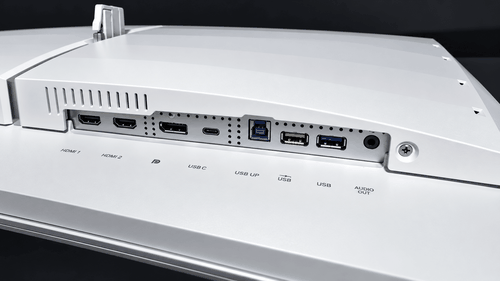
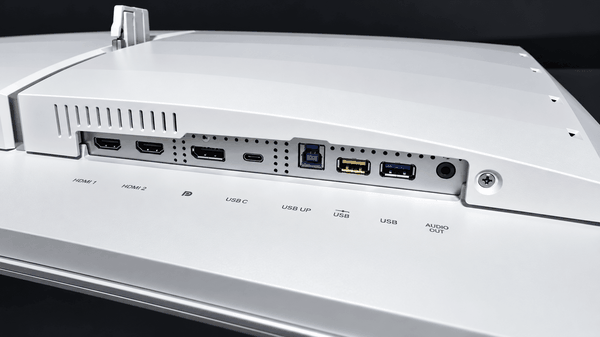
The 4K/240 Hz combination remains the most attractive element for choosing this screen, suitable for owners of high-end gaming PCs. These are not small values, given that we are talking about 240 images per second, each at 3840 x 2160 pixel resolution, which requires a powerful graphics card and, of course, games capable of utilizing it. It goes without saying that for "heavier" titles, it will be normal to settle for lower frame rates, without the monitor's technical peculiarities deteriorating. It reaches around 240 nits over 100% of the area in SDR, rising to 430 nits at 10% in HDR. Available are 2x HDMI 2.1 inputs (HDCP 2.3) and 1x DisplayPort 1.4, compatible with 4K/240 Hz management (full bandwidth support up to 48 Gbit/s), 1x USB-C with DisplayPort Alt Mode, data transmission, and Power Delivery up to 65 Watts, useful for connecting a compatible notebook with a single cable.
The USB hub includes 2x USB-A 3.2 Gen 1 ports, with transfer speeds up to 5 Gbit/s, one of which supports charging according to the BC 1.2 standard. The upstream USB connection allows peripherals connected directly to the monitor to be used. The features are completed by an audio output for headphones or external systems. HDMI 2.1 also extends its use to consoles, allowing the 32M2N8900P to become a single entertainment hub for those who want to use hardware other than a computer without having to resort to different screens. With competitive FPS and faster games, the speed of information transit is more noticeable. The extremely low response times of the QD-OLED (0.03 ms GtG) limit ghosting and trails, providing very clean movements. The indicative input lag at 240 Hz is 12.2 ms, which rises to 22.5ms with V-Sync active, and 18.3ms at 60 Hz.
Similar to Philips TVs with the "Ambilight" system, "Ambiglow" is present here (on 3 sides). The rear LEDs illuminate the nearby wall, reproducing the colors displayed on the screen in real-time, adding an ambient component that expands the spectacle. In this case, the behavior is more discreet and less precise, but it remains a pleasant addition.
The integrated speakers, however, are a service solution. The 2x 5-Watt speakers are sufficient for occasional use, especially with a console, a useful presence that allows the unit to be used without immediately connecting external speakers or headphones.
Gaming and beyond
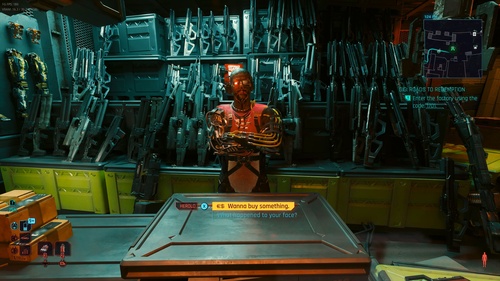
In horror games like Resident Evil Requiem or Alan Wake II, the deep blacks enhance the dark environments, while Hogwarts Legacy and Cyberpunk 2077 highlight the rich colors and lighting effects. In dark scenes, details emerge without the halo that accompanies blooming triggered by backlit screens.
The shooters Overwatch and Counter-Strike 2 highlight the speed of image display and command responsiveness, noting that on PS5 the panel does not exceed 120 Hz. Even Enshrouded and EA Sports FC 26 are enhanced in terms of definition and fluidity, although in some situations a slight trace of ghosting may emerge.
The limit of brightness compared to Mini LED monitors remains, where the QD-OLED offers less intensity on very bright screens, especially when the brightest light points exceed 10-15% of the total area. Overall, the monitor proves suitable for both cinematic adventures and competitive shooters, combining image quality and responsiveness.
This panel has also proven excellent in alternative uses, such as color correction for photos and videos due to its DCI-P3 coverage close to 96%, and the potential it can express when connected to media players or 4K Blu-ray players.
The price question
When this unit first arrived on the market, it represented an expensive proposition, yet its performance was unmatched. Today, the situation has changed, and more recent panels are available, with improvements primarily in ambient brightness management and certain aspects of HDR performance. It all depends on the price, which currently hovers around €600 compared to the initial €1,100.
The real limitation remains primarily linked to the glossy surface: using it in a controlled environment, you will hardly experience any limitations, but with increasing external or artificial light, reflections and purplish blacks would emerge. The Philips Evnia 32M2N8900P is a very successful monitor, but today it must be chosen with greater awareness than when it first appeared on the market, a QD-OLED that has not lost its charm, even if it is no longer a novelty. This can precisely become its main strength: if the price is right, it allows you to take home a 32" 4K/10-bit/240 Hz monitor with image quality capable of challenging even more recent screens.
Similar articles