In the Harsh Middle Ages of 1348 Ex Voto
A violent journey through medieval Italy by Sedleo, a debut Italian studio
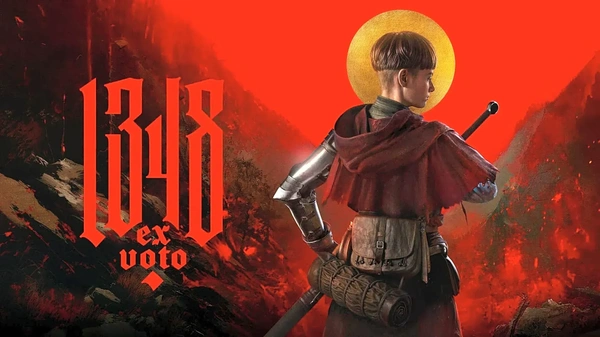


Weapons, maidens, and knights: this is the imagery that most of us associate with the Middle Ages, a legacy of school studies and epic poems. The Middle Ages of 1348 Ex Voto, however, correctly brings to mind another similar trio of words: Guns, Germs, and Steel, the title of an essay by Jared Diamond, which doesn't exclusively discuss that historical period (but rather the last 13,000 years in general, a very interesting read), but which lends itself well to describing Sedleo's debut game, a nascent Florentine studio. Presented at Gamescom last year and published by the French Dear Villagers, 1348 Ex Voto takes us to a much harsher and more difficult Middle Ages than the traditional one, deliberately darkened to tell its story, but also set amidst places and villages that immediately recall Italian landscapes.
The Plot of 1348 Ex Voto
"How beautiful is youth, that flees so fast! Let him who wishes to be happy, be so: of tomorrow there is no certainty": a concept that already seems very clear to Aeta and Bianca, even though Lorenzo De Medici would sing these words more than a century after the events that see them protagonists of 1348 Ex Voto. One, Aeta, the daughter of a noble family, and the other, Bianca, a commoner destined for the convent, the two girls know that no matter how much their feelings unite them, life is destined to separate them, and the numerous deaths from the plague that begin to appear nearby are just another sign of this. What they cannot imagine, however, is that their separation will happen much sooner than expected: bandits have assaulted the village, and upon Aeta's arrival, Bianca is nowhere to be found. Aeta, who had just sworn to Bianca that she would protect her at all costs, then ventures out in search of justice and the only person she cares about in the world.
1348 Ex Voto
There is certainly a lot of emphasis on the narrative component of 1348 Ex Voto, and proof of this is the investment made in the excellent voice acting for the two protagonists, entrusted to Alby Baldwin and Jennifer English, as well as the few, but carefully chosen and refined, lines of dialogue that drive the story forward. For all these reasons, it's a bit strange that the cutscenes themselves, including the opening one which carries much of the narrative weight, turn out to be a bit weak due to overly rigid acting from the models and some imperfections in the rendering of the scenery. Nothing that, however, pulls you too much out of the game, also because as soon as you start walking through those valleys and castles, things change.
1348 Ex Voto: Between Action and Walking Simulator
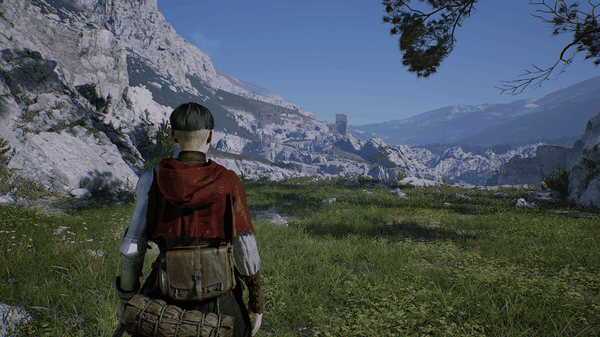
Among the various sources of inspiration cited by the development team, the one closest to the gameplay experience of 1348 Ex Voto is undoubtedly Hellblade, although in the case of the Italian game, the combat is decidedly deeper and more refined than Ninja Theory's title. Aeta's adventure in search of Bianca is a fascinating walk through the nature and villages of an "extremized" Italian Middle Ages, where you will almost exclusively encounter bandits and adversaries on your path. Partly playing with the suggestions of isolated places in Italy, where it is truly possible to often not meet a living soul, partly exaggerating the danger of the period with a long and bloody trail of villages plundered and raided by bandit gangs or religious fanatics, Sedleo plunges us into truly well-drawn and evocative scenarios, where nature appears in all its indifference and rare human traces often mean trouble.
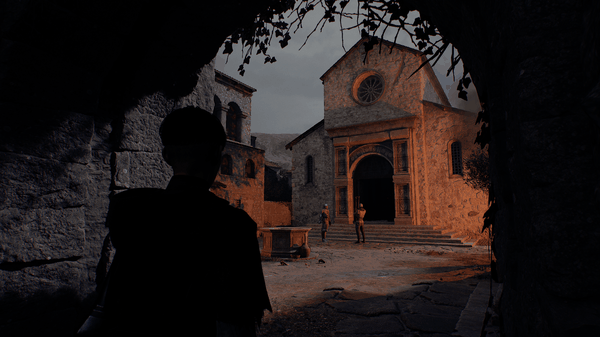
You walk a lot in 1348 Ex Voto, occasionally encountering some environmental puzzles along the way, and other groups of bandits always ready to put you to the sword and kill you. The clashes are perhaps a little less fluid than intended and are based on lunges (one- or two-handed), parrying, and dodging, with a combination of the three elements necessary to overcome the opponent's defenses and resistance. The different weapons, long or short-range, wielded by brigands, soldiers, or other villains, require a slightly different offensive and defensive approach depending on the distance, while a menu of abilities and a greatsword customization option allow you to add new aces to your repertoire. It's a system that, in any case, reflects the rhythms of the game, so fury doesn't pay off, also because Aeta is an aspiring knight who until recently trained in the woods with Bianca. The game seems to be aware of its protagonist's difficulties and, at least in the early stages, scatters food here and there to restore energy. Aeta's growth in sword fighting skills accompanies the increase in enemy levels, but you should never expect a chaotic action game: partly out of a sense of honor, partly to not put the player in too much difficulty, the clashes are always one-on-one, even when the group of opponents is larger.
1348 Ex Voto has been talked about since its first images, undoubtedly thanks to its evocative settings and high-level graphics quality, raising expectations for a game that certainly has declared cinematic ambitions, but also makes no secret of the team's small size. Recent times, however, have taught us that even a few dozen people, with a good idea, can overturn the industry's strongholds: Sedleo's game may not have the same impact as Sandfall's, but it still shows that a talented group can do very good things. 1348 Ex Voto can boast inspired and well-realized scenarios, especially in the overall visual impact, a focused atmosphere, and a balanced system between exploratory walking and white-weapon combat that works. In some ways, 1348 Ex Voto works even beyond what it does thanks to its ability to convey to the player the feelings of difficulty of its protagonist and the brutal era in which she is immersed. A certain stiffness, some unrefined animations, and combat that doesn't meet the player halfway all interact with that sense of solitude, unease, and despair that hangs over Aeta.
If you don't see a score at the end of these considerations, it's because the review code arrived close to the embargo. We will soon return to these lines to update the article with a score and comment: we'll read you here shortly to verify if the mostly positive feelings will also dominate the final phase of our adventure.
***
[UPDATE] With more hours of gameplay and reflection on 1348 Ex Voto, our judgment has cooled slightly. The previous considerations and the good things conveyed by Sedleo's game in the early hours still hold true. However, as we progressed, something got stuck. The combat failed to reach the expected depth and variety, remaining a bit too rigid and repetitive. In the long run, however, 1348 Ex Voto confirmed our initial impression, which is that it is a walking simulator with combat interludes, and while the latter part is less successful, the exploration of medieval Italy is a pleasure, confirming the good feelings we had in the initial tests. 1348 Ex Voto partly pays the price for having sold itself as a game with higher production values than its actual ones, creating a dissonance between expectation and concrete experience: Aeta's adventure is fascinating and stimulating, although hampered by some technical limitations, which however only partially affect what the game wants to do and tell, namely the search for revenge of a person driven more by will than by strength, in a violent and complicated world, where every minimal comfort must be conquered with effort.
Score
Editorial team
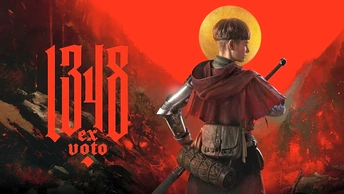
In the Harsh Middle Ages of 1348 Ex Voto
1348 Ex Voto proved to be a more ambitious product than what was actually released, and this indeed influences how the gaming experience is perceived. With a clear mind, however, 1348 revealed itself to be a walking simulator that successfully conveys the atmosphere of the dangerous (and fictional) medieval Italy it aims to portray, but struggles much more (also due to technical limitations) in the combat sections that should punctuate the exploration, often ending up as frustrating stumbling blocks instead. Walking through the valleys, mountains, and villages of the historical cross-section offered by Sedleo is nonetheless worth the price of admission.
Similar articles