Anno 117: Pax Romana Review – When the Grandeur of Rome Meets the Balance of Power
Ubisoft Mainz builds a mature, stable, and surprisingly accessible city builder. A digital Rome that prioritizes harmony over conquest, refined in form and solid in substance, yet without pushing beyond traditional boundaries.
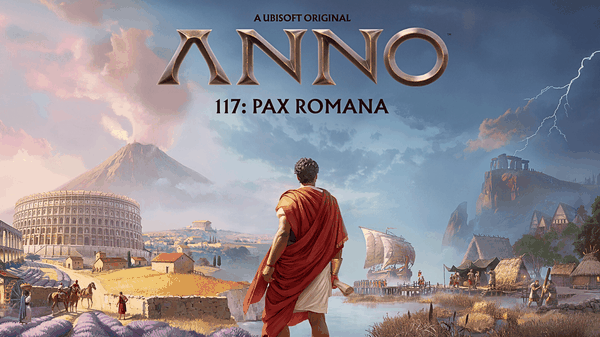


After an early preview of Anno 117: Pax Romana and sharing our first impressions on the channel, it's finally time to tell you about the complete game. The new chapter developed by Ubisoft Mainz marks a turning point for the series: it abandons the industrial race of Anno 1800 to bring the player into the heart of the Roman Empire, where the challenge is no longer to conquer new territories, but to maintain prosperity, balance, and political consensus in an already mature world. It's a transformation that redefines the very concept of a historical management game, shifting the focus from progress to the responsibility of governance.
From the very first hours, Pax Romana stands out for a more accessible and organized approach. The interface has been completely redesigned and accompanied by a series of contextual hints that help interpret the functions and priorities of each phase. The learning curve is smoother, but not simplified: the game gradually teaches you to understand its mechanisms, allowing even less experienced players to naturally enter a deep and layered management system. It's a clear sign of how much Ubisoft Mainz has focused on user experience, building a rare balance between complexity and clarity.
In the world of Anno 117, the Empire is at its peak. The provinces of Latium and Albion are not just two game scenarios, but two different ways of thinking about civilization: the first reflects the order, rationality, and urban perfection of Rome; the second embodies adaptation, wild nature, and the freedom of the northern borders. The alternation between these spaces creates a new rhythm, made of cultural contrasts and political choices that influence every step of the campaign. And it is precisely in this balance between power and identity that Anno 117: Pax Romana finds its true voice: that of a Roman city builder that transforms management into an act of governance and planning into a form of imperial language.
But will the Empire truly be able to maintain its order in the face of the complexity of a changing world?
Anno 117 offers an imperial campaign between power and fragility
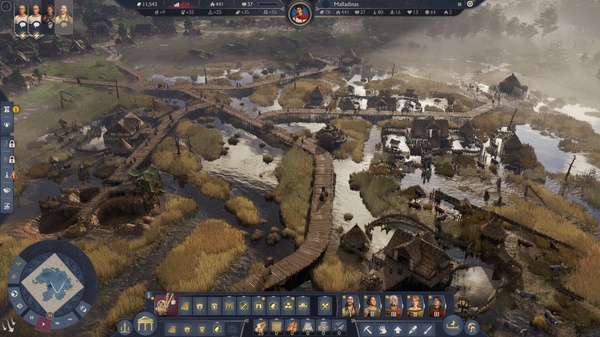
The campaign of Anno 117: Pax Romana introduces the player to an Empire at its zenith, during the reign of Trajan, when the word “stability” matters more than “conquest”. After a brief prologue set in Latium, the cradle of Roman civilization, the game progressively opens access to Albion, modern-day England, transforming the narrative into a journey that crosses opposing geographies and mentalities. This is not a simple change of scenery, but two distinct game areas, each with its own climate, resources, and architecture. One embodies the urban rationality and measure of the capital, the other the challenge of untamed territory, where swamps and Celtic villages resist Roman order.
The story doesn't follow a linear script, but unfolds through administrative missions and dialogue choices, with brief cutscenes that leave the player to interpret the role of governor. Some interactions with other officials and senators give substance to imperial politics, but the tone remains sober: decisions weigh more on budgets than on emotions. This choice is consistent with the series' philosophy, even if it lacks truly epic moments or passages where the tension of command is felt. Power, in Pax Romana, is not spectacle: it is bureaucracy, responsibility, administrative routine.
Each province follows its own management logic. In Latium, urban planning is geometric, based on the order of streets and the rational distribution of districts. In Albion, however, the terrain becomes part of the challenge: the player can choose to reclaim swamps to Romanize the region or adapt to Celtic customs, accepting the natural conformation of the territory. In both cases, the Emperor does not intervene directly: whether the province prospers through discipline or adaptation, what matters is that it remains under control. The narrative component also reflects this philosophy, translating politics into in-game currency, made of favors and influence rather than ideals.
Overall, the plot of Anno 117: Pax Romana does not seek pathos or drama, but historical coherence and institutional credibility. It is a silent story, which tells the grandeur of Rome through its rules, and the fragility of power through its omissions. However, reaching the end of the campaign is surprisingly short and fleeting: the narrative almost abruptly stops, as if a final chapter capable of closing the circle is missing. An absent epilogue that leaves the player suspended, with the feeling that the story of Rome — and its governor — has not yet said all it had to say.
Forget War: Anno 117 Focuses Entirely on Trade and Diplomacy
At the heart of Anno 117: Pax Romana, the work of Ubisoft Mainz achieves its most complete synthesis. Everything, from urban planning to faith, from diplomacy to economics, contributes to building a living system, where every choice reflects on the other like an invisible network. The interface, clearer and more dynamic, guides precisely through this management labyrinth, while contextual tips accompany the player with an almost didactic tone, making complexity more readable without ever trivializing it. It's a rare balance: the game remains deep, but finally becomes welcoming.
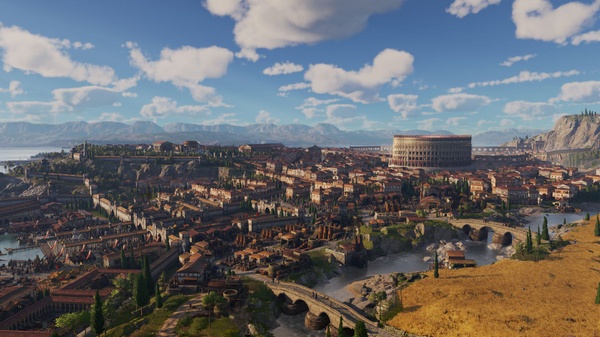
The production system is the backbone of the experience, more organic and reactive than previous chapters. Each building affects a multitude of parameters — well-being, health, security, wealth — and their arrangement is never just aesthetic, but part of the governor's political language. In Latium, the mother province, everything expresses discipline and method: roads trace ordered geometries, fields follow a harmonious rhythm, and the city grows like an organism reflecting the logic of the capital. In Albion, however, nature does not bend: the marshy terrain imposes compromises, asking to choose whether to drain and Romanize, or adapt to the land and customs of the Celts. It is here that the game finds its true tension, not in conquest, but in mediation.
Supporting this dynamic is the new discovery tree, divided into three main axes (civil, economic, and military) that define the identity of each province. Progression is not immediate: one must carefully choose what to develop first, because time becomes a resource as precious as money. The military branch, in particular, shows its weight when strengthened alongside the cult of Ares, capable of transforming provinces into formidable strongholds; but, paradoxically, the game prefers diplomacy to force. Military expansion exists, but the pragmatic, cooperative, and peaceful approach yields the most solid long-term results.
Religion functions as an extension of government policies. Each temple dedicated to a deity provides specific advantages: Epona favors animal productivity and pasture growth; Ceres supports agriculture; Ares enhances military efficiency; while Mercury-Lugus, when maximized, increases ship loading and unloading speed by up to 50%, making it indispensable for trade-oriented provinces. However, these bonuses remain confined to numbers and statistics: the cult does not alter the urban physiognomy or introduce visual mutations in districts, which is a shame.
The multiplayer represents one of the most successful innovations. In cooperative mode, governors share a ruler and a common budget, facing a complex but stimulating start: resources are divided only after conquering new islands, and collaboration quickly becomes indispensable. Once the initial phase is overcome, the experience flows naturally, thanks to shared management of trade routes and a clear division of roles. The competitive mode, on the other hand, adopts the structure of a 4X strategy game, rewarding economic supremacy, diplomacy, or the construction of wonders like the Amphitheater, which can determine a province's political victory.
In cooperative mode, choosing between different difficulties significantly impacts many game factors. For example, the partial construction refund and paid maintenance introduce an element of management tension, especially in the initial phases where money is shared among players. Once the network of cities and trade routes is consolidated, synergy translates into fluidity and gratification: combined management allows for optimizing expansion times and reducing the risk of incidents, providing a balanced game pace even with multiple active provinces. And there are many other variables that will make your cooperative experience very rewarding.
On the warfare front, the series brings back land units but limits their prominence. Battles remain episodic, functional for maintaining control rather than expanding borders. Only in Albion does the presence of a warrior princess introduce a minimum of constant tension, requiring regular defenses and careful monitoring of borders. The difficulty level increases slowly, but consistently: as eras advance, logistical complexity and the need to balance resources, population, and faith grow.
Overall, Anno 117: Pax Romana doesn't reinvent its genre, but refines its grammar. Every mechanic speaks the language of order and measure, and pleasure arises not from expansion, but from control: from seeing a city breathe, function, prosper. It's a game that teaches patience and celebrates balance, reminding us that even in the most powerful Empire in the world, governing remains the most difficult art of all.
Pax Romana bets everything on the solidity of a digital Empire
Tested on PC with RTX 4060 Ti and ultrawide 3440×1440 monitor, Anno 117: Pax Romana confirms itself as a technically impeccable title. In “High” graphics quality mode, with DLSS Balanced – Transformer Model, TAA antialiasing, and textures on “High”, the game performs with remarkable stability. Even during the most intense phases, the frame rate remains stable between 90 and 100 FPS, with no perceptible drops or visible stuttering during wide panoramas. In ultrawide format, the field of view expands naturally and cinematically, giving the sensation of observing a living world in continuous transformation.
Ubisoft Mainz's graphic choices prioritize aesthetic coherence over spectacle. The rendering of materials – particularly marble, copper, and fabrics – is refined but measured, while the dynamic lighting system enhances the depth of cities without introducing excessive contrast. Environmental effects react well to climatic variations, and water reflections in the Albion maps show intelligent use of post-processing. Even without ray tracing, the perceived quality remains high, thanks to a calibrated use of shadows and warm tones.
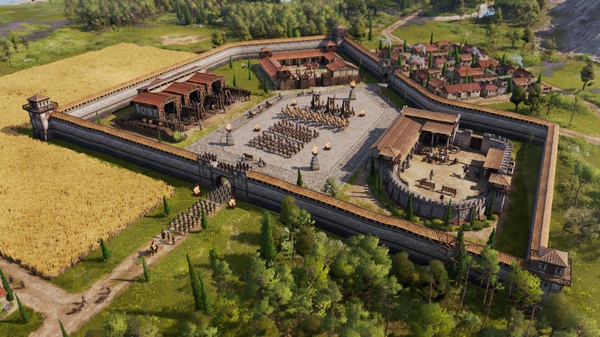
From a performance perspective, the build stands out for its efficiency. With DLSS active in Balanced mode, GPU usage remains stable, and loading times, on NVMe SSD, do not exceed 15 seconds. The incident and resource management system, set to Advanced difficulty, also maintains a constant balance: medium incidents, half construction refund, and regular fertility, without evident imbalances in game pace.
The audio-visual experience remains high-level. The dynamic soundtrack subtly varies between moments of expansion and administrative calm, while the sound environment (markets, voices, fauna, water noise) provides a realism that never descends into chaos. The only visible technical limitation is a slight aliasing on naval structures and watchtowers against the light, but these are marginal imperfections, compensated by a coherent design and a sober artistic direction.
Overall, Anno 117: Pax Romana is a rigorously optimized title built with rare technical clarity. Its solidity comes not from virtuosity, but from precision: every detail serves readability, and every visual effect reinforces the sense of harmony. It is a digital empire where nothing is left to chance, and where technique, finally, does not hide beauty but makes it evident.
Score
Editorial team
Anno 117: Pax Romana Review – When the Grandeur of Rome Meets the Balance of Power
Anno 117: Pax Romana is a mature and refined management game, but also too cautious. Its strength lies in its coherence and attention to detail, but precisely this elegance makes it less audacious than it could have been. A more extended narrative, a more dynamic religious system, and greater incisiveness in moral choices would have given more soul to its perfect empire.
Similar articles