This World Won't Make Me Bad by Zerocalcare: Surrendering to Change
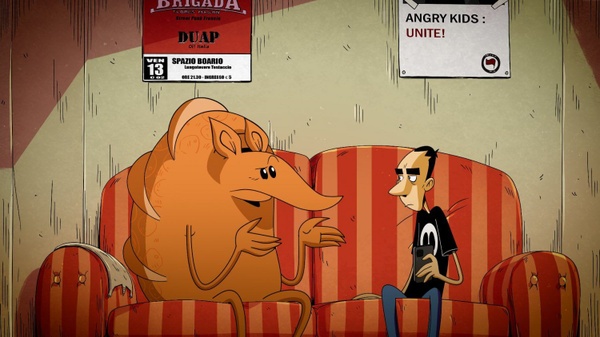


From Facebook comics to a third animated series on Netflix: Zerocalcare's trajectory is constantly rising, and today he is probably the most influential Italian cartoonist ever. This World Won't Make Me Bad, the new series airing these days on Netflix, is the pinnacle (for now) of an artistic journey that, through everyday language and the hypochondria of a couple of generations who grew up with the Roman author, first contributed to the rebirth of comics in Italy in the 2000s and then popularized adult animation on Netflix, now the true heir to national-popular TV. This alone would be significant: if we add that throughout this journey of dozens of comic works, endless book signings, festivals, presentations, the inevitable posters for the 'fracico' wild boar festival, and the artistic direction of an animation project, Michele Rech has essentially remained the same. Let's keep this detail in mind for now: Zerocalcare has always remained the same.
The Plot of This World Won't Make Me Bad
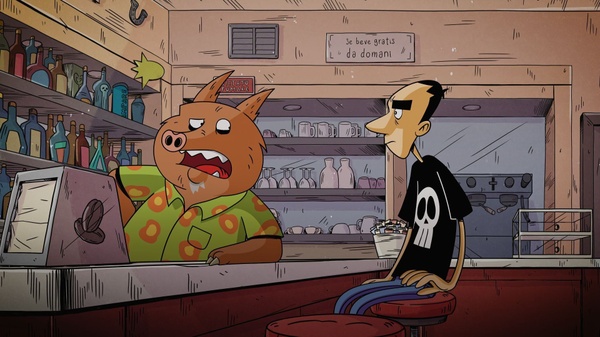
Like almost every piece of Zerocalcare's long narrative, This World Won't Make Me Bad is set in the Roman suburbs and stars Zerocalcare himself and his historical group of friends. On this occasion, the driving force of the story is Cinghiale (the one who always thinks about only one thing), who has become Zero's business partner in the local bar, but money starts to go missing from the till at the end of the month. The confrontation between the two opens a rift into problems that started small and escalated into the territory of low-level Roman crime.
Almost simultaneously, Smeralda, Zero's platonic love, reappears in Zero's life, looking for temporary accommodation after breaking up with her violent boyfriend for the umpteenth time. Sarah would gladly host her, but she already has several trust issues to manage with her partner, so Zero has no choice but to pocket his misanthropy and open his home to his friend. In the meantime, however, problems with local crime worsen, risking to endanger Smeralda as well.
This world hasn't made him bad.
Zerocalcare is still himself, as we said, and the same can be said for his poetics. The Roman artist has always spoken (or rather, drawn and written) about what he experiences firsthand, and he has never deviated from that by a comma: he has grown, he has aged (the hair loss drama that accompanies every Italian makes more than one cameo in this series), and with age, his problems have changed, but they remain his own, those of his neighborhood, his activism, his way of seeing the world. And as much as we might like to believe otherwise, individual change is a slow, very slow, almost imperceptible process from the outside, and Zerocalcare's production, always very inwardly focused, is a reflection of this. The themes rarely change; more easily, the way Zero and the other characters confront them changes.
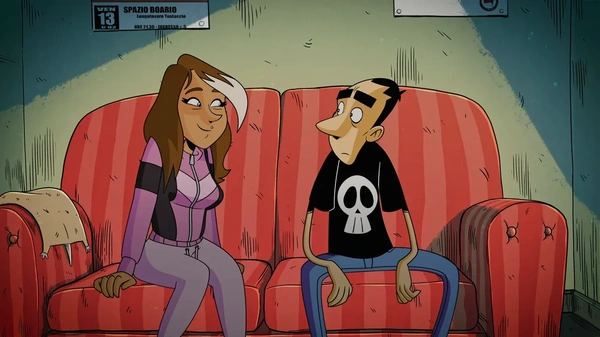
Not changing, in the sense of trying never to deviate from the values that guide him, is somewhat Zerocalcare's characteristic trait. To the point that it seems normal to see his alter ego immediately rule out resorting to the police as a valid tool to help his friend Smeralda, a victim of violence by her partner. Although it is a detail, a handful of frames at most that get lost in the narrative flow of the series' 8 episodes, it is a very significant detail of the internal consistency maintained by Zerocalcare's production, but also of the ease with which he writes himself. This renunciation of the golden rule of Italian seriality, whereby police officers and doctors are to be depicted as saintly figures, goes so unnoticed that controversies have erupted elsewhere, on another ground. In case you don't know what we're talking about, we're referring to the animation, but if we are to clarify this matter, we refer you to a video by Zerocalcare himself; it's interesting to talk about it because it's on that front that the most evident changes are noticed, with a departure from Zerocalcare's style in some background elements and more explicit incursions of other styles (a bit like what happened in Spongebob, to be clear) often for comedic purposes.
If everything changes, can you remain yourself?
Around Zero, however, the world changes. Friends change, each immersed in their own troubles like Secco, whose absence is a silent mystery that snakes through the first part of the series only to reveal itself in the second part. Cinghiale has changed, now married with offspring, having to adapt to the host of problems adopted along with his new family status quo. And Zero? Can you always remain the same if, in the meantime, a good part of your existence is swallowed up by work, presentations, tours, fairs, book signings, meetings, interviews... Who has truly disappeared from the daily rituals of friendship, you or your friends?
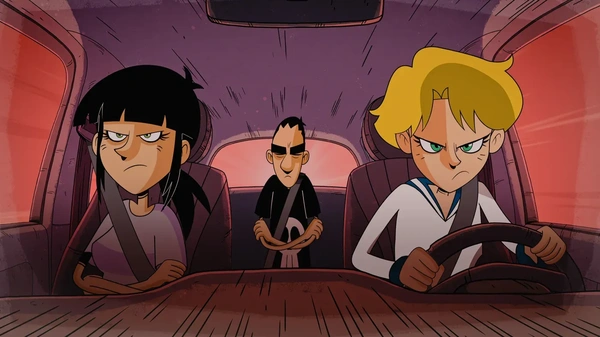
Like almost every work by Zerocalcare, This World Won't Make Me Bad is also a self-analysis session in which the Bao cartoonist looks within himself, searching for answers to questions that come from the very interior he is observing. And the monster, this time, is the awareness of how individualism has managed to plant its flag even where collective action had managed to repel it: Zero with work, Cinghiale with debts, Sarah with relationship problems. We all have a solution for other people's problems, but our own are just ours, a veil to hide from the outside, but also a convenient justification for the progressive retreat into oneself in adulthood. We all have our problems, probably too many to manage them all, and so the problems themselves become shields that justify withdrawal into privacy, although it is sadly clear to everyone that solutions are easier to find together.
Similar articles